

When buying screws at a hardware store, if you ask for “a 6-millimeter screw,” an experienced shop owner will usually follow up with, “Coarse thread or fine thread? Metric or imperial?”
It’s not surprising if you can’t answer right away.
Screws are divided into two major systems—metric and imperial—which are rooted in two centuries of industrial history, involving national competition, the standardization revolution, and the evolution of technology.
This article will help you fully understand this topic.
Key Differences Between the Metric and Imperial Systems
The fundamental differences between metric and imperial screws lie in two points:
Different units of measurement—the metric system uses millimeters, while the imperial system uses inches (1 inch = 25.4 millimeters).
Different thread parameters—the thread angle and pitch standards are different.
The core issue is that these two systems are incompatible.
Forcing a metric bolt into a imperial nut will, at best, prevent it from screwing in, and at worst, result in thread damage.
As the master says: Metric and imperial screws cannot be used interchangeably, just as a USB-A plug won’t fit into a USB-C port—they may both look like “plugs,” but they are actually two completely different standards.
Metric Screw System
Metric screws are currently the most widely used standard worldwide;
China, Europe, Japan, and most other countries adopt this system.
Notation Convention
The notation format for metric screws is: M + nominal diameter × pitch.
M6 × 1.0.
The meanings are as follows:
M = Metric.
6 = major diameter of 6 mm.
1.0 = pitch of 1.0 mm (the axial distance between two adjacent thread peaks).
Coarse Threads and Fine Threads
Screws of the same diameter are classified as either coarse-threaded or fine-threaded, each with its own specific applications:
M6×1.0 (coarse thread): 6 mm diameter, 1.0 mm pitch; highly versatile, provides strong connections, and allows for efficient assembly and disassembly.
M6×0.75 (fine thread): 6 mm diameter, 0.75 mm pitch; offers superior anti-loosening performance and higher adjustment precision.
If the pitch is not specified, coarse thread is assumed by default. For example, “M6” refers to M6×1.0 coarse thread.
Common Metric Sizes
In everyday life and mechanical maintenance, the most commonly encountered metric sizes are as follows:
M3—3 mm in diameter; commonly found in computer cases and small electronic devices.
M4—4 mm in diameter; often used in appliance housings and switch panels.
M5—5 mm diameter, commonly found in bicycles and furniture assembly.
M6—6 mm diameter, the most common size, widely used in automobiles and mechanical equipment.
M8—8 mm diameter, used in engine mounts and medium-sized equipment.
M10—10 mm diameter, used in automotive suspensions and large structural components.
M12 and above—used in heavy machinery and building structures.
Imperial Screw System
Imperial screws are primarily used in the United Kingdom, the United States, and certain traditional industries, and are particularly common in the United States.
Although the United States passed legislation in the 1970s to promote the adoption of the metric system, the imperial system remains predominant in sectors such as hand tools, automobiles, and plumbing.
Notation Conventions
There are various formats for denoting imperial screws; a typical notation is as follows:
1/4-20UNC.
Explanation of each part:
1/4 = Major diameter of the thread: 1/4 inch (approximately 6.35 mm).
20 = 20 threads per inch (in the imperial system, pitch is not specified directly; instead, it is expressed as the number of threads per inch).
UNC = Unified National Coarse (Unified National Coarse Thread).
Three Major Imperial Thread Series
UNC: Unified Coarse Thread, the most commonly used; equivalent to metric coarse thread.
UNF: Unified Fine Thread, with a finer pitch; suitable for vibrating environments.
UNEF: Ultra-Fine Thread, with the finest pitch; used for thin-walled parts.
Common Imperial Sizes
#6-32 (approx. 3.5 mm, close to M3.5): U.S. electronics.
#8-32 (approx. 4.2 mm, close to M4): U.S. electrical appliances.
#10-24 (approx. 4.8 mm, close to M5): General-purpose hardware.
1/4-20 (6.35 mm, close to M6): U.S. automotive and furniture.
5/16-18 (7.94 mm, approximately M8): Medium-strength fasteners.
3/8-16 (9.53 mm, approximately M10): General-purpose machinery.
It is important to note that imperial and metric dimensions are similar but not identical.
Using metric tools on imperial fasteners often results in a loose fit or the inability to drive the fastener in—one of the most common mistakes in practical repair work.
Special Branches of the Imperial System
In addition to the UNC/UNF series, there are two other important branches of the imperial system worth knowing about.
Whitworth Thread (BSW)
This was the first standardized thread system in human history, invented by British engineer Joseph Whitworth in 1841.
It is characterized by a thread angle of 55 degrees (compared to 60 degrees for both metric and UNC threads) and can still be found today on older machinery manufactured in the United Kingdom.
Pipe Threads (BSP / NPT)
Water and pneumatic fittings use a pipe thread system, which differs from standard fastener threads.
Pipe threads rely on the taper of the threads themselves to achieve a seal—the tighter they are screwed in, the better the seal. There are currently two major global standards:
BSP (British Standard Pipe Threads)—dominant in the United Kingdom and used worldwide except in the United States.
NPT (National Pipe Thread) — a U.S. standard with a 60-degree thread angle.
Special note when servicing piping: BSP and NPT look similar, but their thread angles differ (55° vs. 60°); they must not be used interchangeably.
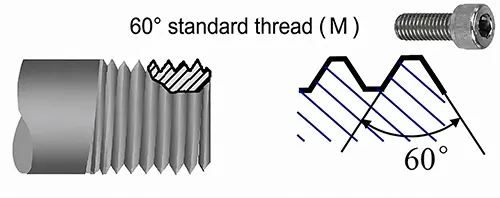
1. Metric Threads M (60° Pitch Angle)
Metric threads, also known as standard metric threads, are commonly used in China.
Metric threads have a 60-degree pitch angle; they are non-sealing threads without taper. Metric Threads—Thread Gauges
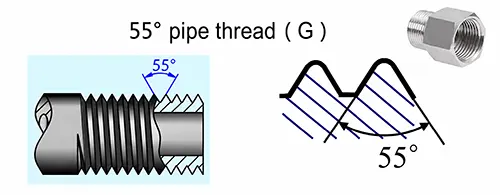
2. British Standard Non-Sealing Pipe Threads G (55°)
G, commonly known as pipe thread, is a non-sealing pipe thread with a 55-degree thread angle and belongs to the Whitworth thread family.
The markings 1/4, 1/2, and 1/8 in thread specifications refer to the diameter of the thread, measured in inches.
Industry professionals typically use the term “fen” to refer to thread sizes; one inch equals 8 fen, so 1/4 inch is 2 fen, and so on.
The Historical Development of the Two Systems
The Birth of Metric Threads
In 1799, France established the metric system, but its application to threads did not occur until 1898.
In 1898, Switzerland, France, Germany, and other countries convened an international conference in Zurich to establish the International Metric Thread Standard (SI Thread), which is the M series commonly used today.
The design logic behind metric threads is clear: diameters are whole numbers in millimeters (6, 8, 10, 12…), pitch values are standardized (1.0, 1.25, 1.5, 1.75…), and the thread angle is uniformly set at 60 degrees.
Because these parameters are consistent and facilitate calculations, metric threads are widely recognized in the mechanical engineering industry as an “elegant” design.
The Origins of Imperial Threads
In 1841, Joseph Whitworth invented the Whitworth thread, putting an end to the previous chaos in which screws were “manufactured differently by each company and were not interchangeable.”
In 1864, the United States established its own American Standard Thread (US Standard), changing the thread angle to 60 degrees (compared to 55 degrees for the Whitworth thread).
It wasn’t until 1948 that the United States and the United Kingdom reached a consensus and unified their standards under the Unified Thread Standard (UN series), though its basic units remained based on the imperial system.
Why Has Unification Not Been Achieved to Date?
Given that the metric system is logically more convenient, why has the imperial system not been completely replaced to this day?
The fundamental reason lies in the prohibitively high cost of conversion.
Tens of thousands of factories, pieces of equipment, molds, measuring tools, and technical drawings in the United States are based on the imperial system.
A full switch to the metric system would require replacing all machine tools, cutting tools, measuring tools, and technical documentation, as well as retraining operators—an economic cost running into the hundreds of billions of dollars.
Consequently, the current global landscape is as follows: the metric system covers more than 80% of the market share, while the imperial system remains dominant in the United States and certain traditional industries (such as aerospace and oil pipelines).
As professionals in the mechanical engineering field, it is essential to be proficient in both systems.
Practical Identification Methods
When faced with a screw of unknown origin, you can quickly identify its thread system using the following three methods.
Method 1: Measure the Diameter
Use a caliper to measure the major diameter of the thread:
Exactly 6.0 mm → Most likely metric M6.
Approximately 6.35 mm → Most likely imperial 1/4 inch.
Approximately 7.9 mm → Most likely imperial 5/16 inch.
Method 2: Measuring Pitch
Measure using a thread gauge (pitch gauge):
Metric coarse thread M6 → Pitch 1.0 mm.
Imperial 1/4-20 → 20 threads per inch (pitch approximately 1.27 mm).
If you do not have a thread gauge, you can measure the total length of 10 threads with a steel ruler and divide by 10 to obtain an approximate pitch.
Method 3: Test-Fitting the Nut
Take a standard nut from a known system and test-fit it—the one that screws in smoothly is the matching system.
Although this method is simple, it is the most reliable.
The master says: In practical work, you must avoid the “good enough” mentality—the habitual thinking that “6 millimeters is about the same as 1/4 inch” has already led to countless cases of thread damage and scrapped workpieces.
A difference of 0.35 mm is still a difference of 0.35 mm.
Summary
Metric screws are designated by their diameter and pitch in millimeters, in a format such as M6×1.0, with a thread angle of 60 degrees.
Imperial screws are designated by their diameter in inches and their pitch in threads per inch, in a format such as 1/4-20UNC.
Metric and imperial systems are incompatible and must not be used interchangeably.
Methods for distinguishing between the two systems: measure the diameter, measure the pitch, and test-fit a nut.
Metric standardization began with the Whitelaw thread in 1841 and was finalized as an international standard in 1898;
The imperial system is a technical legacy of the American industrialization process.
It will be difficult to unify the two standards in the short term, so professionals need to possess knowledge of both systems.