
We often say that mechanical design must ensure “everything is under control,” which has two meanings:
First, all structural details must be carefully considered and fully expressed;
There should be no need to guess the design intent during the manufacturing process, nor should manufacturers be left to redesign or “take liberties.”
Second, all design decisions must be well-founded and not based on arbitrary “gut feelings.”
Many people dismiss this, believing it’s simply impossible to achieve.
In reality, they haven’t mastered design methods or developed good habits.
Even chamfers and fillets—which are often overlooked in design—have their own design principles.
Do you know where to use a chamfer and where to use a fillet, and how large they should be?
Definition
Chamfering and rounding refer to the process of machining the edges of a workpiece into a specific bevel or rounded surface.
Purpose
1) To remove burrs caused by machining from parts, ensuring the product has no sharp edges that could injure the user;
2) To facilitate the assembly of parts;
3) During heat treatment of materials, chamfers help relieve stress, reduce the likelihood of cracks, minimize deformation, and address stress concentration issues.
Five Major Design Principles
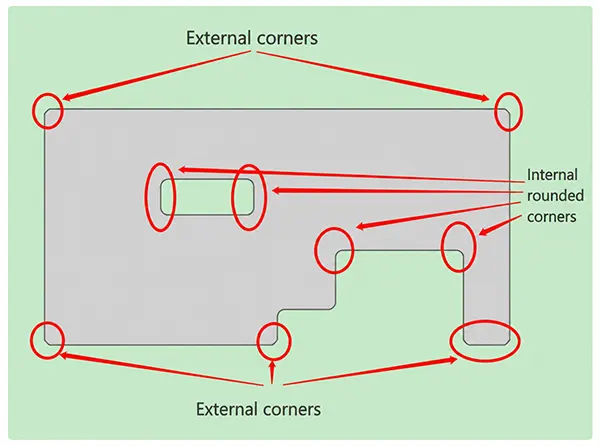
“Round Inside, Square Outside” (Machined Parts) Principle
1) When machining parts with rotating cutting tools, the internal corners of the workpiece should be rounded, while the external corners should be square;
2) For a given feature on the same workpiece, the external square corners and internal rounded corners should be as consistent in size as possible to reduce the number of tool changes.
Note: The term “square” here refers to chamfering.
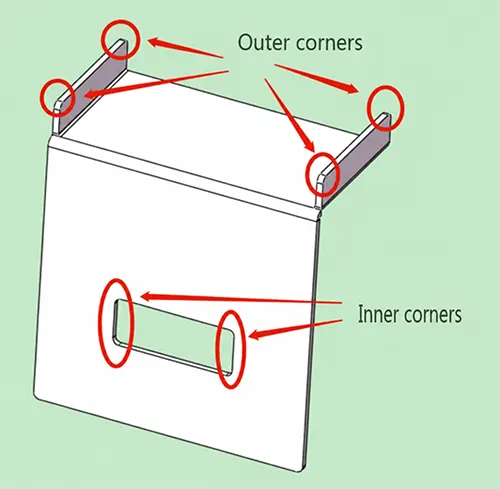
Principles for Inner and Outer Circles (Sheet Metal Parts)
1) Sheet metal parts are processed using laser cutting, which differs from traditional machining;
2) Apply uniform fillets to both the inner and outer edges of the workpiece;
3) Fillet radius range: R = 2~5.
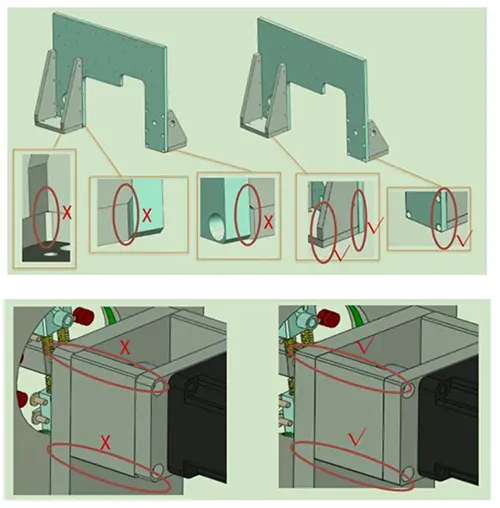
Principles of Neat and Aesthetic Assembly
1) Chamfers ensure a neat and aesthetic fit between assembled parts;
2) The absence of sharp edges prevents personal injury during handling, assembly, and use;
3) Parts without specified chamfer dimensions default to C0.5.
As shown in the figure below, the checked items illustrate a neat assembly.
Note: In some cases, the decision to chamfer a part should not be based solely on the part itself, but also on its assembly relationship with other parts.
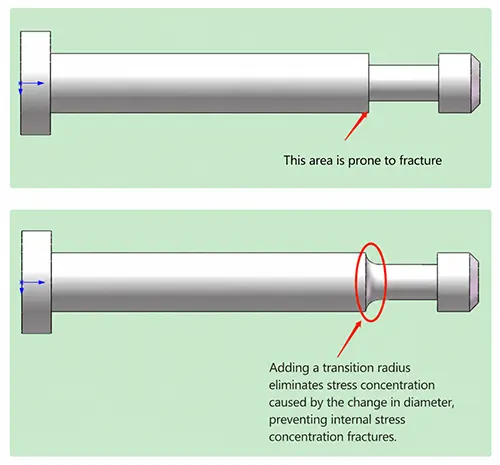
Principles of Stress Relief and Strength Enhancement
1) During heat treatment of materials, internal stress concentrations can occur;
Increasing the transition radius helps eliminate deformation and fracture caused by internal stress;
2) For cantilever-type parts, increasing the radius serves to enhance strength.
Guiding Principles
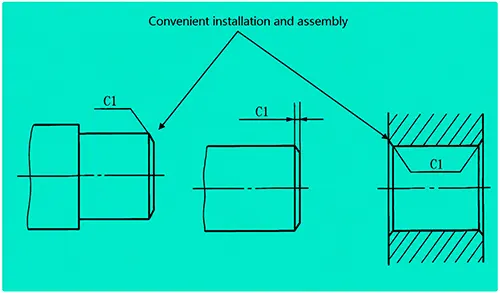
1) For product mounting holes, chamfers should be added to facilitate insertion;
2) To facilitate assembly, parts should be chamfered where they fit together.
Conclusion
In mechanical design, chamfers and fillets are far more than simple finishing features—they play a critical role in manufacturability, assembly quality, structural strength, and product safety.
By following established design principles, such as selecting appropriate chamfers and fillets based on machining methods, assembly requirements, and stress distribution, engineers can reduce manufacturing complexity, improve production efficiency, and enhance the reliability of finished products.
Careful application of these design guidelines ensures that every detail is fully defined, minimizing ambiguity during manufacturing and resulting in components that are easier to produce, assemble, and maintain.