When turning shaft-type and disc-type parts, it is often impossible to complete all machining operations in a single setup; the workpiece must be turned over to continue machining.
Three-Jaw Chuck Alignment Tool
However, after turning the workpiece over, it is difficult to maintain parallelism between the two ends, which may fail to meet drawing specifications, and controlling the total length of the part becomes correspondingly challenging.
Ensuring the axial and radial positioning as well as secure clamping of shaft-type and disc-sleeve-type parts during turning, guaranteeing the end face parallelism and axial dimensions of the workpiece, and ensuring the safety of the turning process is a pressing challenge that needs to be addressed.
Common Clamping Methods for Shaft-Type and Disc-Type Parts
Below, the author discusses and analyzes common machining methods for shaft-type and disc-type parts:
The “one-jaw, one-thrust” clamping method is the most commonly used clamping method for turning shaft-type parts.
When turning shaft-type parts, to ensure that the reference of the center hole aligns with the reference of the blank section clamped by the three-jaw chuck and to avoid over-constraint, the clamped blank section must be as short as possible, typically not exceeding 5 mm.
However, the jaws of the three-jaw chucks we commonly use suffer wear due to prolonged friction with the workpiece during operation and are also subjected to cutting forces.
This causes the clamping surfaces formed by the tips of the three jaws to change from cylindrical to funnel-shaped, with an uneven surface.
During the turning process, excessive cutting forces, loose clamping, and thread jamming can cause the workpiece to loosen and shift to the left, resulting in a loose fit between the center point and the center hole.
This prevents normal machining and has a significant impact on both part quality and workplace safety.
Challenges in Machining Disc-and-Sleeve-Type Parts
When turning disc-and-sleeve-type parts, there are often specific requirements for the parallelism of the part’s end faces.
This is particularly true for parts with small axial dimensions (thin parts), which are difficult to align and clamp securely in a three-jaw chuck.
The traditional method involves turning the outer diameter and inner bore in a single pass, then turning the part over to face the end face, ensuring the total length, and chamfering.
To ensure parallelism between the two end faces, a surface grinder is typically used to grind the opposite end face while holding the reference end face in place.
For lathes without a grinding machine, the workpiece is clamped using the reference surface to align holes or circles, and the other face is then machined flat.
Single-Piece and Batch Production Positioning Methods
The specific turning methods are as follows: For single-piece machining, the disc-shaped workpiece is typically clamped lightly in the chuck.
A brass rod mounted on the tool rest is then lightly tapped against the end face of the rotating workpiece before tightening the chuck.
If high axial dimensional accuracy is required, a dial indicator can be used for calibration and clamping, though this is time-consuming and labor-intensive.
For batch production, a stop shoulder is often turned on the inner curved surface of the chuck jaws, and the workpiece is aligned against the small end face of the shoulder for turning.
While this ensures parallelism between the two end faces of the workpiece, it damages the chuck jaws and makes it difficult to achieve proper clamping for workpieces of different sizes.
Another method involves using soft jaws for turning; however, the soft jaws must be re-machined whenever the workpiece diameter changes.
Limitations in Grinding and Turning-Based Accuracy Control
During machining, one frequently encounters disc-shaped parts made of non-ferrous metals.
For such parts, it is not feasible to use a surface grinder as the final process to ensure parallelism of the workpiece’s end faces.
Additionally, even for parts made of ferrous metals, turning is often the only viable option after considering production efficiency and costs.
When turning shaft-type parts using a three-jaw chuck, operational constraints may prevent the use of a “one-jaw, one-thrust” clamping method.
Alternatively, the workpiece may be too long or have a large outer diameter that exceeds the lathe spindle bore, yet still requires machining of a central bore.
Furthermore, when machining parts with high concentricity requirements, each workpiece must be individually aligned.
This places high demands on the operator’s alignment skills, often requiring tools such as magnetic dial indicators and dial indicator reticules, making the alignment process time-consuming and labor-intensive.
For raw workpieces, inadequate clamping and alignment frequently result in misaligned center holes and insufficient finishing allowances.
Product quality and safe, civilized production are eternal themes in the manufacturing industry.
We have repeatedly emphasized the above issues in our students’ safety and civilized production education, and we have consistently supervised and inspected them during practical training.
Research Direction and Technical Improvement Challenges
My colleagues and I have engaged in a series of discussions and conducted research: could we make some improvements to the three-jaw chuck or add certain devices to resolve these issues?
After searching online, I found that traditional modification methods focus on the spindle taper bore, using a tapered shank to achieve axial positioning—a solution that is extremely inconvenient to install, remove, and adjust, as well as cumbersome and uneconomical.
Is there a solution that is simple to manufacture, easy to use, and highly effective?
Project Design Concept
Through repeated observation and research, the author has found that companies typically use a copper rod mounted on the tool holder for alignment when clamping shaft-type parts.
When machining large-sized sleeve-type parts, the following method is commonly employed: first, one end face is turned;
Then, the part is flipped over, and the three-jaw chuck body is pressed tightly against the already turned end face before clamping; finally, the other end face is turned.
This method not only ensures a secure clamping but also yields workpieces with exceptionally high parallelism between the two end faces.
As a universal clamping device, the chuck body’s end face maintains a very high degree of perpendicularity to the lathe spindle.
Inspired by this, I wondered: Could I add two shims with parallel surfaces to the spindle end face to control the workpiece’s axial positioning?
Later, with the help of colleagues in fabricating the shims and adjusting their thickness as needed, I finally completed this alignment kit for lathe three-jaw chucks.
This kit fundamentally resolves the challenges we faced when turning shaft-type and disc-type parts—namely, how to quickly achieve axial alignment, ensure the rigidity of the process system, and thereby guarantee machining quality.
Project Structure and Instructions for Use
This tool set consists of a new-style shim for three-jaw chucks and alignment pins for shaft components. (Figs. 1–4)
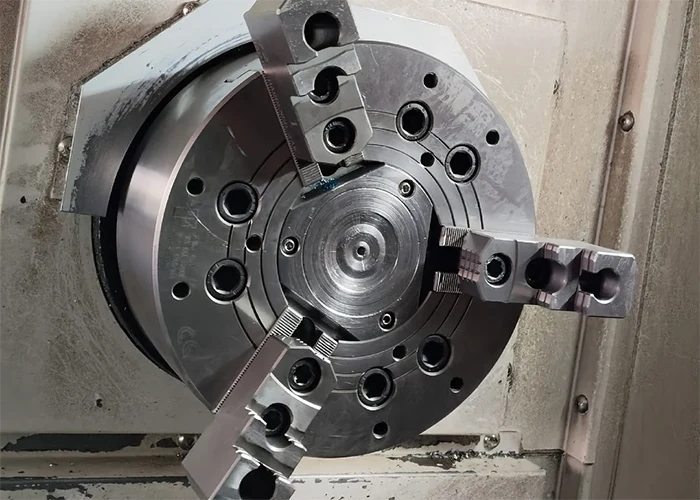
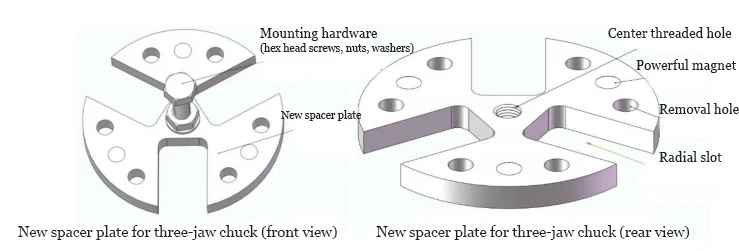
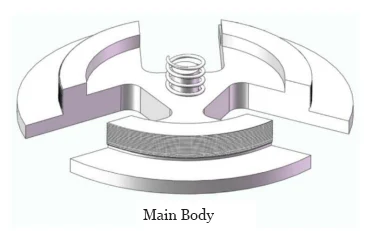
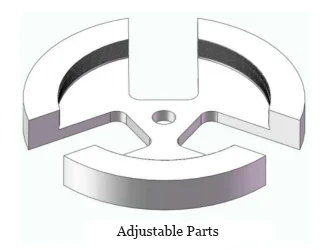
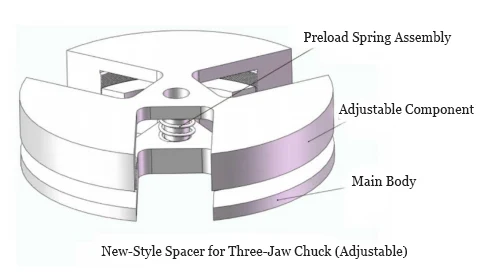
Structure of the New Three-Jaw Chuck Spacer Assembly
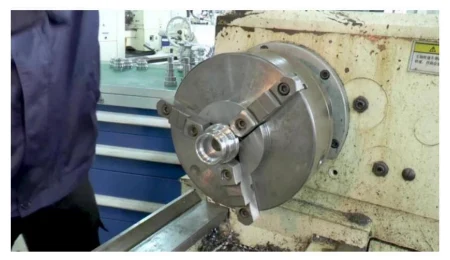
This new three-jaw chuck spacer is an axial positioning device for lathes, consisting of three spacers (spacer, main body, and adjustable component).
The spacer (Part 1) features three radially oriented slots evenly distributed around its circumference;
These slots correspond to the positions of the chuck jaws, and their width is slightly greater than the thickness of the jaws.
Three to six high-strength magnets are evenly distributed along the circumference of one end of the spacer plate, depending on the plate’s thickness.
The center of the spacer plate features an internal threaded hole; when machining this thread, ensure that the thread axis is perpendicular to the end face.
The two end faces of the spacer plate must be parallel, and the surface should undergo quenching and grinding to achieve a surface hardness of HRC 55 or higher.
Adjustable Shim Mechanism and Thickness Control
The adjustable shim consists of two parts: a main body with external threads (Part 2) and an adjustable component with internal threads (Part 3).
Rotating the adjustable component changes the overall thickness of the shim, accommodating the clamping requirements of workpieces of varying thicknesses.
When manufacturing the adjustable shim, ensure that the thread axis is perpendicular to the end face, and select an appropriate thread fit to ensure the parallelism between the two end faces of the shim.
Specifically, the external thread and the body end face should be machined in a single pass.
After assembling the two parts, use the body end face as a reference to grind the end face of the adjustable component on a surface grinder, and then grind the body end face using the adjustable component as a reference.
Cost-Effective Fastening and Anti-Loosening Design
To reduce manufacturing costs and protect the end faces of the shims and shaft-type workpieces as well as the internal threads of the shims, the positioning device uses standard copper components consisting of hex head screws, nuts, and washers.
This system is adjustable and can be set to the required dimensions according to machining requirements.
Since the shims have internal threads in the center, they work in conjunction with the nuts and hex head screws to form a locking nut assembly, which helps prevent loosening during machining.
Installation and Usage Instructions for the New Spacer Plate for Three-Jaw Chucks
When machining sleeve-type parts, select the appropriate shim or combination of shims based on machining requirements.
For example, the jaws of a C6140 lathe three-jaw chuck have a clamping length of 40 mm.
Shim thicknesses include 5 mm, 10 mm, and an adjustable shim with a range of 20–25 mm.
By combining these shims, the clamping length for sleeve-type parts can be adjusted to 0–20 mm, 25 mm, 30 mm, 35 mm, or 40 mm.
Since the adjustable spacer has a pitch of 0.75 mm, it allows for adjustments in 0.25 mm increments, effectively meeting the clamping requirements for virtually all thin workpieces.
To use the system, first select the appropriate spacer or combination of spacers based on your needs.
Then align the radial slots on the spacer with the three jaw positions on the chuck.
Use the built-in powerful magnets in the spacer to secure it to the chuck’s end face.
Place one end face of the disc-sleeve-type part against the end face of the spacer, and tighten the jaws. (Fig. 5)
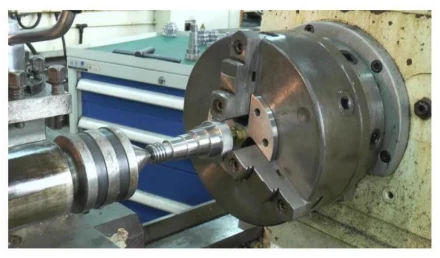
When using this new spacer for axial positioning of shaft-type parts, first adjust the spacer’s positioning element to the required dimension.
Then align the spacer’s radial slots with the three jaw positions of the chuck.
Use the powerful magnets to secure the spacer to the chuck’s end face.
Place one end face of the shaft-type part against the end face of the positioning element, support the other end with a center, and then tighten the jaws. (Fig. 6)
Structure of the Alignment Jig for Shaft Components
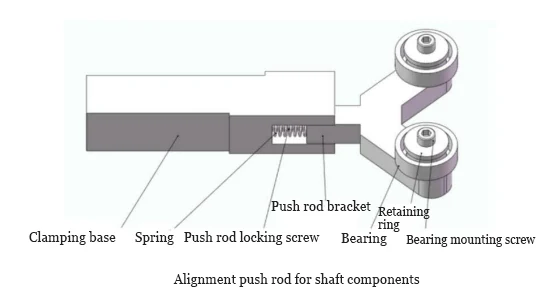
The alignment jig for shaft components is a tool used for quickly aligning shaft components on a lathe.
It consists of a base and a jig. The design uses a V-block equipped with a 90° rolling bearing. Screws and springs secure the V-block to the base while still allowing slight rotation and limited movement.
Installation and Operating Instructions for Alignment Pins for Shaft Parts
When machining shaft parts without a center hole, first install the alignment pin on the lathe.
Operators ensure that the part is roughly aligned and positioned correctly.
They maintain the bearing axis approximately parallel to the spindle axis.
They also adjust the V-block so its center aligns roughly with the spindle center height.
To use the device, first clamp the outer circumference of the shaft workpiece—ensuring the clamping force is light—and start the machine at low speed.
Move the alignment pin to the very front end of the shaft part and lightly touch the outer circumference until the part no longer wobbles.
Stop the machine and quickly tighten the workpiece. Restart the machine to verify that the setup meets machining requirements.
Key Contributions of the Project
Axial Positioning Device
This project mainly develops a new axial positioning device for three-jaw chucks.
It also introduces an alignment pin for shaft-type workpieces that operators can directly mount on the tool holder.
The design is simple and does not interfere with existing operations.
By using the new shim plate for the three-jaw chuck, the operator only needs to select or adjust the positioning elements of the shim plate as required.
Built-in high-strength magnets secure the shim plate onto the chuck face.
This design enables quick and accurate axial positioning through a single contact.
This ensures a unified machining reference, and ensures dimensional consistency.
The design effectively prevents axial movement of the workpiece during turning.
It also addresses problems associated with thin-walled, low-rigidity sleeve-type parts, which tend to deform and vibrate under clamping and cutting forces.
These instabilities negatively affect dimensional accuracy, geometric accuracy, and surface roughness.
Compatibility and Application Range
This new shim fits both conventional and CNC lathes and supports the machining of workpieces with various diameters.
It offers a wide range of applications and high versatility, improving production efficiency and process system rigidity, making it suitable for batch production.
Alignment Pin Operation for Shaft-Type Parts
When using the alignment pin for shaft-type parts, simply lightly clamp the part first.
Align the pin with the rear end of the shaft, then gently touch the shaft. As the shaft’s wobble gradually decreases, tighten the jaws at the appropriate moment.
Efficiency and Precision Improvement in Clamping
The use of this combination tool significantly enhances the speed and safety of three-jaw chuck clamping on lathes, enabling rapid, limited-position clamping with accurate, reliable, and high-precision positioning.
It prevents workpiece movement during turning effectively. It also removes the need for auxiliary alignment tools such as dial indicators, magnetic bases, and dial gauges that are traditionally used in machining alignment.
As a result, the system enables rapid and efficient installation of shaft-type parts without center holes.
Summary
China is a major manufacturing powerhouse, and the government has made the revitalization of the equipment manufacturing industry a key priority in advancing the optimization and upgrading of its industrial structure.
Throughout the entire machining process on a lathe, the time actually spent on cutting accounts for only about 30% of the total;
Operators allocate most of the remaining time to auxiliary operations, including tool installation and adjustment, loading and unloading workpieces, handling materials, and performing quality inspection and testing.
As the machining accuracy of machine tools continues to improve, the structural functionality of three-jaw chucks must also advance in tandem.
This ensures product quality by enhancing workpiece clamping accuracy and guarantees production efficiency by increasing workpiece clamping speed.
Selecting simple, suitable, and efficient tooling fixtures is an effective and convenient way to ensure product quality and improve production efficiency.
The alignment combination tool for lathe three-jaw chucks is easy to use, significantly improves machining efficiency, and has a wide range of applications.
It can serve as a standard component for three-jaw chucks or CNC and conventional lathes, offering broad market prospects.
In the coming days, the author plans to continue improving this alignment tool in two key areas:
First, by adopting superior materials to enhance the strength and wear resistance of the new shims while reducing their weight;
And second, by optimizing the tool’s structural design to accommodate a wider range of applications and expand its scope of use.
It is expected that engineers will further refine the structure of the lathe three-jaw chuck alignment tool and expand its applications to a wider range of use cases.