Against the backdrop of global manufacturing becoming increasingly intelligent and digital, the field of mechanical parts machining has also witnessed unprecedented technological innovation.
Workholding fixtures serve as a vital link between machine tools and workpieces, and their performance directly impacts machining quality, production efficiency, and manufacturing costs.
Traditional workholding fixture designs typically target a single product or a specific process, which limits their ability to meet current production requirements for high product variety, small batch manufacturing, and rapid changeovers.
In the context of smart manufacturing, new requirements have emerged for workholding fixtures.
Beyond high positioning accuracy and reliable clamping, they must also meet demands for rapid changeover, flexible adaptability, and intelligent monitoring.
The machinery manufacturing industry must continue advancing workholding fixture design methods and application strategies to meet these evolving demands.
Such research plays a vital role in improving manufacturing capabilities, increasing production efficiency, and supporting the broader objective of strengthening national manufacturing competitiveness.
This study will discuss the topic from three perspectives: significance analysis, design principles, and practical application, with the hope of contributing to research and practice in related fields.
Significance of Fixture Design
Improving Machining Accuracy and Efficiency
Fixtures play a crucial role in positioning and clamping workpieces during the machining of mechanical parts, and the quality of their design directly impacts machining accuracy.
In a smart manufacturing environment, high-precision fixtures ensure the spatial stability of workpieces during machining, minimize positioning errors and clamping deformation, and guarantee compliance with dimensional accuracy and geometric tolerance requirements.
Scientifically designed fixtures can significantly reduce workpiece setup time and minimize the duration of auxiliary processes, thereby increasing the proportion of effective machining time on the machine tool.
Furthermore, superior fixture design expands the range of permissible cutting parameters, allowing for higher cutting speeds and feed rates, which in turn increases the amount of material removed per unit time and achieves a comprehensive improvement in machining efficiency.
It is worth noting that precision fixtures can also effectively suppress vibration and thermal deformation during machining, ensuring the machining quality of complex surfaces and thin-walled parts.
By optimizing the layout of support points and the distribution of clamping forces, elastic deformation of the workpiece can be minimized, ensuring part consistency and interchangeability in mass production, and meeting the dual demands of modern manufacturing for high precision and high efficiency.
Promoting Automation and Flexibility
Smart manufacturing is a production method characterized by highly automated and flexible processes, and the quality of tooling and fixture design is a critical factor in achieving smart manufacturing.
Modern tooling and fixtures utilize hydraulic, pneumatic, or electric drives to enable automatic loading and unloading of workpieces as well as rapid clamping, ensuring the continuous operation of automated production lines.
Flexible fixture design allows a single fixture to accommodate parts of different specifications and shapes, significantly reducing the frequency of fixture changes and adjustment time during production changeovers.
When this flexibility is combined with the production scheduling capabilities of smart manufacturing systems, enterprises can respond rapidly to market demands and implement mixed-model production, thereby significantly enhancing the overall flexibility and market competitiveness of the manufacturing system.
At the same time, smart tooling and fixtures can seamlessly integrate with robots, CNC machine tools, and logistics systems, exchanging data through standardized interfaces and communication protocols to form a complete automated machining cell.
Reducing Production Costs and Reliance on Labor
Proper tooling and fixture design plays a significant role in controlling production costs.
High-quality fixtures can reduce scrap rates and rework rates, directly lowering material waste and quality-related costs.
Furthermore, the use of automated fixtures greatly reduces the need for manual clamping operations, thereby decreasing reliance on skilled workers.
This effectively alleviates labor shortages and rising labor costs in the manufacturing sector.
Furthermore, the principles of modular and standardized fixture design allow for the reuse and reconfiguration of fixture components, reducing the need to develop specialized fixtures and lowering manufacturing and maintenance costs.
From a full lifecycle perspective, scientifically sound tooling and fixture design helps enterprises allocate manufacturing resources efficiently, thereby generating greater economic benefits.
Key Considerations in the Design of Fixtures
Modular and Standardized Design Concepts
Modularity and standardization have become fundamental principles in the design of workholding fixtures for the era of smart manufacturing.
Modular design breaks down the fixture system into standard modules with independent functions and standardized interfaces—such as base modules, positioning modules, clamping modules, and connection modules—which are assembled and connected via standard interfaces.
This design approach enables enterprises to quickly select and assemble fixture systems that meet specific process requirements based on varying machining tasks, significantly reducing fixture setup time.
Standardized design requires that the dimensional specifications, connection methods, and precision grades of fixture components comply with unified standards, enabling interchangeability between components and mass production, thereby reducing the acquisition and maintenance costs of fixture systems.
The combination of modularization and standardization facilitates the creation of an enterprise-level fixture component database, accumulates design experience and knowledge assets, and provides reusable design resources for future fixture development.
Digital Modeling and Simulation Optimization Technology
In the context of smart manufacturing, the extensive application of digital technology has become a defining feature of fixture design.
By utilizing 3D computer-aided design (CAD) software to create precise digital models of fixtures, the structural configurations and assembly relationships can be visually represented, greatly facilitating the review of design proposals and subsequent adjustments and refinements.
The application of finite element analysis (FEA) technology allows for the accurate prediction of stress distribution and deformation conditions during jig loading at the design stage, thereby providing a reliable basis for structural optimization and ensuring the jig possesses sufficient stiffness and strength.
Motion simulation technology can simulate the motion trajectories and interference conditions of the jig during operation, enabling the early detection and resolution of issues arising from mechanical motion.
Virtual assembly technology verifies the fit between the fixture, the machine tool, and the workpiece, ensuring the manufacturability and assembly feasibility of the design.
The use of digital design methods effectively shortens the fixture development cycle, reduces the risk of design errors, and improves the overall quality of the design.
Flexible Fixture Structures
Current market demands in the manufacturing sector are characterized by high variety, low volume, and customization, placing higher demands on the adaptability of tooling fixtures.
The core of flexible fixture design lies in adopting adjustable and reconfigurable structural forms, enabling the fixture to accommodate the clamping needs of workpieces with varying specifications within a certain range.
Adjustable positioning elements utilize position-adjustment mechanisms to alter the positioning reference, thereby adapting to changes in workpiece dimensions.
Modular clamping mechanisms employ a multi-point distributed layout, allowing clamping points to be selectively activated based on the workpiece’s geometric features.
The emergence of new clamping methods, such as phase-change material fixtures and magnetic fixtures, has further expanded the scope of application for flexible fixtures.
The structural design of flexible fixtures must strike a balance between versatility and specialization, ensuring both a certain range of adaptability and the precision and reliability of positioning and clamping.
This requires designers to possess extensive process knowledge and systematic design capabilities.
Practical Applications
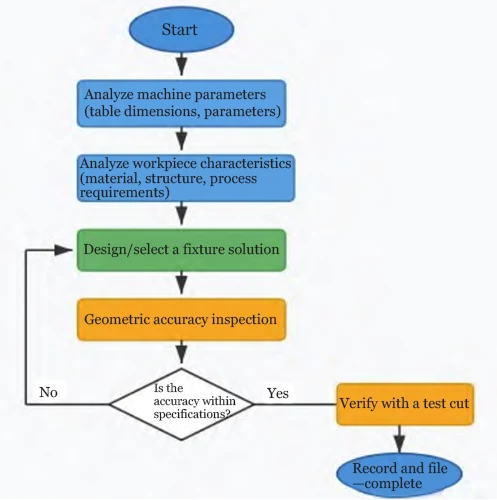
The setup and debugging of fixtures for CNC machining centers is a systematic process, with the main steps illustrated in Figure 1.
Fixture Configuration and Debugging
CNC machining centers serve as the core processing equipment in smart manufacturing workshops;
The proper configuration and precise debugging of fixtures directly impact the successful completion of machining tasks.
During the fixture configuration phase, an appropriate fixture solution is selected or designed based on the machining center’s equipment characteristics—such as table dimensions, spindle parameters, and tool magazine capacity—as well as the workpiece’s material properties, structural form, and process requirements.
The connection method between the fixture and the machine tool table must ensure positioning accuracy and connection rigidity.
Common methods include T-slot connections, pin-hole positioning, and zero-point quick-change systems.
During fixture debugging, geometric accuracy must first be verified.
A dial indicator or laser measuring instrument is used to measure the flatness, perpendicularity, and positional accuracy of the fixture’s locating surfaces to ensure compliance with machining accuracy requirements.
Next, a trial machining verification must be conducted. Machining a test piece allows for the evaluation of the fixture’s actual performance, and fine adjustments should be made based on the results of the trial run.
Once fixture debugging is complete, the debugging parameters and precautions should be documented in detail, and a fixture usage record should be established to provide a basis for future reuse.
For multi-process machining, it is also necessary to consider the unification of reference points and the coordination between fixtures for each process to ensure the transfer of machining accuracy between processes.
Practical Applications of Quick Changeover
Automated production lines aim for continuous production characterized by high efficiency and minimal downtime;
Therefore, the ability to quickly change over tooling and fixtures has become a key factor influencing the overall efficiency of the production line.
The core of a quick changeover system lies in establishing standardized fixture interface specifications, enabling different fixtures to be rapidly connected to and precisely positioned on machine tools or production line equipment.
Zero-point positioning systems are currently widely used and represent one solution for rapid changeover.
By utilizing high-precision locating pins and clamping mechanisms, fixture installation and locking take only a few seconds, with repeatability accuracy reaching the micrometer level.
In automated production lines, rapid changeover practices must also be integrated with production scheduling systems.
This involves preparing the fixtures to be swapped in advance according to the production plan, optimizing the changeover sequence and timing, and reducing changeover wait times.
Offline pre-adjustment technology for fixtures allows for workpiece clamping and position adjustment to be completed outside the production line, thereby further reducing online changeover time.
Flexible manufacturing systems equipped with automatic fixture storage and conveyance devices enable automated fixture retrieval and distribution, working in conjunction with robotic loading and unloading systems to form a complete automated changeover process.
The successful application of rapid changeover systems relies on the joint advancement of several factors, including standardized fixture design, the configuration of changeover equipment, and the optimization of production organization.
Applications of Intelligent Inspection and Fixture Status Monitoring
In a smart manufacturing environment, production processes require visualization, traceability, and optimization, leading to the widespread adoption of intelligent inspection and condition monitoring technologies for tooling and fixtures.
Integrated sensor technology can detect the workpiece’s positioning status and clamping force in real time, ensuring accuracy and consistency in every clamping operation.
Proximity sensors detect whether the workpiece is in position, pressure sensors monitor whether the clamping force has reached the set value, and displacement sensors monitor the movement of the clamping mechanism to ensure it has reached the correct position.
Detection signals are fed back to the control system, which automatically verifies the clamping status before machining begins.
In the event of an anomaly, the system promptly issues an alarm and halts machining to prevent processing accidents and quality defects caused by clamping issues.
Sensors continuously record metrics such as the number of uses, cumulative operating time, and wear on critical components for fixture condition monitoring.
A fixture health evaluation model then processes these data to support proactive maintenance planning.
The data acquisition system uploads fixture operation data to the Manufacturing Execution System (MES) or an industrial internet platform, enabling managers to remotely monitor fixture status and promptly schedule maintenance plans.
With the application of intelligent detection and monitoring technologies, fixtures have evolved from simple process equipment into information nodes within smart manufacturing systems, providing data support for the refined management of production processes.
Conclusion
Fixtures and jigs are essential process equipment for the machining of mechanical parts and play an irreplaceable role in the transformation and upgrading of smart manufacturing.
This study systematically analyzes the significance of fixture and jig design in the context of smart manufacturing.
It examines three key aspects: modular and standardized design, digital modeling and simulation, and flexible structural design.
Finally, it discusses practical application methods such as fixture configuration for CNC machining centers, rapid changeover on automated production lines, and intelligent inspection and monitoring.
The research findings indicate that the design and application of modern workholding fixtures must align with the evolving demands of smart manufacturing.
By fully leveraging digital and information-based technologies, it is possible to continuously enhance the precision, efficiency, and intelligence of fixtures.
With the advancement of emerging technologies such as artificial intelligence and digital twins, workholding fixture design methods will continue to evolve.
Application models of workholding fixtures will also continue to evolve.
These developments will provide stronger technical support for the high-quality development of the machinery manufacturing industry.