
To meet the performance requirements of next-generation aircraft models, the impeller structures of aviation engine centrifugal pumps have evolved into narrow, twisted three-dimensional configurations.
These designs demand higher dimensional accuracy and surface quality, and the widespread use of titanium alloys has significantly increased the complexity of machining processes.
Currently, specialized software such as MAX-PAC for impeller and hub components enables efficient, high-quality machining of impellers.
Overall, research on machining processes for aircraft engine centrifugal pump impellers with three-dimensional narrow, twisted flow channel structures remains limited.
In this study, focusing on the impellers of aircraft engine centrifugal pumps with three-dimensional narrow and twisted flow channel structures, the author utilizes QJCAM computer-aided manufacturing software to investigate cycloidal milling processes tailored to impeller features, proposing tool configurations and application schemes with high accessibility.
Impeller Structures
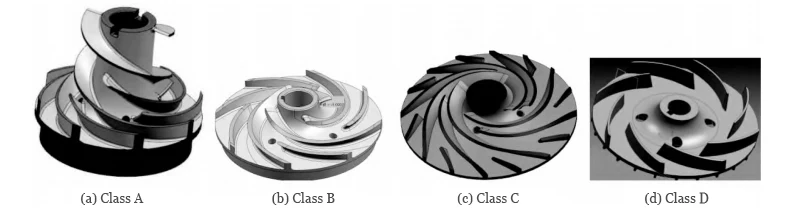
There are four typical impeller structures for aviation engine centrifugal pumps, as shown in Figure 1.
The primary characteristics of Type A impeller structures include two-stage flow splitting, deep and narrow flow passages, a wrap angle of the main blades around the hub exceeding 360°, and a blade height of 15–20 mm; these are typically manufactured as a single piece using additive manufacturing processes.
Type B impeller structures are characterized by narrow, twisted flow channels, free-form main blades, a wrap angle around the hub exceeding 120°, and blade heights of approximately 10 mm.
The profile at the inlet of the bypass blades undergoes a steep change in direction, and these impellers are generally manufactured using five-axis CNC machining.
Type C impeller structures are characterized by multi-stage flow division, with a total of more than 10 blades, and are generally manufactured using five-axis CNC machining.
Type D impeller structures are characterized by the absence of flow-diverting blades, a simple flow channel structure, and short blades with straight surfaces, and are generally manufactured using three-axis CNC machining.
Analysis of Machining Challenges
The Class B impeller features a typical three-dimensional narrow, twisted flow channel structure.
As a small-sized impeller, it serves as a key subject for research on five-axis machining.
Most impellers of this type are made of difficult-to-machine titanium alloys, with a material removal rate of 80% to 90%.
Due to the constraints of the narrow, twisted flow channel structure, small-diameter tools ranging from 2 mm to 4 mm in diameter are typically used, which have low rigidity.
Consequently, the machining challenges of impellers with three-dimensional narrow, twisted flow channels manifest primarily in four aspects.
First, titanium alloys have poor machinability, leading to significant tool wear.
Second, the large machining allowance and high material removal rate result in low cutting efficiency.
Third, tools are prone to interference with the narrow, twisted flow channels, making it difficult to control the tool axes during multi-axis machining.
Fourth, the poor rigidity of the machining system makes the blades susceptible to chatter marks.
Solution
Cycloidal Milling Roughing Solution Based on QJCAM Software
Cycloidal milling features deep cuts, narrow cutting widths, and smooth, continuous toolpaths, which help reduce spindle vibration and improve cutting efficiency, offering significant advantages in heavy-duty machining.
Layer milling better follows the contour of the workpiece surface during light-duty machining, ensuring dimensional accuracy and surface quality.
To fully leverage the characteristics and advantages of cycloidal and layer milling, engineers apply cycloidal milling for the rough machining of impellers, while they use layer milling for semi-finishing and finishing operations.
Cycloidal milling typically operates with a fixed spindle and often leaves significant material residues in irregular areas, which makes subsequent cleanup difficult.
Machining Area Partitioning Strategy
To minimize material residue, analyze the areas where the tool’s contact angle exceeds the critical value during the cutting process.
Consider minimizing the number of tool axis changes, the amplitude of each change, and concentrating the machining allowance as much as possible to define and partition the machining areas.
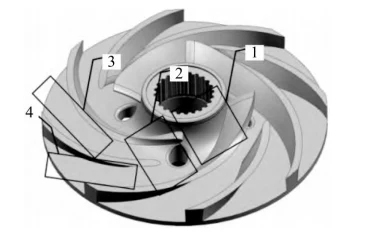
Since the impeller forms a rotational body, engineers select one direction for area partitioning. Figure 2 shows the impeller area partitioning.
From the inlet to the outlet, the design divides the impeller into four regions.
In Region 1, a high blade profile and concentrated material allowance define the leading edge.
Region 2, a relatively high blade profile combined with significant twist defines the flow passage region.
In Region 3, a low blade profile and a large area near the main blades correspond to the trailing edge of the main blades.
Region 4 features a low blade profile and a large area, located near the diverter blades, and is defined as the trailing edge of the diverter blades.
Cycloidal Roughing Toolpath Planning
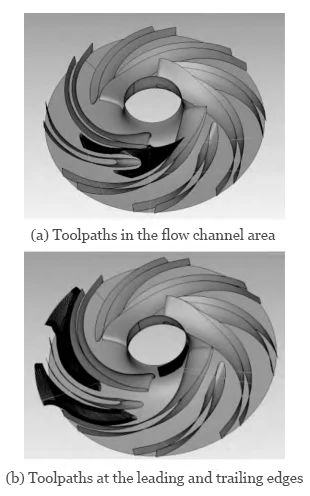
Plan the roughing toolpaths for the cycloidal milling in four separate areas, as shown in Figure 3.
The leading edge has a relatively large allowance depth and a relatively simple structure, so it can be machined in two passes.
The flow channel divergent vanes have a large forward angle, a complex structure, and a large allowance.
To minimize residual material, the process uses layered machining with a depth of 0.3 mm per pass.
The machining strategy treats the trailing edges of the main vanes and the divergent vanes as simple structures with relatively small allowances, enabling single-pass machining.
Structural Design to Enhance Tool Rigidity and Accessibility
Cycloidal rough milling is limited by low tool rigidity, resulting in cutting parameters that remain at relatively low levels.
During layer milling finishing operations, the tool holder swings over a wide range, and the poor accessibility of straight-shank ball-nose cutters makes this the primary stage where chatter and interference occur.
To further increase cutting parameters and reduce interference and chatter, improvements to the tool structure should be considered.
To increase cutting parameters and reduce chatter, it is necessary to improve the tool’s torsional stiffness.
A tool’s torsional stiffness is evaluated by its torsional angle; the smaller the torsional angle, the greater the torsional stiffness.
The formula for calculating the torsional angle P is:

In the equation: T represents the torque acting on the tool during cutting; L represents the overhang length of the tool;
G represents the shear elastic modulus of the tool material;
Lp represents the polar moment of inertia of the tool material.
The formula for calculating the polar moment of inertia Lp of the tool material is:
Lp = πd4 /32 (2)
This leads to the following formula for calculating the torsional angle:

In the equation: d represents the shank diameter.
As shown in Equation (3), reducing the tool overhang and increasing the shank diameter can effectively reduce the torsional angle and improve the tool’s torsional stiffness.
Tool Structure and Clearance Optimization
To further enhance the tool’s resistance to interference, the shank is designed with a stepped structure. The ball-nose cutter structure is shown in Figure 4.
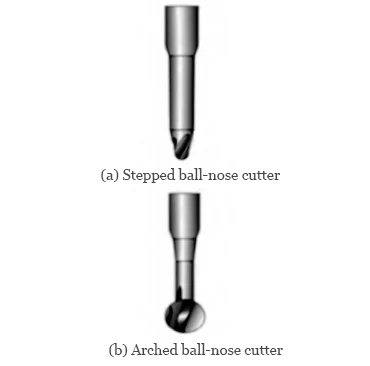
Reducing interference requires improving the tool’s clearance capability.
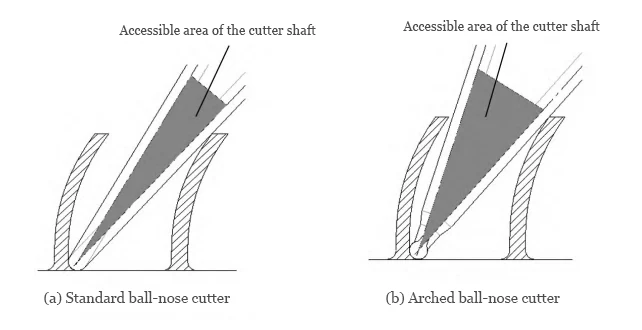
Conventional ball-nose end mills provide a small cutting edge range; to ensure machining quality at the blade root, designers limit the accessible area of the tool shank, which results in poor clearance capability.
To expand the accessible area of the tool shank and improve clearance capability, engineers use arched ball-nose end mills with a larger cutting edge range.
Figure 5 compares the accessible areas of conventional ball-nose cutters and arched ball-nose cutters.
Arched ball-nose cutters can cover a significantly larger area than conventional ball-nose cutters, offering superior clearance.
Application Validation
Based on the aforementioned research, the researchers select a representative three-dimensional impeller with a narrow, twisted flow channel structure for validation, and they present the programming scheme in Table 1.
Using QJCAM software, the researchers perform five-axis machining toolpath planning and simulation calculations for the impeller blade profile.
The researchers monitor tool axis oscillation, analyze the oscillation angle, and further optimize the toolpath to ensure toolpath feasibility and smooth, stable tool axis movement.
| No. | Machining Strategy | Tooling Scheme | Ball Nose Diameter (mm) | Step Length (mm) | Shank Diameter (mm) | Overall Tool Length (mm) |
|---|---|---|---|---|---|---|
| 1 | Swarf milling roughing – leading edge | Stepped ball end mill | 4 | 15 | 8 | 65 |
| 2 | Swarf milling roughing – main blade / rim edge, splitter blade trailing edge | Stepped ball end mill | 4 | 15 | 8 | 65 |
| 3 | Swarf milling roughing – flow channel | Stepped ball end mill | 3 | 15 | 8 | 65 |
| 4 | Semi-finishing main blade (layer milling) | Tapered stepped ball end mill | 4 | 15 | 6 | 65 |
| 6 | Semi-finishing splitter blade (layer milling) | Tapered stepped ball end mill | 4 | 15 | 6 | 65 |
| 8 | Semi-finishing main blade channel & splitter blade channel (layer milling) | Tapered stepped ball end mill | 3 | 15 | 6 | 65 |
| 10 | Finishing main blade (layer milling) | Tapered stepped ball end mill | 3 | 15 | 6 | 65 |
| 11 | Finishing splitter blade (layer milling) | Tapered stepped ball end mill | 3 | 15 | 6 | 65 |
| 12 | Finishing main blade channel & splitter blade channel (layer milling) | Tapered stepped ball end mill | 3 | 15 | 6 | 65 |
| 13 | Finishing blade fillet (layer milling) | Tapered stepped ball end mill | 3 | 15 | 6 | 65 |
Table 1. Programming Scheme
The impeller underwent practical machining verification; the machining process was stable, with no instances of tool breakage or abnormal spindle loads.
After completing machining, the researchers inspected the impeller and confirmed that the blade surface remained intact without overcutting or vibration marks.
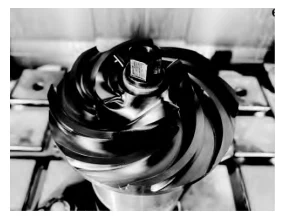
Figure 6 shows the machined impeller, and Table 2 presents the analysis of its technical specifications.
The results indicate that the dimensional accuracy meets the required standards, while the surface roughness significantly exceeds the specified requirements.
Statistical analysis shows that cycloidal rough machining reduces the machining time of a single impeller by approximately 50% compared with layer milling.
| Item | Specification Requirement | Inspection Result |
|---|---|---|
| Blade profile dimensional accuracy (mm) | ±0.1 | > -0.1 and < 0.1 |
| Surface roughness Ra (μm) | 1.6 | 0.5 |
Table 2. Analysis of Technical Indicators
Conclusion
The author proposes a CNC machining process for impeller blades with three-dimensional narrow and twisted flow channel structures.
Verification results indicate that feature-oriented cycloidal milling based on QJCAM software can effectively reduce the machining time during the roughing stage for typical three-dimensional narrow and twisted flow channel impeller blades.
The stepped ball-nose milling cutter and arched ball-nose milling cutter designs significantly enhance tool rigidity and improve tool accessibility, thereby contributing to improved dimensional accuracy and surface quality of the impeller.
The author proposes a highly versatile machining process that can be extended to other complex impeller machining applications.