
Cermet cutting tools were developed in the 1970s. They offer advantages such as high hardness, excellent wear resistance, good chemical stability, and low friction coefficients, and are typically used for the finishing of steel and non-ferrous metals.
Given the properties of cermet materials, their use can increase cutting speeds during machining, thereby improving machining efficiency and surface finish quality.
Cermet materials typically use crystal particles such as Ti(C,N) as the hard phase, with WC and Co serving as the binder.
In contrast, traditional cemented carbide materials use tungsten carbide (WC) particles as the hard phase, with Co, Ni, and other elements as the binder.
Cermets exhibit higher hardness, greater wear resistance, better chemical stability, and stronger oxidation resistance compared to cemented carbides.
After finishing operations, the wear on the cutting edges of metal ceramic tools is uniform, and the surface roughness of the machined parts is superior to that achieved with cemented carbide.
Research on Performance of Metal Ceramic Tools
Murakami et al. investigated the performance of metal ceramic tools during high-speed turning of S32750 duplex stainless steel.
Compared with tools made of various materials, they demonstrated superior performance.
Yi Jiansong et al. investigated the effect of different carbon-to-nitrogen ratios on the high-speed turning performance of metal ceramic tools and found that a 7:3 carbon-to-nitrogen ratio yielded the best performance.
Song Jinpeng et al. studied the influence of WC content on the microstructure and mechanical properties of metal ceramic tool materials and found that WC serves to refine the Ti(C,N) grains; as the WC content increases, the material’s flexural strength gradually improves.
Manufacturing Processes and Application Studies
In addition to research on the composition of cermet materials, some scholars have investigated their manufacturing processes and applications.
Zhang Cuijuan et al. described how to prepare cermets using microwave sintering technology and focused their research on production process factors such as sintering temperature.
Zheng Yong et al. employed discharge plasma sintering technology to prepare metal-ceramic materials; this technology has a significant impact on the microstructure and properties of the materials.
Xu Liqiang et al. and Xu Dongming et al. investigated the performance of metal-ceramic cutting tools during the turning of hardened steel and pure iron materials, demonstrating that the wear resistance of metal-ceramic cutting tools is significantly superior to that of traditional cemented carbide tools.
To apply metal-ceramic materials to end mills, the author, based on Ti(C,N)-based metal-ceramic materials, investigated the influence of cutting edge parameters on the tool life of metal-ceramic end mills.
For face milling processes, orthogonal experiments were conducted on cutting edge parameters, and optimal design parameters were obtained through analysis of the experimental results.
Effect of the Rake Angle
Cermet cutting tools are better suited for the finishing of metallic materials.
During finishing operations, the cutting volume of metal-ceramic tools on metal materials is very small, and the area in direct contact with the metal material is concentrated near the cutting edge.
Therefore, the design of the cutting edge has a significant impact on the milling performance of metal-ceramic end mills and affects their service life.
In face milling operations, the bottom edge of the end mill is involved in the cutting process.
The structure of the front and rear angles of the bottom edge of an end mill is shown in Figure 1.
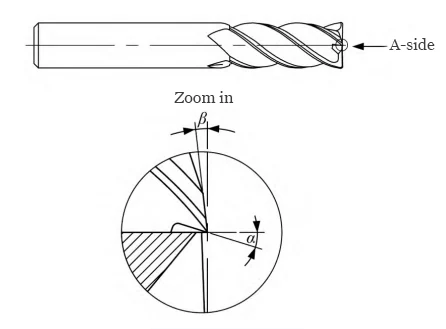
When performing face milling with an end mill, the face that curls the chips is the rake face of the bottom edge, while the opposite face of the cutting edge is the clearance face of the bottom edge.
The magnitude of the rake angle α of the bottom edge affects the sharpness of the end mill; a larger α reduces the milling force, but an excessively large α will reduce edge strength, leading to weakened impact resistance or chipping of the cutting edge.
The rake angle β also affects the tool life and edge strength of the end mill.
During the milling process, material rebound exerts significant impact and wear on the rake face.
An appropriate β ensures a clearance between the rake face and the workpiece surface, thereby preventing impact from material rebound and maintaining the edge’s strength and impact resistance.
Test Protocol
This study examines the effects of varying the rake angle and clearance angle of the bottom edge.
Given the poor chipping resistance of metal-ceramic materials, it is necessary to enhance the strength of the cutting edge.
The solution is to reduce the rake angle, thereby increasing edge strength and preventing chipping during machining.
The rake angle can be set to 5°, 0°, and –5°. Since metal ceramics have poor thermal conductivity, it is necessary to provide adequate heat dissipation space for the tool, minimize the friction area between the tool and the material, reduce heat generation during the milling process, and prevent heat accumulation at the cutting edge.
At the same time, cutting edge strength must be ensured; therefore, the clearance angle can be set to 6°, 8°, and 10°.
Based on the above settings, the rake angle and clearance angle of the bottom edge were selected as the two experimental factors.
Three different test values were set for each factor, employing a two-factor, three-level orthogonal experimental design, as shown in Table 1.
| Level | Pre-Bending Angle (°) | Post-Bending Angle (°) |
|---|---|---|
| 1 | 5 | 6 |
| 2 | 0 | 8 |
| 3 | -5 | 10 |
Table 1: Two-Factor, Three-Level Orthogonal Experimental Design
Experimental Tool Design Scheme
By setting factors and levels to combine different combinations of rake angle and clearance angle, various experimental tool designs were developed, as shown in Table 2.
The basic parameters of the end mill are listed in Table 3.
Since cermets are more suitable for finishing under high linear velocity conditions, the milling parameters used in the experiments are shown in Table 4.
| Tool No. | Pre-Bending Angle (°) | Post-Bending Angle (°) |
|---|---|---|
| 1 | 5 | 6 |
| 2 | 5 | 8 |
| 3 | 5 | 10 |
| 4 | 0 | 6 |
| 5 | 0 | 8 |
| 6 | 0 | 10 |
| 7 | -5 | 6 |
| 8 | -5 | 8 |
| 9 | -5 | 10 |
Table 2: Experimental Tool Design Scheme
End Mill and Milling Parameters
| Item | Value |
|---|---|
| Diameter (mm) | 12 |
| Shank Diameter (mm) | 12 |
| Cutting Edge Length (mm) | 25 |
| Overall Length (mm) | 100 |
| Helix Angle (°) | 40 |
Tab 3: Basic Parameters of the End Mill
| Parameter | Value |
|---|---|
| Milling Method | Down Milling |
| Cutting Speed (m·min⁻¹) | 602 |
| Feed Rate (mm·min⁻¹) | 6400 |
| Depth of Cut (mm) | 0.2 |
| Width of Cut (mm) | 9 |
Table 4: Milling Parameters
Test Setup and Tool Life Evaluation Method
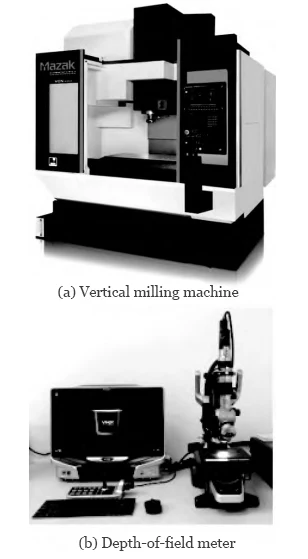
The test workpiece measured 300 mm × 200 mm × 100 mm, was made of 45 steel, had a Brinell hardness (HB) of 180, and was clamped in a vertical milling machine.
The vertical milling machine’s spindle has a maximum speed of 18,000 rpm and a power rating of 28 kW.
During the test, an image of the bottom edge of the end mill is captured using a depth-of-focus measuring instrument every 10 mm of milling, and the wear value of the rake face behind the bottom edge is measured and recorded.
When the wear value or notch depth reaches 0.2 mm, the test tool is deemed to have failed, and cutting is stopped; the distance milled by the end mill at this point is used as an indicator of the tool’s service life.
The test setup is shown in Figure 2.
Test Results
Using a wear value or a notch depth of 0.2 mm as the criterion for determining tool failure, the total milling distance at which the test tool was ultimately deemed to have failed is shown in Table 5.
| Test Tool No. | Bottom Rake Angle (°) | Bottom Relief Angle (°) | Milling Distance at Failure (m) | Tool Failure Mode |
|---|---|---|---|---|
| 1 | 5 | 6 | 50 | Chipping |
| 2 | 5 | 8 | 60 | Chipping |
| 3 | 5 | 10 | 90 | Chipping |
| 4 | 0 | 6 | 60 | Wear |
| 5 | 0 | 8 | 70 | Wear |
| 6 | 0 | 10 | 100 | Wear |
| 7 | -5 | 6 | 60 | Wear |
| 8 | -5 | 8 | 60 | Wear |
| 9 | -5 | 10 | 70 | Wear |
Table 5. Milling Distance at Which Test Cutters Were Determined to Have Failed
Mean Analysis of Experimental Results
A mean analysis was performed on the test results. For each level of a given factor, the test results were averaged to obtain the mean value for that factor at that level.
The range of the mean values of the test results across different levels of the factor was then calculated.
Finally, the ranges of the mean values for different factors were compared; a larger range indicates a greater influence of that factor on the test results.
The results of the mean analysis are shown in Table 6.
| Factor | Before Bottom Cutting | After Bottom Cutting |
|---|---|---|
| Level 1 Mean / m | 66.67 | 56.67 |
| Level 2 Mean / m | 76.67 | 63.33 |
| Level 3 Mean / m | 63.33 | 86.67 |
| Range of Means / m | 13.34 | 30 |
| Influence Ranking | 2 | 1 |
Table 6. Results of Mean Analysis
Main Effect Trends of Experimental Factors
Line charts were plotted for the mean values of the test results at different levels of each factor, i.e., the main effect plots of the means, as shown in Figure 3.
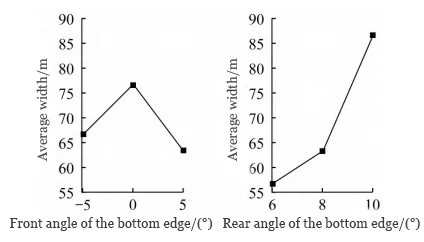
These clearly illustrate the trends in how the test results vary under the influence of different factors.
ANOVA Model and Significance Testing Framework
An analysis of variance (ANOVA) was performed on the test results.
Let the number of degrees of freedom be f; the total degrees of freedom fT is:
fT = n - 1 (1)
Where: n is the number of trials.
The degrees of freedom fj for experimental factor j are:
fj = m - 1 (2)
Where: m is the number of levels of the experimental factor.
The degrees of freedom for the error term, fe, are:
fe = fT - ∑fj (3)
Sum of Squares and Mean Square Formulation
The sum of the squares of the deviations and S is:

In the formula: i represents the experiment number; yi represents the result of experiment i; y− represents the average of the experimental results.
The sum of the squares of the deviations from the mean, denoted by M, is:
M = S/f (5)
At this point, if the sum of the squares of the deviations for a particular experimental factor is less than the sum of the squares of the deviations for the error, the sum of the squares of the deviations for that experimental factor is attributed to the error, resulting in a new sum of the squares of the deviations for the error, S*e, which is given by:
S*e = Sj + Se (6)
In the formula: Sj is the sum of the squares of the deviations for experimental factor j; Se is the sum of the squares of the errors.
F-Test Statistic for Significance Evaluation
The significance test statistic F is:
F = M/S*e (7)
The F-statistic characterizes the significance of different experimental factors on the experimental results.
The larger the F-statistic, the more significant the effect of the experimental factor on the results.
The F-statistic can also be compared with a table of significance test critical values.
There are different tables of significance test critical values for different significance levels.
For an experimental design with different factor levels, the corresponding critical value can be looked up, and the F-statistic of the experimental results can be compared with this critical value.
If the F-value is greater than the critical value, the experimental factor has a significant effect on the experimental results; otherwise, the effect is not significant.
Significance Evaluation and Statistical Results
Assuming a significance level of 0.05, consulting the significance test critical value table for a significance level of 0.05 reveals that the critical value for the significance test of the rake angle and clearance angle in this experiment is 6.94.
Additionally, the probability P of extreme experimental results occurring for different experimental factors can be obtained using the analysis software.
P can also characterize the significance of different experimental factors on the experimental results; the smaller the P value, the more significant the influence of the experimental factor on the results.
Calculations show that the F-value for the rake angle is 1.86 with a P-value of 0.269, while the F-value for the clearance angle is 9.57 with a P-value of 0.03.
Combined with the results of the mean analysis, it can be seen that the clearance angle has a significant effect on the tool life of the cermet end mill, whereas the rake angle has no significant effect.
Wear Mechanism and Tool Life Behavior
As shown in Figure 3, the service life of the metal-ceramic end mill exhibits a trend of first increasing and then decreasing with an increase in the rake angle, while it is positively correlated with the clearance angle.
Analysis indicates that the optimal rake angle is 0°, and the optimal clearance angle is 10°.
As can be seen from the failure modes of the cutting edges on the metal-ceramic end mills, significant chipping occurred on all cutting edges when the rake angle of the root face was 5°.
Reducing the rake angle of the bottom edge significantly improves chipping, with the failure mode shifting to normal wear, indicating that cermet materials have poor chipping resistance.
When the rake angle of the bottom edge is set to –5°, the sharpness of the cutting edge decreases, making the cermet end mill more prone to generating cutting heat during the milling process.
If the rake angle is too small, the chip curling radius decreases, heat dissipation becomes even poorer, and heat accumulates at the cutting edge without being effectively dissipated, leading to reduced strength at the cutting edge tip, increased susceptibility to wear, and a shortened tool life of the metal-ceramic end mill.
Influence of Rake Angle on Machined Surface Quality
Test results indicate that the rake angle of the bottom edge also affects the machined surface.
The larger the rake angle, the less contact there is between the rake face and the machined surface.
Consequently, the compressive force exerted on the rake face by material rebound after milling is reduced, which lowers the temperature at the cutting edge, slows the wear rate, and extends the service life of the metal-ceramic end mill.
Conclusion
This study analyzes the influence of cutting edge parameters on the tool life of metal-ceramic end mills.
Orthogonal experiments reveal that, under face milling conditions for 45 steel, the rake angle of the bottom edge has a significant effect on the tool life of metal-ceramic end mills, whereas the influence of the rake angle is not significant.
For face milling of 45 steel, the optimal design parameters for the cermet end mill are a rake angle of 0° and a clearance angle of 10°.
Cermet end mills exhibit poor chip-breaking performance but strong wear resistance; therefore, during tool design, a balance must be struck between tip strength and milling temperature.