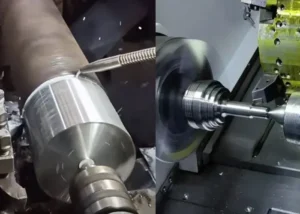
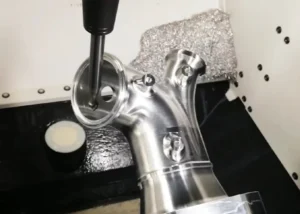
Milling cutters are typically multi-tooth tools. Because multiple teeth engage in the cutting process simultaneously, they have a long cutting edge and can operate at high cutting speeds, resulting in high productivity.
Different types of milling cutters can be used to machine flat surfaces, grooves, and steps, as well as the tooth profiles of gears, threads, and spline shafts, and various shaped surfaces.
Structure of a Milling Cutter
Taking an indexable milling cutter as an example:
Key Geometric Angles
A milling cutter has one principal rake angle and two front angles: one is called the axial rake angle, and the other is called the radial rake angle.
The radial rake angle γf and the axial rake angle γp: the radial rake angle γf primarily affects cutting power;
The axial rake angle γp affects chip formation and the direction of the axial force.
When γp is positive, the chip is ejected away from the machined surface.
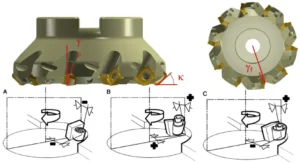
Front Angle (Contact Surface of the Front Cutting Edge).
Negative front angle: Used for steel, steel alloys, stainless steel, and cast iron.
Positive front angle: Used for ductile materials and certain high-temperature alloys.
Neutral front angle: Used for thread cutting, grooving, profiling, and form tools.
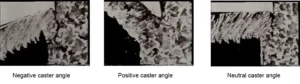
Use a negative dihedral angle whenever possible.
Milling Cutter Geometry
1. Rake Angle – Rake Angle
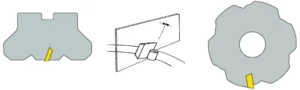
Cutting is smooth and chip evacuation is efficient, but the cutting edge strength is relatively poor.
It is suitable for machining soft materials, as well as stainless steel, heat-resistant steel, mild steel, and cast iron.
This type should be the preferred choice for low-power machine tools, systems with insufficient rigidity, and situations where built-up edge occurs.
Advantages:
Smooth cutting.
Smooth chip evacuation.
Good surface finish.
Disadvantages:
Cutting edge strength.
Not conducive to initial contact.
Workpiece detaches from the machine table.
2. Negative Angle – Negative Angle
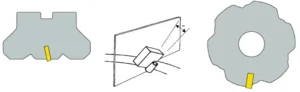
High impact resistance; features negative-rake inserts; suitable for rough milling of cast steel, cast iron, and high-hardness, high-strength steel.
However, it consumes a high amount of power during milling and requires excellent machine tool rigidity.
Advantages:
Cutting edge strength.
Productivity.
Pushes the workpiece toward the machine table.
Disadvantages:
Higher cutting forces.
Chip jamming.
3. Positive Angle – Negative Angle
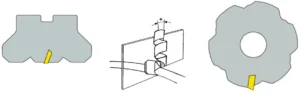
The cutting edge offers excellent impact resistance and is very sharp. It is suitable for machining steel, cast steel, and cast iron.
It also performs well in heavy-duty milling operations.
Advantages:
Smooth chip evacuation.
Favorable cutting forces.
Wide range of applications.
Milling Cutter Pitch
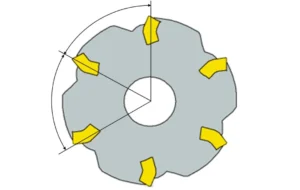

1) Close-pitch teeth: High feed rate, high cutting forces, and limited chip clearance.
2) Standard-pitch teeth: Conventional feed rate, cutting forces, and chip clearance.
3) Coarse-tooth: Low feed rate, low cutting forces, and large chip clearance.
If the milling cutter is not equipped with a dedicated finishing insert, the surface roughness depends on whether the feed per revolution exceeds the width of the insert’s finishing edge.
Examples: Slot Milling & Contour Milling
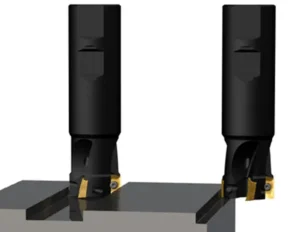
Number of teeth:
Coarse or standard teeth for slot milling (safety).
Fine teeth for profile milling (productivity).
Types and Applications of Milling Cutters
Based on tooth structure, milling cutters can be classified into straight-tooth and helical-tooth types.
Based on the relative position of the teeth to the cutter’s axis, they can be classified into cylindrical milling cutters, angle milling cutters, face milling cutters, and form milling cutters, among others.
They can be classified according to tooth geometry into straight-tooth milling cutters, helical-tooth milling cutters, angular-tooth milling cutters, and curved-tooth milling cutters.
Based on tool structure, they can be classified into solid-body milling cutters, modular milling cutters, grouped or set milling cutters, insert-type milling cutters, mechanically clamped welded milling cutters, and indexable milling cutters.
However, they are typically classified based on the form of the cutting edge back.
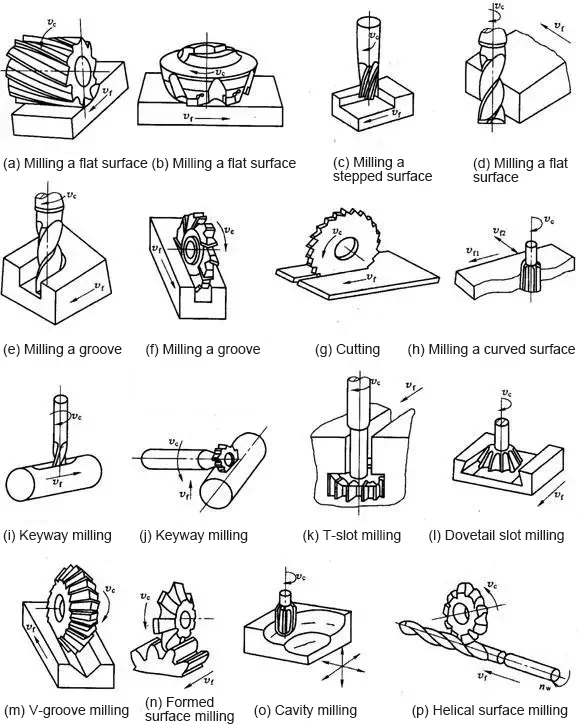
Classification of Toothed Milling Cutters
1. Face Milling Cutters
These include solid face milling cutters, indexable-tooth face milling cutters, and machine-mounted indexable face milling cutters.
They are used for roughing, semi-finishing, and finishing various flat surfaces and stepped surfaces.
2. End mills
Used for milling stepped surfaces, side surfaces, grooves, various types of holes in workpieces, and internal and external curved surfaces.
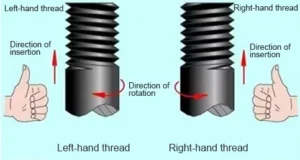
End mills can be broadly categorized into two types: left-hand and right-hand.
Many people still lack a clear understanding of the difference between left-hand and right-hand end mills.
1) Right-Hand Milling Cutter
First, you can determine whether a cutting tool is left-hand or right-hand using the following method.
When facing a vertically positioned milling cutter, if the flute rises from the lower left to the upper right, it is right-hand; if the flute rises from the lower right to the upper left, it is left-hand.
For right-hand cutting, you can also use the right-hand rule: the four curved fingers indicate the direction of rotation, and the raised thumb indicates the direction of climb—this is right-hand cutting.
The helical flute serves to carry away chips and also forms part of the milling cutter’s rake angle and face.
2) Left-Hand Milling Cutters
Left-hand milling cutters are typically selected for applications requiring high-precision machining.
They are commonly used for finishing operations on mobile phone buttons, membrane switch panels, LCD panels, acrylic lenses, and similar components.
However, for applications with particularly stringent requirements—especially in the manufacturing and machining of mobile phone keys or electronic device panels, where both high precision and a high surface finish are essential—it is necessary to select a left-hand, down-cut milling cutter.
This prevents issues such as white edges on the cutting edge and chipping at the workpiece’s cut edges.
3. Keyway Cutters
Used for milling keyways and similar features.
4. Groove Cutters and Saw-tooth Cutters
Used for milling various grooves, side surfaces, stepped surfaces, and for sawing.
5. Special-purpose Slot Milling Cutters
Used for milling various special slot shapes, including shaped slot milling cutters, half-moon keyway milling cutters, and dovetail slot milling cutters.
6. Angle Milling Cutters
Used for milling straight slots, helical slots, and other features on cutting tools.
7. Die and Mold Milling Cutters
Used for milling convex and concave forming surfaces on various dies and molds.
8. Grouped Milling Cutters
A set of milling cutters combined into a group, used for milling complex forming surfaces, surfaces on different parts of large components, and wide flat surfaces.
9. Back-tooth Milling Cutters
For milling operations that require the original cross-section to be maintained after regrinding the front face, the rear face is designed with a back-tooth configuration.
This category includes disc-groove milling cutters, convex semicircular milling cutters, concave semicircular milling cutters, double-angle milling cutters, and form milling cutters.
Down-Milling and Up-Milling
Face Milling and Climb Milling
There are two methods based on the feed direction relative to the workpiece and the rotation direction of the milling cutter on the milling machine:
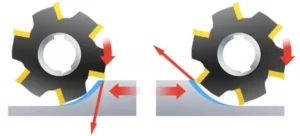
The first type is face milling, in which the direction of the cutter’s rotation is the same as the direction of the feed.
The cutter engages the workpiece immediately upon starting the cut and removes the final chip.
The second type is up-milling, in which the direction of the cutter’s rotation is opposite to the direction of the feed.
Before cutting begins, the cutter must slide a short distance across the workpiece, starting with a cutting depth of zero and reaching its maximum cutting depth by the end of the cut.
Cutting Force Direction and Milling Performance
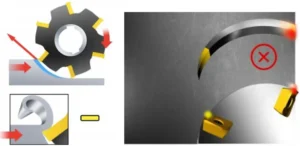
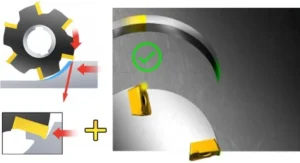
When using three-flute end mills or certain types of vertical or face milling, the cutting forces act in different directions.
During face milling, the end mill is positioned directly on the outer surface of the workpiece, so special attention must be paid to the direction of the cutting forces.
In conventional milling, the cutting forces press the workpiece toward the table;
In up-milling, the cutting forces push the workpiece away from the table.
Since down-milling produces the best cutting results, it is generally the preferred method.
Up-milling should only be considered when the machine tool has thread clearance issues or when problems cannot be resolved by down-milling.
Ideally, the cutter diameter should be larger than the workpiece width, and the cutter’s axis should always be slightly offset from the workpiece’s centerline.
When the tool is positioned directly over the cutting center, burrs are highly likely to form.
Cutter Positioning and Its Effect on Cutting Stability
As the cutting edge enters and exits the cut, the direction of the radial cutting force constantly changes, which can cause the machine spindle to vibrate and become damaged;
The insert may fracture, resulting in a very rough machined surface.
If the milling cutter is slightly offset from the center, the direction of the cutting force will no longer fluctuate—the milling cutter will acquire a preload.
We can compare center milling to driving in the center of the road.
Every time the milling cutter’s insert enters the cut, the cutting edge is subjected to an impact load, the magnitude of which depends on the chip cross-section, workpiece material, and type of cut.
Whether the cutting edge engages correctly with the workpiece during entry and exit is a critical factor.
Insert Entry and Exit Conditions
When the milling cutter’s axis is positioned entirely outside the width of the workpiece, the impact force during entry is borne by the outermost tip of the insert.
This means the initial impact load is absorbed by the most vulnerable part of the tool.
The cutter also exits the workpiece via the tip; in other words, from the start of the cut until the tool leaves the workpiece, the cutting force acts continuously on the outermost tip until the impact load is relieved.
When the milling cutter’s centerline is exactly aligned with the workpiece edge, the insert disengages from the cut when the chip thickness reaches its maximum, resulting in peak impact loads during both entry and exit.
When the milling cutter’s centerline is positioned within the workpiece width, the initial impact load during entry is absorbed by the portion of the cutting edge farthest from the most sensitive tip, and the insert exits the cut more smoothly during withdrawal.
For each insert, the manner in which the cutting edge leaves the workpiece during exit is critical. Residual material near the exit point may slightly reduce the insert clearance.
When the chip breaks away from the workpiece, an instantaneous tensile force is generated along the insert’s rake face, often causing burrs on the workpiece.
This tensile force can compromise the safety of the cutting edge under hazardous conditions.
Conclusion
In milling operations, selecting the appropriate milling method, cutter position, and cutting parameters is essential for achieving stable machining performance, high surface quality, and extended tool life.
Down-milling is generally preferred because it provides better cutting conditions and superior machining results.
Proper cutter positioning, particularly maintaining a slight offset from the workpiece centerline, helps reduce vibration, minimize burr formation, and improve process stability.
In addition, controlling insert entry and exit conditions is critical for reducing impact loads, preventing premature tool wear, and protecting the cutting edge.
By understanding the relationship between cutting forces, tool geometry, and workpiece engagement, machinists can optimize milling efficiency while ensuring consistent part quality and reliable machining performance.