
With the continued development of the manufacturing industry, sectors such as aerospace, electronics, and automotive manufacturing are increasingly relying on micro-components.
The manufacturing precision of these micro-components serves as a critical foundation for ensuring the stable operation of related equipment.
Therefore, increasing requirements drive higher demands on their machining accuracy and quality.
CNC milling machines are essential equipment for micro-component machining;
Equipped with advanced machining processes, they serve as vital tools for ensuring the quality of micro-component machining.
To improve the machining quality of micro-parts, numerous researchers have proposed optimization schemes for CNC milling machine machining technology aimed at enhancing machining positioning accuracy.
However, during the optimization process, these methods suffer from delays in acquiring actual positional data during machining, resulting in the accumulation of errors and negatively impacting machining positioning accuracy.
To improve the machining positioning accuracy of CNC milling machines for micro-parts, this study extracts feature point information based on the specific conditions of micro-parts during the machining process on CNC milling machines.
The system constructs an error prediction model based on this information set.
The model’s prediction results guide the design and implementation of an error compensation strategy, which optimizes the machining technology for micro-parts on CNC milling machines.
Techniques for Improving Positioning Accuracy
Establishing a Set of Feature Point Information
The positioning accuracy of CNC milling for micro-components is closely related to mechanical structural accuracy and process parameter settings.
Construction of Point Cloud Model for Micro-Components
This study examines the structural features of micro-components to construct a point cloud model.
Based on their topological relationships, the system establishes a covariance matrix of neighboring points for the micro-components, as shown in the following formula.

Where:
- Cqi is the covariance matrix of the neighborhood points of a small part;
- qi is a data point in the point cloud model of the small part;
- i is the index of the data point;
- m is the total number of neighborhood points for that data point;
- j is the index of a neighborhood point;
- aj is the position of the neighborhood point;
- a is the mean of the neighborhood points for that data point;
- and T denotes the transpose.
Feature Extraction Based on Covariance Matrix
The covariance matrix of the neighborhood points of the small part captures the geometric variation patterns of the part’s surface.
This process derives curvature and edge feature information from the surface.
A feature point identification function follows, and the system designs it with the calculation formula as follows.

In the equation: δ(qi) represents the constructed set of feature points, φi represents the curvature feature reflected by the covariance matrix, and θ represents the curvature change threshold.
Tool Tip Displacement Modeling in CNC Milling System
Considering that open-loop systems do not inherently possess position feedback capabilities, this study, based on the structure of a CNC milling machine, constructed a displacement function for the tool tip in the vertical direction.
This function was used to evaluate the influence of various factors on positioning accuracy quantitatively. The calculation formula is as follows.

In the equation:
- z represents the vertical displacement of the tool tip;
- A represents the amplitude of vibration;
- f represents the vibration frequency;
- t represents the cutting time;
- and α represents the initial phase angle of the tool tip on the CNC milling machine.
A dataset of characteristic points for the CNC milling of small parts is constructed based on the above analysis.
This dataset provides a data foundation for subsequent error prediction.
Development of a Prediction Model
The set of feature point data for small parts machined on a CNC milling machine described above serves as the basis for calculating radial errors on different planes.
The calculation uses the following formula.

Where:
- βza is the angular error of the a-axis in the z-direction;
- ΔL is the distance between the two measurement planes;
- Δy1 and Δy2 represent the radial errors in the y-axis direction measured on different planes.
Using the same method, the system calculates the radial errors on different axes measured on different planes during the machining process of a CNC milling machine.
This calculation yields the fundamental formula for overall error measurement.
Overall Machining Error Modeling Based on Spatial Error Theory
Spatial error theory is introduced based on the set of feature points constructed in Section 1.1.
This theory guides the design of a formula for calculating the overall machining error of positional information during the machining process.

In the equation: Δe represents the overall machining error of the CNC milling machine, ΔP represents the tool position deviation, and ΔQ represents the positioning error in the machining of small parts.
Error Transfer Function for Systematic Error Propagation
The calculation results presented above and the relationship between system input and output errors guide the design of an error transfer function.
The function describes the propagation and accumulation of errors within the system.
The formula is as follows.

In the equation:
- Δg represents the cumulative total error of the CNC milling machine at any given position;
- J represents the rotational inertia of the CNC milling machine’s motor;
- τ represents the error transfer coefficient of the CNC milling machine;
- Δβ represents the cumulative total error accumulated during the machining process after accounting for the system’s dynamic characteristics and error transfer mechanisms.
- and k1 and k2 are the weights of Δe and Δβ, respectively.
Thus, a prediction model for machining errors in CNC milling machines has been established.
By utilizing this prediction model to forecast error data during the machining process of small parts, numerical references are provided for subsequent compensation efforts.
Implementation of an Error Compensation Strategy
Using the above model, the system calculates the machining errors of the CNC milling machine.
Threshold comparison determines whether error control is necessary, and the system generates error compensation commands accordingly.
Based on the issued error commands and the absolute value of the CNC milling machine’s operational error, the system calculates the control direction vector using the following formula.

Where: ef is the control direction vector of the CNC milling machine, (xn, yn) are the coordinates of the current feature point, and (xl, yl) are the coordinates of the reference feature point.
Based on the above process, the system determines the control direction vector of the CNC milling machine and outputs its attitude compensation values on the A-axis and B-axis to control the machine’s attitude.
Subsequently, the system moves the axial position of the cutter along a straight line to compensate for the new positional error caused by attitude error compensation.
The calculation formula is as follows.

In the equation:
- ΔX denotes the compensation value along the x-axis;
- ΔY denotes the compensation value along the y-axis;
- ΔZ denotes the compensation value along the z-axis.
- Δω denotes the rotation angle compensation value for the a-axis;
- and Δζ denotes the rotation angle compensation value for the b-axis;
- (xu, yu) represent the coordinates of the current feature point after attitude compensation;
- and zt represents the input coordinate component used in the compensation calculation.
Based on the obtained results, the system adjusts the tool tip position of the CNC milling machine.
This adjustment enables precise cutting of micro-parts and ensures accurate control over the CNC milling process of micro-parts.
Experimental Analysis
Experimental Setup
The experiment selected small aerospace components with complex microstructures as the machining targets and utilized the ROBODRILL α-D21LiB5 CNC milling machine as the test equipment.
The specific parameters are shown in Table 1.
表1
The experiment uses G-code as the programming language for CNC machining.
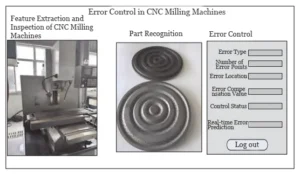
The technical solution designed in this paper optimizes the machining process of this CNC milling machine. The error control platform appears in Figure 1.
Error Compensation in CNC Milling of Micro-Parts
To verify whether the machining positioning accuracy of the CNC milling machine improves after optimization using the method described in this paper, experiments machine small aerospace parts using the CNC milling machine.
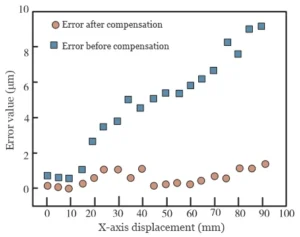
The study records the X-axis error values under uncompensated conditions. At the same time, the method described in this paper performs error compensation.
By comparing the error values on the X- and B-axes of the small aerospace parts before and after compensation, the effectiveness of the error compensation was verified.
The compensation results are shown in Figure 2.
After applying the error compensation method described in this paper, the absolute values of machining errors for the small aerospace parts were all within 2 μm.
Compared to the pre-compensation results, the error values were significantly reduced.
The results demonstrate the effectiveness of the method described in this paper.
The method compensates for predicted machining errors of the CNC milling machine.
This compensation effectively reduces deviations during the machining process of small parts and improves their machining positioning accuracy.
Analysis of Machining Positioning Accuracy Tests
One-sided test results are avoided by introducing comparison methods in this study.
The comparison methods include techniques that improve the efficiency and accuracy of planer and milling machine machining in mechanical processing, as well as techniques that improve the positioning accuracy of CNC milling machine processing of automotive parts.
These methods enhance the comparability of the test results.
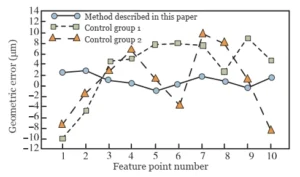
The study applies different methods to machine identical small aerospace parts and calculates the geometric errors between their feature points and the design drawings.
Through comparison, the optimization effects of the three methods were verified.
Figure 3 presents the geometric errors of feature points on machined parts obtained using different methods.
The method described in this paper optimizes the CNC milling machine, and it keeps the deviations of all feature points from the drawings within ±4 μm.
In contrast, the control group CNC milling machine shows significantly lower machining accuracy than the optimized CNC milling machine.
The results demonstrate that the proposed method effectively improves the machining positioning accuracy of CNC milling machines.
Conclusion
In this paper, a point cloud model serves as the basis for constructing a covariance matrix of neighboring points for micro-parts.
Combined with displacement functions, this formed a set of feature point information for the CNC milling of micro-parts.
A CNC milling machine error prediction model was designed based on the dataset to address radial and positional errors.
The model output guided attitude and positional compensation during the machining process, enabling high-precision CNC milling of micro-parts and improving machining positioning accuracy.
Environmental factors may still influence the error prediction process, which can cause inaccurate predictions and negatively affect subsequent machining accuracy.
Future research should focus on optimizing the error prediction model to further enhance the positioning accuracy of CNC milling machines.