
What is 5 axis CNC?
Introduction to 5-Axis CNC Machining
As industrial products become lighter, stronger, and geometrically more complex, traditional machining methods are increasingly stretched beyond their practical limits.
Five-axis CNC machining has emerged as a decisive advancement in subtractive manufacturing, enabling manufacturers to meet rising demands for accuracy, efficiency, and design freedom.
Unlike conventional three-axis machining, 5-axis CNC machining allows cutting tools to approach a workpiece from multiple orientations in a single setup, dramatically changing how complex components are produced.
At its core, 5-axis CNC machining is still subtractive manufacturing—material is removed from a solid block to form a finished part.
What differentiates it is the degree of motion control made possible by CNC automation, supported by tightly integrated CAD and CAM systems.
This combination allows digital designs to be translated directly into highly precise physical components with minimal manual intervention.
Industries such as aerospace, automotive, medical devices, mold and die, and precision engineering increasingly rely on 5-axis machining not as a luxury, but as a baseline capability for competitiveness.
What 5-Axis Machining Really Is
Five-axis machining refers to CNC-controlled motion along five independent axes, typically three linear axes and two rotational axes.
While two-axis and three-axis machines can only approach a part from limited directions, 5-axis machines can orient either the cutting tool, the workpiece, or both, to access virtually any surface.
This capability allows complex geometries to be machined in a single setup rather than requiring repeated repositioning.
From a production standpoint, this has measurable consequences. Fewer setups reduce cumulative positioning errors, improve surface continuity, and significantly shorten total machining time.
According to industry studies published by SME, multi-axis machining can reduce total cycle time by 30–60% for complex parts when compared with equivalent multi-setup 3-axis processes, while also improving dimensional consistency.
How 5-Axis CNC Machining Works
The process begins with a digital CAD model defining the geometry and tolerances of the part. CAM software then calculates toolpaths that determine how cutting tools move relative to the workpiece.
These toolpaths are converted into machine-specific G-code, which the CNC controller executes with high precision and repeatability.
What distinguishes 5-axis machining is the coordinated motion of the axes. The three linear axes—X, Y, and Z—control basic positioning, while the rotational axes allow either the tool or the workpiece to tilt and rotate dynamically.
This synchronized movement enables constant optimal tool orientation, reducing cutting forces and improving surface finish.
The exact axis configuration depends on machine design, but the principle remains the same: motion freedom directly translates into manufacturing capability.
What “5-Axis” Means in Real Production
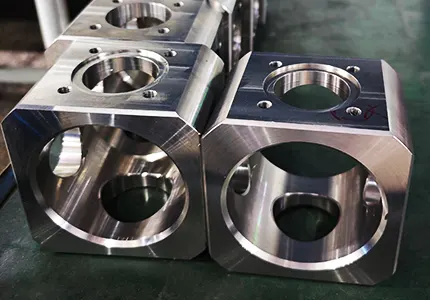
In practical terms, 5-axis machining allows manufacturers to machine five sides of a component in a single setup.
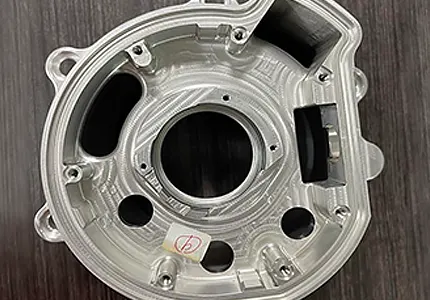
Features such as compound curves, deep cavities, undercuts, and sculpted surfaces can be produced without removing and re-clamping the part.
This not only accelerates production but also enables first-time-right manufacturing by eliminating cumulative setup errors.
From a quality perspective, this approach significantly improves surface integrity. Continuous tool engagement and consistent cutting angles reduce tool marks and vibration.
For high-value components such as turbine blades or medical implants, this directly translates into reduced post-processing and higher functional reliability.
Types of 5-Axis Machining in Industrial Use
In simultaneous 5-axis machining, all five axes move continuously during cutting.
This method is essential for parts with complex freeform surfaces, such as impellers, aerospace blades, and advanced mold surfaces.
The continuous motion ensures smooth transitions and superior surface finishes, but it requires advanced CAM software and skilled process planning.
By contrast, 3+2 machining—also known as indexed 5-axis machining—uses the rotational axes to position the part at a fixed angle, after which conventional 3-axis machining is performed.
While simpler to program, it still eliminates multiple setups and is highly effective for angled holes, multi-side features, and prismatic parts.
Machine Configurations and Their Impact
The two most common 5-axis machine configurations are trunnion-style and swivel-head (head-table) designs. Trunnion machines rotate the workpiece, making them efficient and compact for medium-sized components.
Swivel-head machines, on the other hand, rotate the cutting head while the table remains stationary, providing better support for heavier parts and improving accuracy under load.
Machine selection directly influences achievable accuracy, part size, and overall production efficiency.
Why Manufacturers Choose 5-Axis Machining
The primary motivation for adopting 5-axis machining is operational efficiency. By reducing setups, manufacturers lower labor costs, minimize human error, and shorten lead times.
Shorter and more rigid cutting tools can be used because the tool can approach the part from optimal angles, resulting in improved tool life and reduced vibration.
From a business perspective, the advantages compound over time. Although 5-axis machines require higher initial investment, studies from modern machine tool builders indicate that per-part costs can be reduced by 20–40% for complex components once setup reduction, scrap reduction, and faster cycle times are considered.
Comparative Capability Overview
| Machining Type | Typical Setups | Geometry Capability | Accuracy Consistency | Production Efficiency |
|---|---|---|---|---|
| 3-Axis CNC | 3–6 setups | Limited | Moderate | Low–Medium |
| 4-Axis CNC | 2–4 setups | Improved | Good | Medium |
| 5-Axis CNC | 1 setup | Very High | Excellent | High |
This comparison highlights why 5-axis machining has become essential for precision-driven industries rather than an optional upgrade.
Applications Across Industries
In aerospace manufacturing, 5-axis machining is indispensable for producing turbine blades, blisks, and structural components where aerodynamic efficiency and weight reduction are critical.
Automotive manufacturers rely on it for prototyping, high-performance engine components, and complex tooling.
In the medical sector, implants and surgical instruments demand organic geometries and tight tolerances that are impractical with traditional machining.
Energy, industrial equipment, and mold-making sectors similarly benefit from the ability to machine high-stress, complex components efficiently.
Materials and Machining Capability
Five-axis CNC machining is compatible with a wide range of materials, from aluminum and stainless steel to titanium, Inconel, advanced plastics, composites, and graphite.
The ability to maintain optimal cutting angles is particularly valuable when machining difficult materials, where heat control and tool wear are critical factors.
Challenges and Technical Considerations
Despite its advantages, 5-axis machining introduces technical challenges.
Programming complexity is higher, requiring advanced CAM software and deeper machining knowledge.
Collision risk increases with simultaneous axis motion, making simulation and verification essential. Skilled operators and engineers are critical to fully realizing the benefits of the technology.
Digital Workflow and CAM Integration
Modern CAM platforms, such as Autodesk Fusion for Manufacturing, play a central role in making 5-axis machining accessible and reliable.
Integrated CAD/CAM environments enable seamless transitions from design to machining, while digital twin simulation and collision detection significantly reduce risk.
Advanced toolpath strategies, automatic tool tilting, and adaptive roughing simplify what was once an expert-only process.
The Strategic Importance of 5-Axis Machining
As product life cycles shorten and customization increases, manufacturing flexibility becomes a strategic requirement.
Five-axis CNC machining supports this shift by enabling rapid iteration, reduced lead times, and higher design freedom.
What was once a competitive advantage is now increasingly a necessity for manufacturers operating in high-precision markets.
Looking Ahead: The Future of 5-Axis Machining
The future of 5-axis CNC machining lies in deeper automation and intelligence. AI-assisted CAM programming, digital twins, hybrid additive-subtractive machines, and lights-out manufacturing are already reshaping production environments.
Integrated platforms like Fusion are expected to play a central role in connecting design, machining, and factory automation into a unified digital ecosystem.
Conclusion and Business Value
Five-axis CNC machining delivers measurable business value through higher productivity, superior quality, reduced lead times, and lower total manufacturing costs.
By enabling complex geometries, tighter tolerances, and efficient production workflows, it empowers manufacturers to innovate faster and compete more effectively in demanding global markets.
Final Call to Action
For companies seeking precision, repeatability, and speed, 5-axis CNC machining is no longer optional.
Submitting CAD designs for professional 5-axis evaluation is often the first step toward achieving production-ready parts with confidence, from prototype to full-scale manufacturing.
References
- Society of Manufacturing Engineers (SME), Multi-Axis Machining Technology Overview, SME Publications.
- ISO 10791-6, Test Conditions for Machining Centres — Accuracy of 5-Axis Machines.
- Sandvik Coromant, White Paper: Benefits of 5-Axis Machining, 2023.
- Autodesk, Fusion Manufacturing Technical Documentation, Autodesk Inc.
- Okuma Corporation, 5-Axis Machining Performance and Productivity Studies.

how much does a 5 axis cnc machine cost?
The cost of a 5 axis CNC machine can vary depending on the brand, size, and features. On average, prices range from $100,000 to $500,000. ...
How to set up a 5 axis cnc machine?
How to operate a 5 axis cnc machine?
Learn how to operate a 5 axis CNC machine efficiently with our comprehensive guide. From setup to programming, our step-by-step instructions will help you master ...
what is positional 5 axis machining?
Discover what positional 5 axis machining is and how it can revolutionize your manufacturing process. This article delves into the details of this advanced technique, ...
what are the leading manufacturers of 5-axis cnc machines?
When looking for the leading manufacturers of 5-axis CNC machines, companies like Haas, Mazak, DMG Mori, Okuma, and Makino are among the top choices in ...
what is simultaneous 5-axis machining?
Simultaneous 5-axis machining is a cutting-edge technology used in manufacturing to produce intricate parts with complex geometries. This process allows the cutting tool to move ...