Thanks to their lightweight, high-strength, and corrosion-resistant properties, titanium alloy slingshots have long been a popular category among outdoor accessories.
However, the high hardness and high viscosity of TC4 titanium alloy, combined with the slingshot frame’s complex structure—featuring multiple curved surfaces, numerous corners, and deep, irregularly shaped holes—have long made polishing a major challenge for manufacturers.
In the past, reliance on manual polishing not only kept labor costs high but also made it difficult to achieve a uniform finish across products.
Issues such as dents, scratches, and hard-to-reach corners have consistently hindered the high-quality, mass production of slingshot components.
A combined process of wet grinding and dry polishing offers a brand-new solution for polishing titanium alloy slingshots.
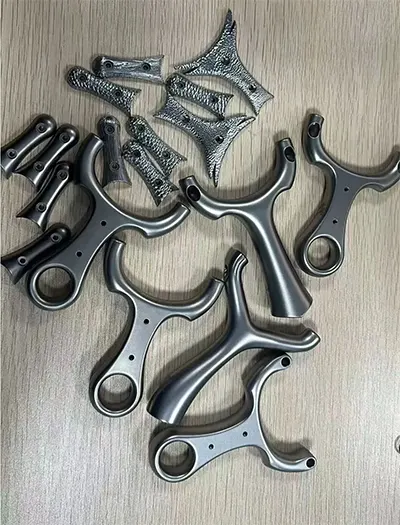
Before Polishing: The Real-World Challenges of CNC-Machined Blanks
After CNC machining, the titanium alloy slingshot frame has taken shape, but the workpiece surface retains numerous machining marks and sharp burrs.
Complex areas such as the curved handle, the bend at the bow tip, and the inner bore of the finger ring are difficult to reach with ordinary abrasives.
Under traditional manual polishing methods, workers must polish each piece’s edges and corners and treat curved surfaces one by one:
1. Uneven pressure applied by hand to irregular curved surfaces results in inconsistent brightness across each workpiece, leading to noticeable color variations between batches;
2. Titanium alloy is extremely prone to new scratches; the slightest carelessness can render a workpiece scrap;
3. It is difficult to thoroughly clean internal bores and hard-to-reach corners through manual polishing;
4. Labor costs continue to rise, production capacity cannot keep up with large-volume orders, and delivery cycles are difficult to control.
Many factories face a dilemma: to achieve a high-quality mirror finish, they must invest in a large number of skilled workers;
Yet, when prioritizing production capacity, the appearance quality of the finished products suffers significantly.
After Polishing: Wet Grinding + Dry Polishing to Achieve an Overall 8K Mirror Finish
After undergoing the complete process of wet grinding for pre-polishing followed by compartmentalized dry polishing for precision finishing, the slingshot workpiece undergoes a qualitative transformation.
The wet grinding process is performed first to efficiently remove coarse tool marks and sharp burrs left by CNC machining, leveling the entire base surface of the workpiece and eliminating surface irregularities;
The workpieces are then transferred to the compartmentalized dry polishing equipment, where each piece is placed in its own separate compartment, completely isolated from the others, thereby eliminating the risk of collisions, knocks, and scratches at the source.
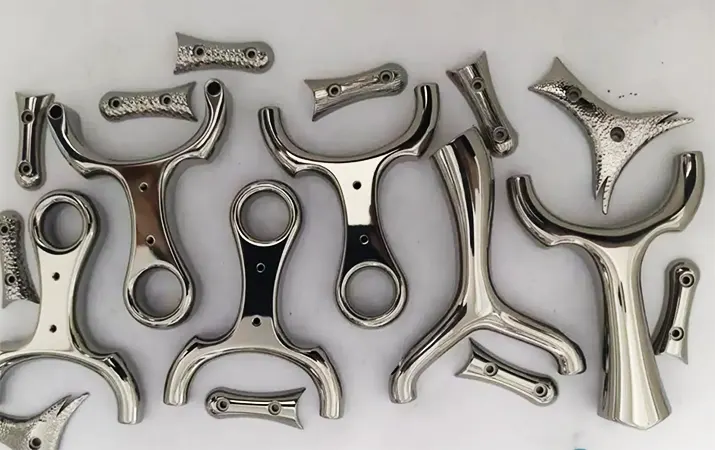
After dry precision polishing:
The outer contours of the bow frame, complex curved surfaces, the angle of the bow tip, and the inner bore of the finger ring are all polished to a high gloss with no blind spots;
The entire piece achieves a fine 8K mirror finish with uniform and translucent luster;
There are no tool marks or burrs, and the edges and corners of the workpiece feature smooth transitions;
The batch exhibits high consistency, with each finished product having a stable and uniform appearance.
Once polished, these titanium alloy slingshots can either be shipped directly as finished products or used immediately in subsequent surface treatment processes, such as electroplating, providing an excellent foundation for downstream processes.
Core Process Advantages: Solving the Challenges of Titanium Alloy Polishing
Compartmentalized Design to Reduce Scrap Rates
Unlike conventional drum polishing, where workpieces mix and collide with one another, the compartmentalized structure isolates each workpiece.
For complex-shaped workpieces with prominent edges and corners—such as slingshots—this design effectively prevents dents and surface scratches caused by collisions, significantly reducing scrap rates.
Combined Wet-and-Dry Process: Balancing Efficiency and High Gloss
The process begins with wet grinding for coarse polishing and leveling, followed by dry polishing to achieve a mirror-like finish.
This approach overcomes the limitations of single-process methods: wet grinding efficiently removes deep scratches, while dry polishing delivers superior mirror-like results.
The combination of both ensures both high production capacity and excellent finished product aesthetics.
Simultaneous Processing of Complex, Irregular Workpieces and Hard-to-Reach Areas
Slingshot frames feature numerous irregular curved surfaces, bent arcs, and annular inner holes.
The equipment’s grinding media can fully conform to every contour of the workpiece, allowing the machine to simultaneously polish hidden areas that are difficult to reach by hand.
Mass Production: Reduced Costs and Increased Efficiency
This process eliminates the heavy reliance on skilled polishers.
The equipment processes multiple workpieces at once, ensuring standardized finished results.
While increasing production capacity, it reduces labor costs, enabling stable delivery even for large-volume orders.
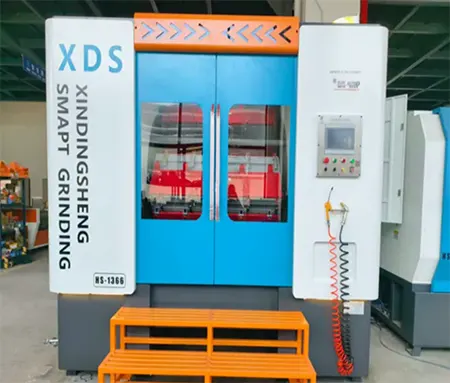
More Than Just Slingshots: Widely Applicable to Titanium Alloy Hardware Components
This combined dry-wet finishing and polishing process applies to slingshot components.
It is also suitable for a wide range of irregularly shaped titanium alloy and stainless steel parts.
Common application scenarios cover watch cases, eyeglass frames, fishing lures, and precision-cast hardware.
It addresses production needs for deburring, surface leveling, matte finishing, and mirror polishing on complex curved components.
In the era of hardware manufacturing, a quality product is not defined solely by its material and structure; surface finishing is a direct reflection of the product’s value.
Conclusion
In summary, conventional manual polishing can hardly resolve the polishing bottlenecks of complex-shaped TC4 titanium alloy slingshots and restricts stable mass production.
The integrated wet grinding and compartmentalized dry polishing process provides a viable solution.
The compartmentalized layout avoids workpiece collision and lowers scrap rates;
The matching of rough wet grinding and precision dry polishing balances processing efficiency and outstanding 8K mirror surface quality; grinding media can access complex curved surfaces and internal blind zones that manual polishing struggles to handle.
Meanwhile, this technology cuts dependence on experienced workers, controls production costs and guarantees consistent appearance across batches.
Beyond titanium alloy slingshots, this composite polishing method can be extended to watch cases, spectacle frames, fishing lures and other special-shaped precision hardware.
It proves that advanced surface finishing technology serves as a vital support for enhancing product added value, helping hardware manufacturers achieve stable, high-quality and cost-effective mass production of complex metal components.