Anyone who works with sheet metal enclosures knows that how the four corners are divided and joined directly determines the amount of welding required, the appearance quality, and assembly efficiency.
A seemingly insignificant difference of just a few millimeters can force a welder to spend an extra half hour grinding, or it can make the entire enclosure look “clunky” rather than refined.
Today, using three 3D breakdown diagrams, one detailed close-up, and one on-site workshop photo, we’ll thoroughly explain the three most common methods for joining corners, helping you quickly determine which structure to use.
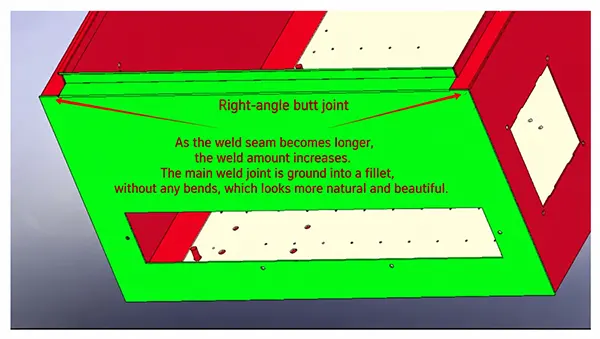
Option 1: Right-Angle Butt Joint—The Most Direct Approach, but Requires the Most Welding
The right-angle butt joint is the most “intuitive” method: cut two adjacent sheets directly at a 90° angle, stand them upright to butt them together, and then spot-weld and full-penetration weld them.
From a 3D modeling perspective, the corner structure is simple, the cutting path is the shortest, and it’s the easiest for designers to draw.
However, the drawbacks are also obvious:
Longer welds: The two panels form a continuous vertical weld at the corner, resulting in increased welding volume;
Rounded corners require grinding: To achieve smooth, rounded corners on the enclosure’s exterior, post-welding grinding is necessary—a labor-intensive process that is prone to uneven results;
Lack of natural bend appearance: Since it does not utilize the natural arc transitions inherent in sheet metal bending, the visual appearance tends to be somewhat rigid.
Therefore, right-angle butt joints are more suitable for internal structural components, applications with minimal aesthetic requirements, or situations where the welds will be subsequently covered by powder coating or spray painting.
Option 2: Beveled Joints—Fewer Welds, but Sharp Corners and Misalignment Pose Risks
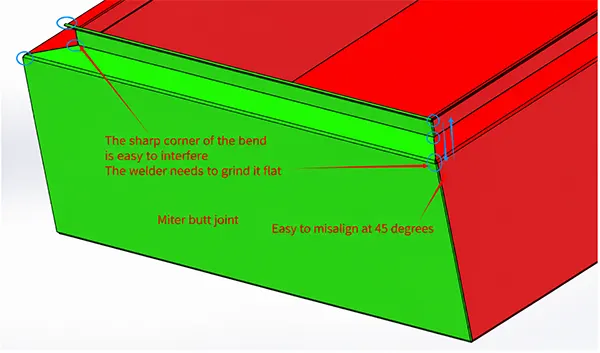
To reduce the length of the welds, many people cut two panels at a 45° bevel and join them, turning the welds from “vertical lines” into “diagonal lines.”
In theory, mitered joints do indeed shorten the weld and reduce the amount of filler metal needed, and the enclosure as a whole appears neater.
However, two problems often arise during on-site construction:
Sharp corners from bending tend to get stuck: After a sheet is bent, a sharp corner forms at the end of the bend.
When mitering the joints, this sharp corner easily comes into contact with the opposite panel surface, preventing the pieces from fitting together;
Misalignment at 45° is common: When joining beveled surfaces, there is no reliable “stop” or locating surface, so even a slight push can cause misalignment, requiring the welder to make repeated adjustments;
Welders still need to grind the joints: After joining, the sharp corners must still be ground smooth;
Otherwise, it will affect subsequent assembly and the final appearance.
Therefore, although beveled joints may look “sophisticated,” without positioning aids, their on-site workability is not ideal, and the rework rate is often quite high.
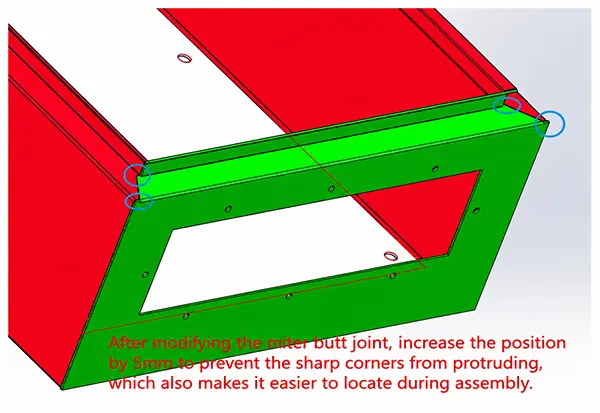
Option 3: Modified Beveled Joint—5mm Offset for Reduced Welding and Improved Alignment
Is there a way to retain the advantage of “short welds” in beveled joints while avoiding issues such as sharp corners jamming or misalignment?
The answer is to add an offset step of approximately 5mm to the beveled joint.
The modified structure works as follows:
A short flat section (typically around 5 mm) is left at the end of the bent edge to form a “step”;
During beveled joint assembly, this step first aligns with the plane of the adjacent sheet, serving as a positioning guide;
The sharp corner created by the bend is “diverted” to the outer side of the step, so it no longer abuts the mating sheet;
The weld length remains shorter than that of a right-angle joint, keeping the amount of welding manageable;
During assembly, there is no longer a need for repeated alignment checks; workers can position the parts accurately as soon as they are placed, significantly improving efficiency.
This method combines the dual objectives of “reducing weld length” and “ease of assembly,” making it one of the structures that has received the best feedback from the field.
Close-Up Details and Workshop Validation
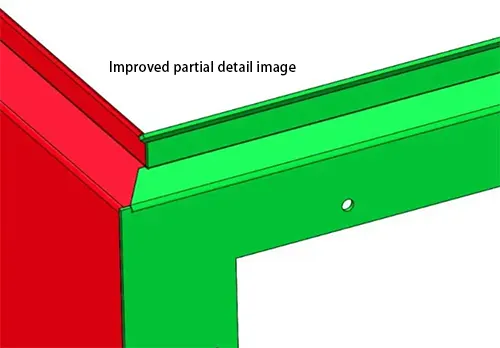
By zooming in on the modified section, we can better understand the function of this 5mm step: it acts as a “hidden rebate” between the two panels.
The stepped surface on one side fits flush against the main surface of the other panel, naturally creating a beveled joint and completely avoiding sharp corners.
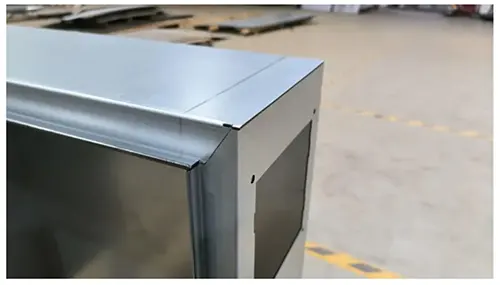
The image below shows the actual result produced in the workshop:
The edges and corners are straight, the transitions are smooth, the welds are short and concentrated on the beveled surfaces, and after powder coating, the seams are virtually invisible.
From the 3D design to the finished product, the feasibility of the improved beveled joint has been validated.
Summary: How to Choose Among the Three Methods?
If appearance and cost requirements are not high: Right-angle butt joints are the fastest, but require the most welding and grinding;
If you want to minimize welds but have average assembly precision:
Beveled butt joints are feasible, but proper positioning fixtures are essential; otherwise, the rework rate will be high;
If you’re looking to minimize welding, ensure good assembly, and achieve a refined appearance:
Modified beveled butt joints (with a 5mm clearance) are currently the most balanced solution.
Final Reminder: 5 mm is an empirical value; the specific measurement should be adjusted based on sheet thickness, bend radius, and enclosure dimensions.
The thicker the sheet and the larger the bend radius, the larger the offset can be; conversely, it can be slightly smaller.
We recommend first testing a few pieces using scrap material to confirm the fit before cutting the full batch, to avoid having to rework the entire batch.
A small detail like this corner split holds a wealth of wisdom in sheet metal fabrication—it saves material, labor, and sanding time.
Apply this improved approach to your next project, and I’m sure both the welders and quality control will thank you.