
In the field of materials science and engineering, 45 steel is widely used in the manufacture of shaft components, and improving its performance has always been a key focus of industrial R&D.
Background of 45 Steel in Shaft Component Manufacturing
With continuous advancements in industrial technology, higher demands are being placed on the strength and wear resistance of shaft components.
High-frequency quenching is an important surface hardening method that can effectively increase the surface hardness and wear resistance of 45 steel shaft components, thereby extending their service life.
However, the high-frequency quenching process is often accompanied by issues such as uneven distribution of the hardened layer and deformation, which directly affect the final performance and application effectiveness of the parts.
Problems in Hardened Layer Distribution and Deformation
Uneven distribution of the hardened layer leads to significant variations in surface hardness, thereby weakening the part’s wear resistance and fatigue resistance;
Deformation defects reduce dimensional accuracy, and in severe cases, can make assembly difficult or even render the part unusable.
Therefore, a systematic investigation into the distribution patterns of the hardened layer and the deformation control mechanisms during high-frequency quenching of 45 steel shaft components is of great significance for enhancing component service performance and ensuring product quality.
Significance of Process Optimization
By optimizing high-frequency quenching process parameters, engineers can achieve a uniform distribution of the hardened layer.
They can also effectively control deformation during the process. This optimization provides scientific theoretical guidance for actual production.
It offers technical support for industrial manufacturing practice. These improvements promote further development in materials science and engineering.
Distribution of the Hardened Layer
Mechanism of Hardened Layer Formation
During the high-frequency quenching process, the outer layer of 45 steel shaft components can be heated to temperatures above the austenitizing range in a short period of time, primarily due to the highly efficient energy transfer of high-frequency induction heating.
Austenite is a high-temperature stable phase that forms rapidly during rapid heating. Under the influence of rapid cooling, it undergoes a phase transformation into martensite, ultimately forming a densely structured hardened layer on the part’s surface.
The primary microstructure of this hardened layer is martensite, which possesses high hardness and excellent wear resistance.
The evolution of the material’s microstructure and structure during this rapid heat treatment process is a decisive factor in the depth and uniformity of the hardened layer, directly affecting the part’s final mechanical performance.
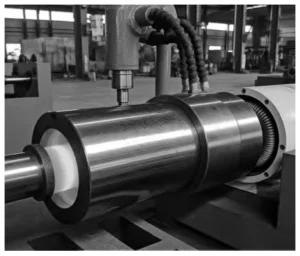
The high-frequency quenching process is illustrated in Figure 1. Precise control of parameters such as heating rate, holding time, and cooling rate during this process has a critical impact on the formation of the hardened layer.
The heating rate must be maintained at a relatively high level to ensure uniform austenitization and effective diffusion; however, the holding time must be carefully controlled to prevent grain coarsening caused by excessively high temperatures.
The cooling rate must be sufficiently fast to promote the martensitic phase transformation and ensure that the resulting hardened layer meets design specifications in terms of both depth and hardness distribution.
Factors Affecting the Distribution of the Hardened Layer
The distribution characteristics of the hardened layer are influenced by a combination of factors, with quenching temperature playing a decisive role.
When the quenching temperature exceeds the appropriate range, austenite grains may become excessively coarse, thereby weakening the grain refinement effect of the hardened layer;
Conversely, if the temperature is set too low, the material cannot be fully austenitized, ultimately resulting in the hardened layer depth falling short of expectations.
› Influence of Cooling Medium
The selection of the cooling medium is of utmost importance.
Different cooling media vary in cooling efficiency and thermal conductivity, and these differences directly affect the cooling rate of the hardened layer as well as the extent to which the martensitic transformation is completed.
› Effect of Heating Duration
Heating duration also has a certain influence on the distribution of the hardened layer.
If heating continues for too long, the internal temperature of the workpiece is likely to exceed the reasonable range, resulting in an abnormally large heat-affected zone and potentially degrading the material’s mechanical properties.
Conversely, insufficient heating time makes it difficult to achieve a complete austenitic transformation, thereby affecting the normal formation of the hardened layer.
It is therefore clear that precise control of heating duration is critical to achieving the desired hardened layer distribution.
› Role of Induction Coil and Material Structure
Additionally, the shape and positional accuracy of the induction coil significantly affect the distribution of the hardened layer.
Uneven gaps between the coil and the workpiece can cause variations in local heating intensity, resulting in deviations in the thickness of the hardened layer.
If the coil design does not conform to the curved surface features of shaft-type parts, it is likely to cause inconsistencies in the depth of the hardened layer between the ends and the center.
At the same time, the original microstructural state of the workpiece, such as the interlamellar spacing and distribution uniformity of pearlite, affects the austenitization process, thereby altering the microstructural continuity of the hardened layer.
Deformation Control in High-Frequency Quenching
Analysis of Deformation Mechanisms
In the high-frequency quenching process of 45 steel shaft components, the deformation mechanisms are diverse.
The core cause lies in the non-uniform distribution of the internal stress field within the material, and differences in the material’s thermal expansion behavior are one of the key factors leading to workpiece deformation.
The rapid heating and cooling characteristics of the high-frequency quenching process create significant temperature differences in different regions of the component, and the inconsistency in the degree of thermal expansion and contraction across various sections directly induces thermal stress.
Simultaneously, the influence of internal stresses generated by microstructural phase transformations is equally significant. When austenite transforms into martensite, the material undergoes significant volumetric expansion;
This volumetric effect is particularly pronounced under the rapid phase transformation conditions of high-frequency quenching, further exacerbating the non-uniformity of internal stress distribution within the workpiece, ultimately leading to macroscopic deformations such as bending and twisting.
An in-depth analysis of this deformation mechanism serves as the theoretical basis for formulating effective deformation control strategies.
Furthermore, there is a close correlation between the evolution of the material’s microstructure and its macroscopic deformation characteristics during high-frequency quenching.
Microstructural factors such as the spatial distribution of carbides, grain size, and morphological features all significantly influence the material’s thermomechanical properties and deformation behavior.
Therefore, by rationally optimizing pre-processing techniques prior to heat treatment—such as employing pre-treatment methods like normalizing or annealing to improve the material’s initial microstructure—an effective technical approach can be provided for controlling the deformation of components after high-frequency quenching.
A Study on Factors Affecting Deformation
The degree of deformation in high-frequency quenched 45 steel shaft components is regulated by the synergistic interaction of multiple factors, with material properties serving as the core intrinsic factor.
As a typical medium-carbon steel, 45 steel possesses excellent hardenability and comprehensive mechanical properties;
However, its carbon content makes it more susceptible to significant internal stresses during high-frequency quenching due to phase transformations and differences in thermal expansion and contraction, which in turn induce macroscopic deformation.
› Influence of Heating and Cooling Conditions
The heating method is another critical process factor; precise control of the heating rate and accurate matching of the heating zone during induction heating are crucial steps in reducing the risk of deformation.
The impact of cooling rate on deformation is particularly pronounced. An excessively fast cooling rate promotes complete martensitic transformation and ensures hardening effectiveness.
It also significantly increases residual stress levels. This condition exacerbates the tendency for deformation.
Conversely, an excessively slow cooling rate reduces the risk of deformation and cracking by mitigating thermal and phase-transition stresses.
It may also result in incomplete martensitic transformation. This condition weakens the material’s strengthening effect and makes it difficult to meet hardness requirements.
Therefore, process design must involve the appropriate selection of cooling media and methods to achieve a synergistic balance between hardening effectiveness and deformation control.
› Effect of Part Geometry and Residual Stress
Part geometry is an external factor that cannot be overlooked.
For shaft-type parts, the higher the length-to-diameter ratio, the greater the risk of bending deformation during quenching due to differences in the distribution of axial and radial thermal stresses;
Stress concentrations are prone to form at the abrupt changes in cross-section of stepped shafts, leading to exacerbated local deformation.
Furthermore, if residual stresses generated during machining and other pre-processing steps are not fully eliminated through annealing, aging, or similar processes prior to high-frequency quenching, these stresses will combine with the thermal and phase-transition stresses generated during quenching.
This not only increases the total amount of deformation but also makes the deformation behavior more difficult to predict, further complicating deformation control.
Development and Implementation of Deformation Control Strategies
During the high-frequency quenching process of 45 steel shaft components, workpieces often experience deformation; therefore, it is essential to establish a scientific and reasonable control plan.
First, precise control of the heating and cooling processes is a prerequisite for effective deformation management.
This can be achieved by improving the structure of the induction heating coils and adjusting power parameters, as well as by introducing a high-precision temperature control system, which allows for effective regulation of the heating rate and temperature range.
Material properties and application requirements must be comprehensively considered to select appropriate cooling media and processes, ensuring a balance between surface hardening effectiveness and deformation control.
The proper selection of tooling, fixtures, and support devices plays a critical role in suppressing deformation.
The optimized design of fixture structures must fully account for the workpiece’s geometric shape, dimensional parameters, as well as the effects of thermal stress evolution and microstructural phase transformations during the high-frequency quenching process.
Optimizing fixture layout and precisely controlling clamping force can minimize potential part deformation and maintain the stability of the workpiece’s geometry and dimensions.
Pre-deformation processes serve as an effective means of controlling deformation.
By pre-setting specific deformation parameters for the workpiece, potential deformation during the high-frequency quenching stage can be compensated for, ensuring that the final geometry and dimensional tolerances of the workpiece meet specifications.
Optimization of the High-Frequency Quenching Process for 45 Steel Shaft Components
Optimization of Process Parameters
When improving the high-frequency quenching process for 45 steel shaft components, it is essential to first define the optimization objectives and the fundamental principles to be followed.
This process requires precise control of the hardened layer depth, hardness distribution, and deformation to comprehensively enhance the overall performance of the workpiece.
› Strategy for Process Parameter Optimization
The strategy for optimizing process parameters primarily involves the organic integration of experimental data and theoretical analysis.
Through experimental methods, comprehensive measured data on the distribution characteristics of the hardened layer and associated deformation under various process parameter conditions are obtained, serving as empirical evidence for subsequent theoretical research.
Theoretical analysis relies primarily on relevant theories in materials science and heat treatment to deeply investigate the mechanisms by which process parameters influence the distribution of the hardened layer and deformation characteristics.
Based on this, mathematical models are constructed or simulation software is employed to further predict and optimize process parameters.
› Optimization Process Stages
The optimization process comprises three stages: preliminary screening, fine-tuning, and validation.
During the preliminary screening stage, a reasonable range of process parameters is initially determined based on practical experience and theoretical knowledge.
In the fine-tuning stage, optimal parameter configurations are gradually identified through repeated experiments and in-depth data analysis.
The validation stage focuses on systematically testing the optimization results to confirm their applicability and stable performance in actual manufacturing environments.
› Experimental Design and Simulation Methods
During the preliminary screening stage, orthogonal experimental design can be used to determine the influence weights of key parameters, such as the interaction between quenching temperature and heating time on the hardened layer depth.
During fine-tuning, response surface analysis is introduced to construct mathematical correlation models between parameters and performance indicators, enabling multi-objective optimization.
Concurrently, by integrating material thermal properties and utilizing finite element simulation, the effects of process parameters on the hardened layer and deformation can be predicted in advance, thereby reducing the uncertainty associated with experimentation.
Evaluation and Verification of Process Optimization Results
Evaluating the effectiveness of process optimization is a critical step in ensuring the quality of improvement outcomes.
This evaluation encompasses multiple aspects, including the distribution of the hardened layer, the effectiveness of deformation control, and the overall performance of components.
The evaluation of hardened layer distribution typically relies on methods such as microhardness testing and metallographic examination to quantitatively characterize key parameters, including the depth of the hardened layer and trends in hardness.
The effectiveness of deformation control is primarily assessed by measuring parameters such as the degree of variation in part geometric dimensions and form errors, and then using these parameters to determine whether the deformation control measures adopted have been effective.
Furthermore, comprehensive indicators such as the component’s mechanical properties and durability must be analyzed collectively to systematically evaluate the true effectiveness of process improvements.
The verification phase employs comparative analysis to systematically compare the performance metrics of components before and after process optimization, followed by statistical tools to assess the significance of data differences.
This ensures the impartiality and accuracy of evaluation conclusions.
Through a systematic evaluation and verification process, it is ensured that the optimized process parameters meet the established objectives when implemented.
Application of the Optimized Process
Implementing the optimized high-frequency quenching technology into actual manufacturing processes is the key to realizing its practical value.
During the implementation phase, real-time monitoring of production line operations is required.
Process parameters must be dynamically adjusted based on technical requirements, such as the hardening depth and hardness of each batch of workpieces, to ensure process adaptability.
Concurrently, a rigorous end-to-end quality management system must be established.
Through sampling inspections of each batch of components, the stability and consistency of product quality are ensured.
Establishing a feedback mechanism is equally critical.
By systematically collecting process data from the production site, customer usage feedback, and long-term performance tracking results of the workpieces, empirical evidence for process optimization can be generated, providing data support for parameter iteration.
Furthermore, it is necessary to continuously track technological frontiers and industrial innovation trends in the field of high-frequency quenching, promptly incorporating emerging technologies and advancements in materials science to drive the continuous upgrading of the process system.
The improved high-frequency induction hardening technology not only significantly enhances the surface hardness and wear resistance of 45 steel shaft components but also effectively controls workpiece deformation, thereby achieving a dual improvement in product quality and manufacturing efficiency.
The research presented in this article has not only brought significant economic benefits to the enterprise but also provided valuable technical insights and engineering practice references for the improvement of high-frequency hardening processes for similar metal shaft components.
Conclusion
In summary, this paper focuses on the high-frequency quenching process for 45 steel shaft components, with particular emphasis on analyzing the evolution of the hardened layer morphology and the mechanisms of strain control.
Based on a systematic analysis of the hardened layer formation mechanism, the core factors determining its distribution characteristics and deformation behavior have been identified.
The study found that precisely adjusting key process parameters—such as quenching temperature, heating duration, and cooling medium—in conjunction with effective deformation control measures can significantly improve the uniformity of the hardened layer in 45 steel shaft components while limiting deformation to an acceptable range.
The optimized high-frequency quenching process not only enhances the surface hardness and wear resistance of the parts but also effectively ensures their dimensional accuracy and shape stability.