
Against the backdrop of rapid technological advancements, the aerospace manufacturing industry has imposed increasingly stringent technical requirements on material performance metrics.
Introduction
Due to their low density, high strength, and excellent ductility, aluminum alloys have become a critical and indispensable material in the aerospace sector.
Aluminum alloys are prone to corrosion in natural environments. This corrosion severely impacts their service life and safety.
It also affects the structural strength, service life, and maintenance costs of aircraft.
The Role of Sulfuric Acid Anodizing in Improving Material Performance
Sulfuric acid anodizing of aluminum alloys is an electrochemical process that forms a dense oxide film on the surface of the alloy, thereby enhancing the material’s corrosion resistance and hardness.
Environmental and Health Concerns with Traditional Processes
The traditional sulfuric acid anodizing process generates large amounts of waste liquid, exhaust gases, and residues.
These by-products contain heavy metal ions and harmful chemicals. They pose serious threats to the environment and the health of operators.
Particularly against the backdrop of increasingly prominent global environmental issues, the pollution caused by this process has drawn greater attention.
Inconsistencies exist between old and new versions of industry-level standards in the aviation sector.
These inconsistencies lead to significant variations in the effectiveness, stability, and reliability of sulfuric acid anodizing treatments across different products.
This not only affects the performance of aluminum alloys but also poses a potential threat to aircraft operational safety.
Environmental Optimization Strategies
To address these issues, this study thoroughly investigates environmental optimization strategies for the sulfuric acid anodizing process of aerospace aluminum alloys, as well as the experience and content of international standard development.
The study begins with an analysis of pollution problems associated with traditional processes.
The study proposes specific environmental improvement measures. These measures aim to reduce environmental pollution and resource consumption during the sulfuric acid anodizing process.
Improved process flows and environmentally friendly materials and equipment help achieve these reductions.
The study integrates relevant international standards with practical application scenarios. The study interprets unified standards and operational requirements.
These standards and requirements apply to the sulfuric acid anodizing process for aerospace aluminum alloys.
This ensures consistency and reliability in treatment outcomes while enhancing the economic efficiency and practicality of the process.
Through this research, we aim to promote the sustainable and standardized development of the aerospace manufacturing industry and provide valuable references for surface treatment processes across various sectors.
Current Status of the Sulfuric Acid Anodizing Process for Aluminum Alloys
Sulfuric acid anodizing of aluminum materials used in aircraft is an important surface treatment technology that significantly enhances the material’s resistance to corrosion and friction.
This process involves applying an electric current to an electrolytic solution, thereby forming a thick and uniform oxide protective layer on the surface of the aluminum.
This oxide barrier effectively prevents the intrusion of corrosive elements, slows down the corrosion rate of the aluminum, and extends its service life.
Currently, this process has been widely adopted in the fields of aircraft structural manufacturing and maintenance, and the process system is relatively mature.
Environmental Impact and the Need for Green Improvements
Environmental requirements in modern manufacturing continue to rise. The existing sulfuric acid anodizing process for aluminum alloys exposes environmental pollution issues.
These issues include the use of hazardous chemicals and the discharge of waste liquids. These problems make process optimization and green improvements urgent.
Emerging Eco-Friendly Technologies
Currently, a series of innovative and environmentally friendly technologies have emerged in the sulfuric acid anodizing process, such as hexavalent chromium-free deoxidation treatment and eco-friendly sealing solution formulations.
In traditional anodizing technology, hexavalent chromium is widely used as a deoxidizer; however, its high toxicity poses a serious threat to the environment and human health.
Consequently, low-pollution, low-toxicity hexavalent-chromium-free deoxidation technologies have emerged.
Currently, trivalent chromium or other chromium-free deoxidizers, such as organic carboxylic acids and fluorides, have yielded positive results in laboratory and are gradually being applied in actual production.
These hexavalent-chromium-free deoxidizing agents are not only environmentally friendly but also play a positive role in enhancing the corrosion resistance of aluminum alloys.
Eco-Friendly Sealing Solutions
In addition, research on environmentally friendly sealing solution formulations is another important current focus.
Sealing solutions are used to treat the anodized oxide film, causing the microporous structure to contract and seal, thereby improving the stability of the film.
Traditional sealing solutions contain harmful components such as nickel nitrate and hexavalent chromium, which can easily cause environmental pollution.
Researchers aim to reduce the negative environmental impact of sealing solutions.
Researchers develop eco-friendly alternatives with low toxicity, low pollution, and minimal resource consumption.
These alternatives include solutions based on rare earth salts and organic acids. Researchers also optimize formulations to minimize waste discharge.
In current industrial applications, these eco-friendly sealing solutions have demonstrated excellent process stability and environmental benefits.
Challenges with standards
In addition to environmental considerations, the sulfuric acid anodizing process for aerospace aluminum alloys also faces the challenge of insufficient standardization.
Currently, updates to the standards for this process are lagging behind.
The standards currently in use were revised long ago, resulting in many process methods and requirements that have since changed.
Consequently, they struggle to meet the modern development needs of the aerospace sector and fail to support the transition toward green manufacturing.
The standardization system remains inadequate. This inadequacy affects the consistency of corrosion resistance, wear resistance, and service life of aluminum alloy sulfate anodized coatings.
It also poses potential risks to aircraft structural safety and operational reliability.
At the same time, the lack of unified operating procedures and quality control systems makes it difficult to ensure process stability and reproducibility, thereby hindering the widespread adoption and mass production of new processes.
Measures for Optimizing the Sulfuric Acid Anodizing Process of Aluminum Alloys
The Anodizing Process
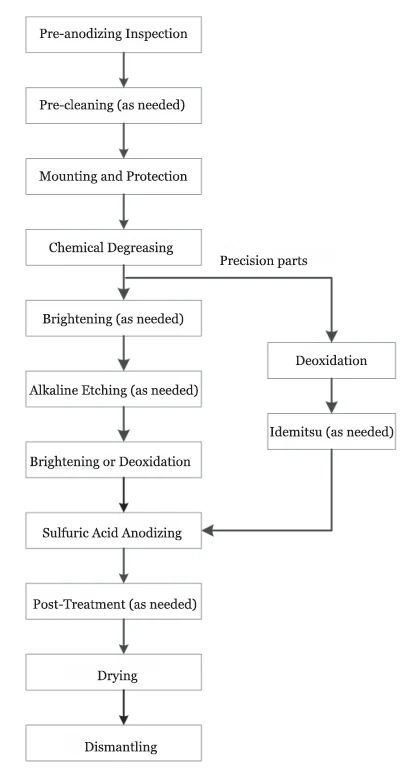
This paper proposes a standardized sulfuric acid anodizing process for aerospace aluminum alloys, clarifying key stages such as pre-anodizing preparation, anodizing treatment, and post-anodizing sealing (see Figure 1).
The aim is to support and promote the application and development of the sulfuric acid anodizing process, thereby improving the quality and efficiency of sulfuric acid anodizing for aluminum alloys.
Figure 1 illustrates the main process flow for sulfuric acid anodizing of aerospace aluminum alloys.
Sulfuric acid anodizing of parts should be performed after machining, welding, forming, shot blasting, heat treatment, and other processing steps that cause part deformation have been completed.
When required for assembly, parts may undergo necessary drilling and local finishing after sulfuric acid anodizing.
Surfaces prone to solution retention, such as overlapping surfaces, joints, and welded parts, should not be anodized.
Prior to anodizing, mechanical cleaning with abrasives that may cause contact corrosion—such as steel wire or iron oxide powder—is prohibited. Parts treated by anodizing should be kept dry and clean.
If painting is required and there are no special specifications, parts that have undergone sealing treatment should be painted within 24 hours, while parts that have not undergone sealing treatment should be painted within 16 hours.
For cast aluminum alloy parts, after mounting, they should first be immersed in cold water for 3 to 5 minutes before proceeding to the next process.
Anodizing Solution Formulation
The new eco-friendly formulation differs from traditional sulfuric acid anodizing formulations. The formulation adds tartaric acid and malic acid. These additions significantly optimize the process and performance.
The optimized process improves the quality of the aluminum alloy sulfuric acid anodizing process. The optimized process also reduces the burden of wastewater treatment.
The specific sulfuric acid anodizing solution formulation is shown in Table 1.
As shown in the solution formulation, sulfuric acid concentration has been reduced by 25%–50%, resulting in a 30% reduction in acid mist emissions.
The use of organic acids as chelating agents enhances the density and hardness of the coating, improving corrosion resistance by 20%–30% while reducing the risk of “burn-through” and increasing the yield rate.
The new formulation demonstrates outstanding environmental benefits:
- It reduces acid mist emissions, improves workshop air quality, and lowers respiratory risks for operators;
- It reduces the risk of heavy metal migration, preventing secondary pollution of soil and water;
- and after simple treatment, some organic acids can be recovered from the waste liquid, promoting resource recycling.
In contrast, traditional formulations, due to their high sulfuric acid concentration and heavy metal residues, require complex neutralization and precipitation processes, resulting in high environmental disposal costs.
Furthermore, the new formulation achieves higher precipitation efficiency of heavy metals in waste liquid through complexation, reducing the amount of neutralizing agent by 40% and lowering the COD of wastewater by 50%.
Additionally, the organic acids are biodegradable, meeting environmental regulations and facilitating a transition from “end-of-pipe treatment” to “pollution reduction at the source.”
| Solution | Component / Item | Concentration (g/L) | Control Range (g/L) |
|---|---|---|---|
| Solution 1 | Sulfuric Acid (as H₂SO₄) | 200 | 180–220 |
| Aluminum (as Al₂O₃) | — | ≤20 | |
| Cl⁻ (as NaCl) | — | ≤0.2 | |
| Solution 2 | Sulfuric Acid (as H₂SO₄) | 130 | 120–140 |
| Sodium tartrate (Rochelle salt) | 33 | 25–40 | |
| Oxalic Acid | 15 | 10–20 | |
| Solution 3 | Tartaric Acid | 80 | 72–88 |
| Sulfuric Acid | 40 | 36–44 | |
| Aluminum (as Al₂O₃) | — | ≤5 | |
| Solution 4 | Sulfuric Acid | 50 | 45–55 |
| Sodium tetraborate | 6 | 5–7 | |
| Malic Acid | 6 | 4–8 | |
| Aluminum (as Al₂O₃) | — | ≤5.5 |
Table 1. Formulation and Process Parameters of Sulfuric Acid Anodizing Solutions
Sealing Solution Formulation
The paper addresses environmental and safety issues in traditional aluminum alloy anodizing sealing processes.
Harmful components such as hexavalent chromium and nickel salts cause these issues. The paper proposes an eco-friendly sealing process. The process builds on existing sealing solution formulations.
After sealing with a dilute chromate solution and deionized water, rinsing is not required; however, after sealing with a dilute chromate solution, residues may remain on certain parts of the components due to poor drainage of the sealing solution.
Operators remove residual solution before drying. They use methods such as blowing with compressed air, rinsing or soaking with cold water, absorbing with a clean fine cotton cloth, or tilting and inverting the parts to drain the liquid.
These methods improve the sealing effect. These methods also improve the density of the coating.
This method effectively improves the microporous structure of the oxide film and features low toxicity, low pollution, and good stability, as shown in Table 2.
| Sealing Solution Name | Control Item | Preparation Concentration | Solution Control Range |
|---|---|---|---|
| Dilute Chromate Sealing | Cr⁶⁺ | Chromic anhydride 0.069 g/L; anhydrous sodium chromate 0.048 g/L or anhydrous potassium chromate 0.069 g/L or anhydrous chromic acid 0.058 g/L | 45 ppm–100 ppm |
| Dilute Chromate Sealing | Silicate Salt (SiO₂) | — | ≤10 ppm |
| Dilute Chromate Sealing | Total Dissolved Solids (TDS) | — | ≤250 ppm |
| Dilute Chromate Sealing | pH Value | — | 3.2–3.8 |
| Dilute Chromate Sealing | Temperature | — | 88°C–93°C |
| Dilute Chromate Sealing | Time | — | 23 min–28 min |
| Hot Water Sealing | pH Value | — | 4.5–6.5 (adjusted with sulfuric acid, ammonia, or sodium bicarbonate) |
| Hot Water Sealing | Temperature | — | 90°C–100°C |
| Hot Water Sealing | Time | — | 15 min–25 min |
| Nickel Acetate Sealing | Nickel Acetate (Ni(CH₃COO)₂) | 11 g/L | 7.5 g/L–15 g/L |
| Nickel Acetate Sealing | pH Value | — | 5.2–5.8 |
| Nickel Acetate Sealing | Temperature | — | 90°C–100°C |
| Nickel Acetate Sealing | Time | — | ≥15 min |
Table 2. Sealing Solution Formulations and Process Parameters
Wastewater Treatment and Recycling
Wastewater generated during the sulfuric acid anodizing of aluminum alloys contains various potentially hazardous components, including acids, alkalis, metal ions, and organic substances.
If discharged directly into the environment without proper treatment, it poses a serious threat to ecosystems.
Therefore, this study designed a multi-stage integrated wastewater treatment and recycling process aimed at achieving the harmless treatment and resource recovery of wastewater.
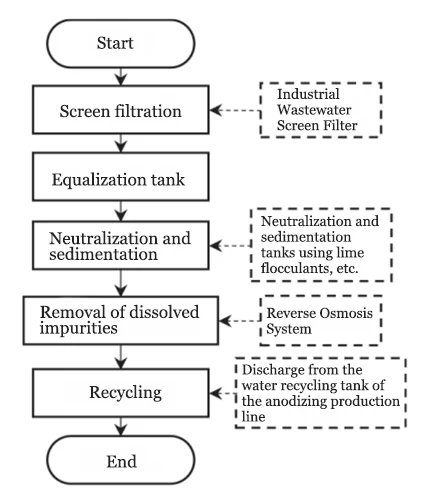
The process comprises multiple stages, including screen filtration, neutralization and precipitation, and reuse/discharge.
Figure 2 illustrates the specific flowchart and the equipment used.
The wastewater first passes through a bar screen filter to remove suspended particles and larger impurities, then enters a homogenization and equalization tank to regulate water quality and flow.
Chemicals are then added in the neutralization and sedimentation tank to remove metal ions and neutralize acidity or alkalinity.
After sedimentation, the supernatant is sent to a reverse osmosis unit to further remove dissolved hazardous substances and organic impurities.
The precipitates generated during the treatment process can be collected centrally, properly treated, and recycled to recover valuable metals, thereby achieving resource recycling.
The treated water can be reused in production lines or discharged into a reclaimed water reservoir, reducing the consumption of fresh water and wastewater discharge, and lowering both costs and pollution loads.
At the same time, this maintains ecological balance and provides strong support for sustainable development.
Research on the Standardization
Importance of Standardization
Standardization is key to promoting the standardization of the sulfuric acid anodizing process for aerospace aluminum alloys and achieving high-quality development.
Process standards and operating procedures ensure consistency in processes and workflows across different manufacturers. They enhance the stability and reliability of aluminum alloy material performance.
They serve as the cornerstone for ensuring product quality and also improve process consistency and further strengthen international competitiveness.
However, the current standard system is incomplete and out of step with technological trends, making the formulation and implementation of unified standards an urgent priority.
First, ensuring material quality and reliability.
Unified standards guarantee consistency in coating performance across different manufacturers and product batches. They reduce performance fluctuations.
They ensure the interchangeability, reliability, and safety of aircraft components and also reduce costs and improve efficiency.
Unified standards can streamline processes, eliminate redundant steps, and shorten production cycles.
They also facilitate the standardized procurement of raw materials and equipment, thereby lowering procurement and inventory costs. Third, promoting international trade and cooperation.
Unified international standards can eliminate technical barriers, foster mutual recognition and exchange of technologies, increase product export shares, and enhance global competitiveness.
Standardization drives technological progress and innovation within the industry.
It codifies mature technologies. It also undergoes continuous revision and improvement.
These revisions and improvements facilitate collaborative problem-solving among experts and enterprises from various countries.
This collaboration promotes the research, development, and application of new green and energy-efficient technologies.
The development of standards should take into account environmental protection and sustainable development requirements. Standards incorporate environmental friendliness into their specifications.
This incorporation promotes more environmentally friendly and efficient production. It reduces pollution and resource waste. It achieves sustainable economic, social, and environmental development.
Main Content of the Standardization Study
The standardization study on sulfuric acid anodizing of aerospace aluminum alloys primarily covers the following aspects:
(1) Standardization of process parameters.
Establish uniform specifications for key process parameters such as electrolyte composition, temperature, current density, and anodizing time.
These parameters directly affect the density, thickness, and corrosion resistance of the anodized coating and serve as a crucial basis for ensuring consistent product quality.
(2) Standardization of operating procedures.
Production units and operators establish detailed standardized operating procedures and precautions. These procedures ensure uniform operating standards during the anodizing process.
They reduce the impact of human factors on process stability. They also reduce the impact of human factors on treatment results.
(3) Standardization of testing methods.
Engineers standardize testing methods and evaluation criteria for key performance indicators.
These indicators include coating thickness, hardness, and corrosion resistance.
Standardization ensures consistency in the quality of the anodized coating. It guarantees the accuracy of test results. It also guarantees the comparability of test results.
Revisions to Relevant International Standards
The two international standards include ISO 8078:1984 “Aerospace—Anodizing of aluminum alloys—Sulfuric acid process, non-stained coatings” and ISO 8079:1984 “Aerospace—Anodizing of aluminum alloys—Sulfuric acid process, stained coatings.”
These standards were published a long time ago.
Many of the process methods and requirements contained therein have since changed and are no longer able to meet the evolving needs of the aerospace industry.
Revised Standards for Modern Demands
The latest developments in the sulfuric acid anodizing process for aluminum alloys drive revisions of ISO standards.
The revised ISO standards focus on requirements such as environmental sustainability and energy efficiency.
The revised ISO standards also include content such as dilute chromic acid sealing.
The latest editions of both international standards have now been published, namely ISO 8078:2025 and ISO 8079:2025.
These standards primarily aim to enhance product corrosion resistance. They apply sulfuric acid-based cathodic protection processes to aluminum alloys.
These processes produce surface coating materials such as dyed coatings or undyed coatings. These coatings exhibit color variations.
These advancements meet the current market’s demands and expectations for high-quality products.
Key Changes in the Revised Standards
Taking ISO 8079 as an example, the standard applies to the production and testing of sulfuric acid anodized coatings on aluminum alloys, aiming to improve product corrosion resistance.
Dyed coatings are produced for aesthetic purposes or for color-coding parts.
The new version retains the technical content of the original standard.
It incorporates revisions based on the technical capabilities and development trends of mainstream products from manufacturers specializing in aluminum alloy sulfuric acid anodizing.
It also incorporates the provisions of relevant regional standards established by major organizations.
(1) Environmental Considerations and Hexavalent Chromium-Free Sealing
For environmental reasons, provisions regarding hexavalent chromium-free sealing have been added.
The section on sealing solutions now includes the statement: “If approved by the buyer, hot water or a hexavalent chromium-free sealing solution may be used for sealing”;
(2) Refinement of Clamping Point and Coating Appearance Requirements
The revised standard retains the original content. It refines specific requirements for clamping points. These refinements enhance the standard’s practicality.
The standard adds a requirement that minor clamping marks are permitted. The standard also requires operators to keep the area and number of clamping marks as small and few as possible.
(3) The requirements for coating appearance have been refined.
Building upon the original standard, a new provision states that “arc marks, blisters, and acid etching defects are unacceptable”;
(4) Revised Oxide Coating Description and Thickness Measurement
The revision draws on relevant feedback. It revises the description of the oxide coating.
The revised description follows ISO 2064 Metallic and other inorganic coatings—Definitions and conventions concerning the measurement of thickness.
The standard measures the average thickness of the coating using the eddy current method. The standard sets the average coating thickness between 6 μm and 25.0 μm depending on the anodized alloy.
(5) Improved Solution Analysis Requirements
The new standard refines the requirements for solution analysis cycles. It revises and improves the original standard’s requirements for anodizing bath solutions.
The bath solution undergoes periodic filtration. Chemical analysis controls the composition of the bath solution.
The frequency of bath solution analysis shall take into comprehensive consideration bath solution aging, contamination, utilization rate, production speed, and any readjustments or additions to the bath solution.
Optional: The bath solution may be filtered periodically.”
Improvements and Implementation of Standards
Currently, the latest ISO 8078: 2025 and ISO 8079:2025, the international standards for aluminum alloy sulfate anodizing, have been released.
Tailored to the needs of the aerospace sector, these standards incorporate environmental requirements for solutions, standardize process flows, operational procedures, testing methods, and quality control requirements.
They provide clear technical foundations for the standardized implementation of anodizing processes and also provide operational guidance for the standardized implementation of anodizing processes.
They address issues such as unstable coating performance and also address issues such as poor environmental compliance found in traditional processes.
The newly released standards focus on process uniformity, operational safety, and environmental compliance.
They use the quantification of key parameters and apply the institutionalization of processes. They design dynamic update mechanisms.
These approaches resolve the issue of insufficient adaptability caused by differences among enterprises in traditional standards. They provide the industry with a practical and traceable technical framework.
Enterprises show significant variations in technical proficiency, equipment capabilities, and management capacity regarding the aluminum alloy sulfuric acid anodizing process.
Unified standards show limited adaptability and enforcement.
Individual organizations refine process requirements. They also refine quality requirements. They incorporate technical content from international standards.
By institutionalizing and documenting key process parameters, operational steps, and safety requirements, operators can perform tasks in accordance with standardized procedures, thereby reducing human error and enhancing product quality and process consistency.
Operators must strictly enforce the operational procedures and safety regulations stipulated in standardized documents during actual operations.
These measures ensure that the production process remains under control.
They also ensure that product performance remains stable. They further ensure that the safety of operators is effectively safeguarded.
Communication platforms can be established on this basis. Seminars on standard promotion and exchange can also be organized.
These activities share experiences. They promote the complementary sharing of resources. They narrow the gaps between enterprises and elevate the overall level of the industry.
Conclusion
With the rapid development of the aviation industry, the sulfuric acid anodizing process for aluminum alloys has become increasingly important.
This study conducts an in-depth investigation into its environmental optimization and standardization.
This study analyzes existing environmental issues. It proposes actionable measures. It clarifies the standardized process flow for aluminum alloy sulfuric acid anodizing.
Environmentally friendly solution formulations are provided.
It also provides wastewater recycling processes. These measures reduce pollution risks. They enhance coating corrosion resistance. They also improve process sustainability.
Additionally, process optimization achieves energy conservation and emission reduction, thereby lowering energy consumption.
Regarding standardization, based on the published international standards ISO 8078:2025 and ISO 8079:2025, we systematically conducted gap analysis and targeted upgrades.
We thoroughly analyzed core requirements outlined in the international standards, including environmental compliance, refined process parameters (such as sulfuric acid concentration and current density), and inspection requirements.
We audited existing enterprise processes and evaluated equipment capabilities and addressed gaps in data traceability.
These actions advanced the enhancement of the enterprise’s existing sulfuric acid anodizing process capabilities on a module-by-module basis.
This approach transformed international standards into the core drivers for improving technical compliance and market competitiveness.