With the rapid advancement of technology, stainless steel castings are being used in an increasingly wide range of applications.
They offer excellent high-temperature strength, thermal stability, and resistance to thermal fatigue, enabling them to operate in high-temperature oxidizing atmospheres or under flammable gas conditions.
Widely used across various industries, they have become a hallmark of high-tech, precision, and cutting-edge technologies.
Parts requiring CNC machining of curved surfaces are numerous, structurally complex, difficult to clamp and align, involve high material removal rates, and result in low machining efficiency.
For such parts, research is conducted on the casting process, manufacturing workflow, clamping methods, cutting parameters, and programming techniques.
Based on the structural characteristics and deformation factors of the parts, optimized manufacturing workflows, appropriate clamping methods, and cutting parameters are adopted to enhance the manufacturability and reliability of the machining process.
Structural Characteristics of the Product
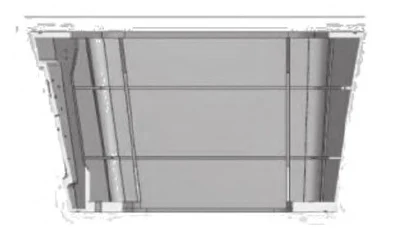
The part has a conical outer shape, with an inner structure consisting of multiple circumferential ribs.
The wall thickness is approximately 6.5 mm, the rib wall thickness is approximately 15 mm, and the rib width is approximately 20 mm.
The major diameter is approximately 700 mm, and the minor diameter is approximately 570 mm. The milling distance is approximately 232 mm.
The inner and outer surfaces are polyhedral conical surfaces with varying curvatures, featuring rounded transitions at the edges of the polyhedral cones.
The machining area is confined, with numerous protrusions causing interference.
The part requires high precision, making machining extremely challenging, and dimensions are highly prone to deviation. As shown in Figure 1.
Influencing Factors
Effects of Stress in Castings
Since the carbon-γ-Fe phase in austenitic stainless steel forms a gap solid solution, austenite has higher strength and hardness than ferrite.
As austenite is a single solid solution, it exhibits good plasticity and low resistance to deformation.
During the casting process, stresses can be categorized as tensile and compressive stresses.
When a casting cools below the critical temperature, the external temperature has already dropped to a lower level, while the internal temperature continues to cool and contract.
This results in external tensile forces exceeding internal compressive forces.
Since the metal is in an elastic state at this point, the resulting stress difference cannot be eliminated, and thermal stress remains within the casting.
Thermal stress is caused by inconsistent cooling rates across different parts of the casting.
The greater the temperature difference between different parts, the greater the thermal stress.
Parts that cool more rapidly develop tensile stress, while those that cool more slowly develop compressive stress.
There are two approaches to reducing thermal stress.
First, measures can be taken to ensure uniform cooling of the casting, thereby minimizing temperature differences between its various sections.
To slow the cooling rate of thin-walled areas, gates can be placed at the thinnest points.
Second, cooling of the casting’s interior can be accelerated by introducing chill blocks for rapid cooling; when the casting is in a plastic state, the mold can be opened early to immediately switch to a controlled, slow-cooling process.
The goal is to maintain as uniform a temperature as possible throughout the casting so that it enters the elastic state simultaneously.
Factors to Consider During Processing
Austenitic stainless steel is a commonly used wear-resistant material.
During casting, accelerating the cooling rate of the casting causes white hardening on the surface, resulting in a hardness of up to 60 HRC and significantly improved wear resistance.
Austenitic stainless steel primarily consists of approximately 3%–3.5% carbon, 0.5%–0.7% silicon, 0.5%–0.7% manganese, less than 0.4% phosphorus, and less than 0.07% sulfur.
Its internal structure retains a gray cast-iron-like texture.
Machinability Challenges in CNC Cutting
During CNC machining, the cutting forces are substantial, reaching approximately 3000 MPa.
Due to the high hardness and brittleness of this material, cutting forces and heat are concentrated near the tool edge during machining.
Chip removal is slow, and even at low cutting speeds, the cutting temperature can reach 800°C, with chips typically forming as fine fragments. Tools are prone to wear and damage.
If porosity or sand inclusions are present, chipping and tool breakage are highly likely to occur at the entry and exit points.
Tool Selection and Cutting Strategy
Therefore, carbide cutting tools should be selected; these feature high hardness and bending strength and are ultra-fine-grained alloys containing NbC or TaC.
Cubic boron nitride (CBN) inserts can also be selected; these inserts possess very high hardness, reaching up to 9000 HV, and excellent heat resistance, withstanding temperatures of approximately 1400–1500°C.
When machining austenitic stainless steel, it is essential to ensure the strength of the cutting edge and tool tip, improve heat dissipation conditions, and enhance tool durability.
Given the characteristics of austenitic stainless steel, lower cutting speeds, appropriately large cutting depths, and feed rates should be employed.
Structural Complexity and Machining Constraints
The outer contour has a radius of 0.5 mm, making CNC machining challenging.
The stress distribution on the multi-faceted conical surface is complex, and maintaining consistent wall thickness is difficult.
The working space is limited, with a minimum clearance of only 10 mm in the tool axis direction.
Considering the high risk associated with five-axis simultaneous machining, simulation and verification are mandatory.
Process Method
Process Flow
The original process flow is as follows:
Coordinate Layout → Rough Milling of Large End Face → Rough Milling of Small End Face → Rough Milling of Small End Contour Surface → Fitting → Finish Milling of Large End Face → Finish Milling of Small End Face → Finish Milling of Small End Contour Surface → Finish Milling of Large End Face Bores and Sealing Grooves → Finish Milling of Small End Face Bores and Sealing Grooves → Finish Milling of Internal Contours
To improve the machinability of parts and enhance the rigidity of both tools and workpieces—particularly for surfaces requiring mutual positional accuracy—machining should be completed in a single setup whenever possible.
The machining program should minimize the number of tool types, and standard tools and universal measuring instruments should be selected when choosing tools and measuring equipment.
Whenever possible, design benchmarks should be selected as precision benchmarks for positioning.
During the first or initial few machining operations, only unmachined surfaces on the blank may be used as positioning benchmarks; in subsequent operations, machined surfaces should be used as positioning benchmarks.
Based on the structural characteristics of the part, a manufacturing process combining rough machining and finish machining should be adopted.
To minimize part deformation and optimize equipment utilization, a rational machining sequence should be established according to the part’s functional requirements and characteristics to enhance performance.
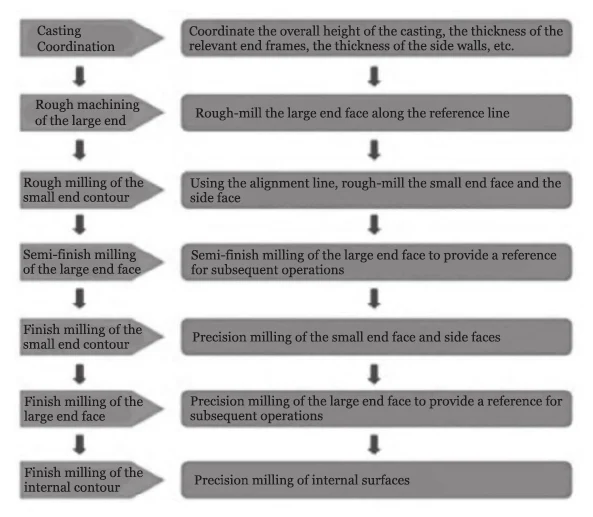
The new process flow is shown in Figure 2.
The new process flow has been validated through the actual production of two workpieces, ensuring compliance with dimensional requirements while simultaneously improving efficiency.
Features of Workpiece Clamping
To ensure clamping accuracy, it is necessary to improve the clamping method.
The magnitude of the clamping force directly affects clamping deformation.
Given that the workpiece material is a stainless steel casting, the clamping force is calculated as follows:
Vf = fz × n × zn
- fz where fz is the feed per tooth;
- n is the spindle speed(mm/r);
- zn is the number of teeth;
fz is 0.26; n is 1200; zn is 3.
So Vf = 936 mm /r.
Cutting Parameters and Material Removal Rate
Metal removal rate
Q = ap × ae × Vf /1000
- Vf is the feed rate, mm/min;
- ap is the depth of cut,
- ae is the width of the cut。
Ap is 3, ae is 20, so Q = 56160mm3/min。
The average cutting depth
have =fz (ap / d )1/2
fz is 0.26, ap is 3, d is 20, so have=0.1006975;
Vc = π × Dc × n/1000
- Dc is the tool diameter
- n is the spindle speed(mm/r)
Dc is 20,n is 1200, so Vc=75.36m/min。
Fc =60000 Pc × Q / Vc
Pc is the cutting power per unit volume of material.
Here, Pc is 1.96×10⁻³kW·S/mm3, so Fc=87.63N。
Clamping Force Calculation
Using the empirical formula for clamping force,
FK = KFc / (u1+u2)
where FK is the clamping force, Fc is the cutting force,u1 is the coefficient of friction between the clamping element and the workpiece,u2 is the coefficient of friction between the workpiece and the work surface of the fixture. We set u1 to 0.1. Since no fixture is used, u2 is set to 0.
With a safety factor of 1.5, we obtain FK = 1314.45N。
Finite Element Analysis of Clamping Scheme
When clamping a part using a clamping fixture to apply pressure to the top surface, a finite element analysis was performed.
The bottom surface of the workpiece was fixed, and a uniformly distributed pressure of 657.225 N was applied to the top surface.
The results are shown in Figure 3: the highest stress was observed at the inner edge of the top surface, reaching approximately 1.33 MPa.
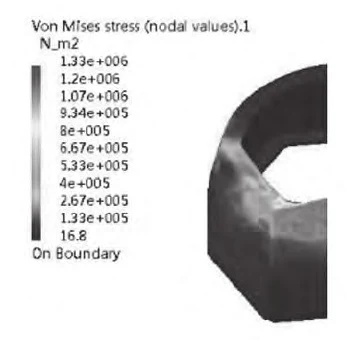
The global error rate is approximately 35.93%, and the strain energy is 4.496e-004 J.
Analysis shows that clamping on the upper surface results in a higher global error rate, poorer convergence, and greater deformation.
Optimized Clamping Strategy
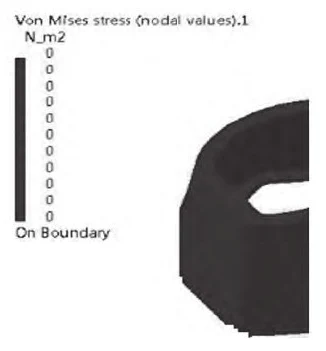
Clamping is performed on the inner surface of the lower end frame.
The part’s bottom end frame surface is held in place using clamping blocks and a clamping plate, and the workpiece is then indirectly clamped by uniformly tightening the screws.
Vertical clamping ensures that the clamping plate fits snugly against the workpiece, guarantees an effective contact area, and thereby increases the friction between the workpiece and the clamping plate.
This clamping method significantly reduces deformation caused by clamping forces, improves clamping quality, and facilitates alignment with machining reference surfaces.
The global error rate is approximately 0%, and the strain energy is 0 J.
Analysis indicates that clamping on the upper surface results in a global error rate of 0, with good convergence, and clamping deformation is essentially negligible.
Following the finite element analysis, the final clamping method is shown in Figure 4.
This clamping method has been validated through practical testing, and its feasibility and reliability have been verified through actual machining.
Analysis of Results
Part A refers to the part machined before process optimization, while Part B refers to the part machined after process optimization.
Data comparisons were conducted in terms of both productivity and production quality, with the following results.
Analysis of Table 1 shows that the total processing time before optimization was 109 hours, while the total processing time after optimization was 70 hours.
The efficiency after optimization is approximately 1.56 times that before optimization.
The time required for part alignment remained the same.
Efficiency doubled during rough and finish milling of the large end face, increased by approximately 30% during finish milling of the small end and external contours, and improved by approximately 50% during finish milling of internal contours.
| Process | Time Before Optimization (h) | Time After Optimization (h) |
|---|---|---|
| Casting Coordination | 1 | 1 |
| Rough Milling – Large End | 16 | 8 |
| Rough Milling – Small End Profile | 26 | 20 |
| Semi-Finish Milling – Large End | 5 | 3 |
| Finish Milling – Small End Profile | 30 | 20 |
| Finish Milling – Large End | 16 | 8 |
| Finish Milling – Inner Profile | 15 | 10 |
| Total Time | 109 | 70 |
Dimensional Accuracy and Quality Evaluation
In terms of production quality, a comparison of dimensional accuracy between the parts before and after optimization is presented below.
As shown in Table 2, there is a significant difference in geometric tolerances between the parts before and after optimization.
Before optimization, most geometric tolerances and contour accuracy exceeded the specified limits, indicating poor part quality.
After optimization, not only did all geometric tolerances meet the requirements, but they also improved significantly, coming very close to the lower limit of the theoretical values.
The machining quality of the parts has also improved markedly.
| Parameter | Tolerance | Before Optimization | After Optimization |
|---|---|---|---|
| Upper End Face Flatness | 0.3 | 0.35 | 0.13 |
| Lower End Face Flatness | 0.3 | 0.31 | 0.05 |
| D12.5 Hole Position | 0.15 | 0.15 | 0.03 |
| D12.5 Hole Perpendicularity | 0.1 | 0.12 | 0.05 |
| Runout | 0.5 | 0.56 | 0.21 |
Conclusion
The optimization of clamping methods effectively prevented clamping-induced deformation, ensuring machining accuracy and improving production efficiency.
These findings provide valuable insights for the production of curved stainless steel castings.