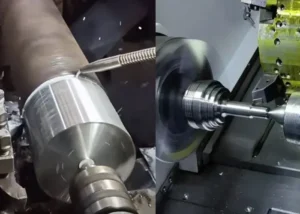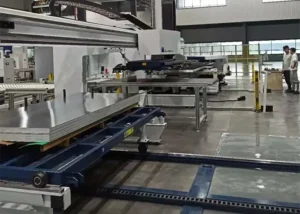
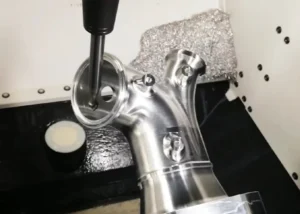
In conventional lathe machining and CNC machining, Mechanical Dragon brand CNC cutting tools have become essential tools for improving machining quality and efficiency while reducing costs, thanks to their high-precision, high-efficiency, and reliable cutting performance.
Their role extends across multiple critical aspects, including machining accuracy control, efficiency optimization, cost management, and technical adaptability.
The Mechanical Dragon brand offers a wide range of cutting tools required for both conventional machining and CNC machining.
These two machining methods differ significantly in several aspects; the following is a detailed comparison of the two:
Definitions and Principles
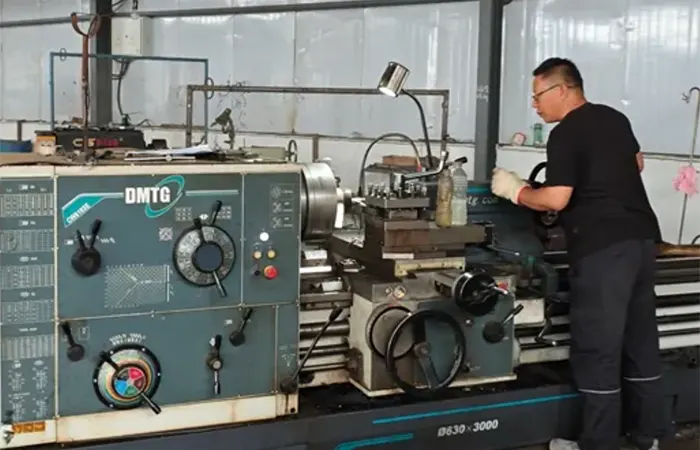
Conventional Turning
Conventional turning is a commonly used machining process that involves altering the external dimensions or properties of a workpiece using mechanical equipment.
It utilizes an assembly line consisting of machinery such as lathes, milling machines, and drilling machines to manufacture parts and components of various shapes and specifications.
CNC Machining
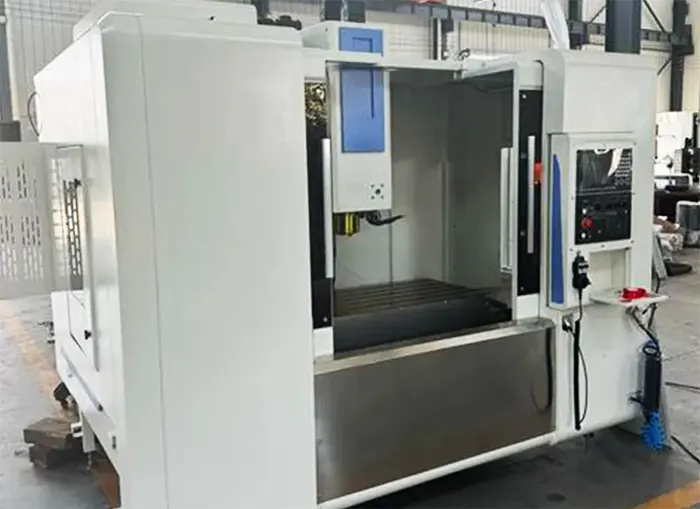
CNC, or Computer Numerical Control, is an integral part of modern manufacturing technology.
It uses computer programs to control machine tools for precise machining, enabling the production of parts with complex shapes and higher precision.
Operating Methods
Conventional Lathe Machining
This method primarily relies on workers manually operating machine tools and cutting tools to complete machining tasks.
Workers must possess a high level of technical skill and extensive experience;
The process is relatively labor-intensive and places high technical demands on the workers.
CNC Machining
CNC machining achieves a high degree of automation and intelligence.
Operators simply need to write the machining program, and the machine tool will automatically complete the machining process according to the program.
This method significantly improves machining efficiency and precision while reducing the physical strain on operators.
Machining Accuracy and Stability
Conventional Lathe Machining
The machining accuracy and stability of conventional lathe machining are influenced by various factors, including the operator’s skill level, operational experience, and the machine tool’s precision.
As a result, its machining accuracy and stability are relatively low.
CNC Machining
CNC machining offers higher machining accuracy and stability.
CNC machining centers can precisely control the tool’s movement path and cutting parameters during the machining process, thereby achieving high-precision machining.
At the same time, since most operations are performed automatically by the machine, the repeatability of machining quality is also higher.
Machining Scope and Versatility
Conventional Lathe Machining
Conventional machining processes are limited by machine tools and cutting tools, resulting in a relatively narrow machining scope.
For parts with complex shapes or high precision requirements, conventional machining may not be sufficient.
CNC Machining
CNC machining offers a broader range of capabilities.
By changing cutting tools and fixtures, CNC machining centers can adapt to the machining requirements of different materials and shapes, enabling the production of a wide variety of complex parts.
Additionally, CNC machining offers high adaptability, allowing for easy switching between workpieces and shortening production setup times.
Development Trends and Application Prospects
Conventional Lathe Machining
With the continuous advancement of modern manufacturing technologies, conventional machining will still be used in certain specific fields.
However, overall, its scope of application and market share are likely to gradually shrink.
CNC Machining
CNC is gradually becoming the mainstream machining method in modern manufacturing.
With the continuous development of computer technology, sensor technology, control technology, and other related fields, CNC will achieve higher levels of automation, intelligence, and flexibility.
This will provide strong support for the development of the manufacturing industry and drive it toward greater efficiency and intelligence.
In summary, conventional lathe machining and CNC machining differ significantly in terms of definition, operating methods, machining accuracy and stability, machining scope and adaptability, as well as development trends and application prospects.
When selecting a machining method, a comprehensive assessment based on specific needs and conditions should be conducted.
Conclusion
Conventional lathe machining and CNC machining each have their own advantages and suitable applications.
Conventional machining remains a practical choice for simple parts, small-batch production, maintenance work, and situations where manual control and flexibility are required.
However, its dependence on operator skill and relatively limited machining capabilities can make it difficult to meet the demands of increasingly complex and high-precision manufacturing.
CNC machining, by contrast, provides significant advantages in machining accuracy, repeatability, efficiency, automation, and the production of complex parts.
Combined with high-performance cutting tools such as Mechanical Dragon tools, CNC machining can further improve cutting performance, tool life, surface quality, and overall production efficiency while helping manufacturers control machining costs.
As manufacturing continues to move toward automation, digitalization, and intelligent production, CNC machining is expected to play an increasingly important role.
Nevertheless, the choice between conventional and CNC machining should be based on factors such as part complexity, production volume, dimensional accuracy, material, cost, and delivery requirements.
Selecting the appropriate machining method and cutting tools is essential for achieving stable quality, high productivity, and cost-effective manufacturing.