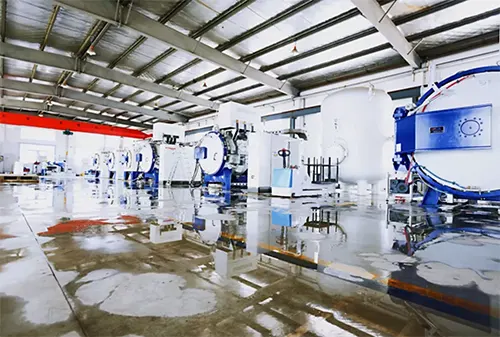
Heat treatment is a process I use to improve the performance of a workpiece by altering its internal microstructure or changing the chemical composition of its surface.
After a customer places an order, the sawing shop cuts the mold steel to the specified dimensions based on the customer’s requirements, and the workpiece is then sent to the machining department for a series of grinding or milling operations.
Depending on the requirements or after rough machining, the mold is returned to the factory for heat treatment, with different heat treatment processes selected based on the specific material requirements.
Today, we’ll discuss heat treatment processes such as quenching, tempering, nitriding, cryogenic treatment, and oxidation. So, what do these processes actually mean? Find out below!
Classification of Heat Treatment Processes
Quenching
1. What is quenching?
A heat treatment process in which steel is transformed into the austenitic phase and then cooled at an appropriate rate, causing martensite or other unstable microstructural transformations to occur throughout the entire cross-section of the workpiece or within a specific region.
2. What is the purpose of quenching?
1) To improve the mechanical properties of metal products or components.
For example: to increase the hardness and wear resistance of tools and bearings;
To raise the elastic limit of springs, and to enhance the overall mechanical properties of shaft-type components.
2) To improve the material or chemical properties of certain special steels.
For example, to enhance the corrosion resistance of stainless steel and to increase the permanent magnetism of magnetic steel.
Tempering
1. What is tempering?
A heat treatment process in which a quenched workpiece is heated to a temperature below the critical point AC1 and held for a certain period of time, followed by cooling using a specified method to achieve the desired microstructure and properties.
2. What are the purposes of tempering?
1) To reduce internal stress and lower brittleness.
Quenched parts exhibit significant stress and brittleness; if not tempered promptly, they often deform or even crack.
2) To adjust the workpiece’s mechanical properties. After quenching, the workpiece has high hardness and high brittleness.
To meet the varying performance requirements of different workpieces, tempering can be used to adjust hardness, strength, ductility, and toughness.
3) To stabilize the workpiece’s dimensions. Tempering stabilizes the microstructure, ensuring that no further deformation occurs during subsequent use.
4) To improve the machinability of certain alloy steels.
Nitriding
1. What is nitriding?
Nitriding is a chemical heat treatment process in which nitrogen atoms are diffused into the surface layer of a workpiece at a specific temperature and in a specific medium.
2. What is the purpose of nitriding?
To impart excellent wear resistance, fatigue resistance, corrosion resistance, and high-temperature resistance to the workpiece.
Nitriding is a chemical heat treatment process in which nitrogen atoms diffuse into the surface layer of a workpiece at a specific temperature and in a specific medium.
Deep Cryogenic Treatment
1. What is deep cryogenic treatment?
Deep cryogenic treatment involves subjecting metal to temperatures below -160°C, causing the soft retained austenite to be almost entirely transformed into high-strength martensite.
2. What is the purpose of deep cryogenic treatment?
To eliminate retained austenite (which accounts for approximately 8–20% after quenching and tempering;
Since austenite is highly unstable, it easily transforms into martensite when subjected to external forces or changes in ambient temperature.
Because martensite has a larger volume than austenite, this causes irregular expansion of the material, reducing the dimensional accuracy of the workpiece).
After cryogenic treatment, residual austenite is reduced to less than 2%, which reduces residual stress, stabilizes the metal matrix, and increases the strength and toughness of the metal material, while significantly improving its red hardness.
Oxidation
What is oxidation?
Through oxidation treatment, a dense, protective oxide film is formed on the surface of steel components.
This film consists primarily of magnetic iron oxide (Fe₃O₄), which provides anti-welding properties.
The FeS film obtained through surface sulfidation serves both to reduce friction and prevent welding.
At the same time, this process enhances corrosion resistance and high-temperature oxidation resistance.
What Are the Differences Between Workpieces Made Using Different Processes?
Are you guys still a little confused by the processes described above?
Let’s take a look at the visual differences between workpieces made using different processes.
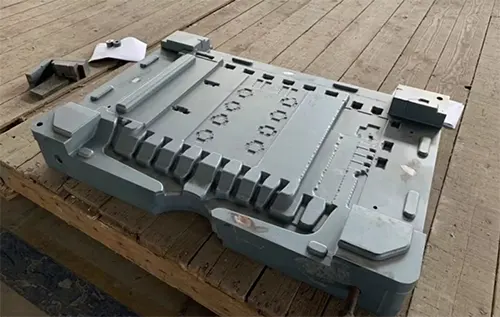
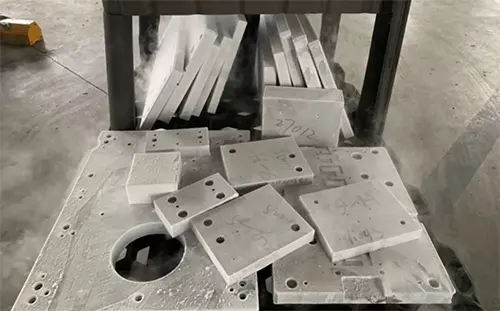
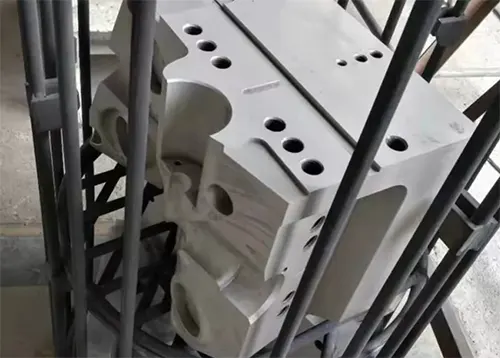
As can be clearly seen from the image, first, the color of the workpiece changes; second, this is inextricably linked to the manufacturing process.
If a workpiece requires a higher level of hardness, this can be achieved through heat treatment.
For example, a mold that originally could only produce 10,000 samples can now, through heat treatment to increase its hardness, produce 100,000 or even 1,000,000 samples, greatly improving its utilization rate.
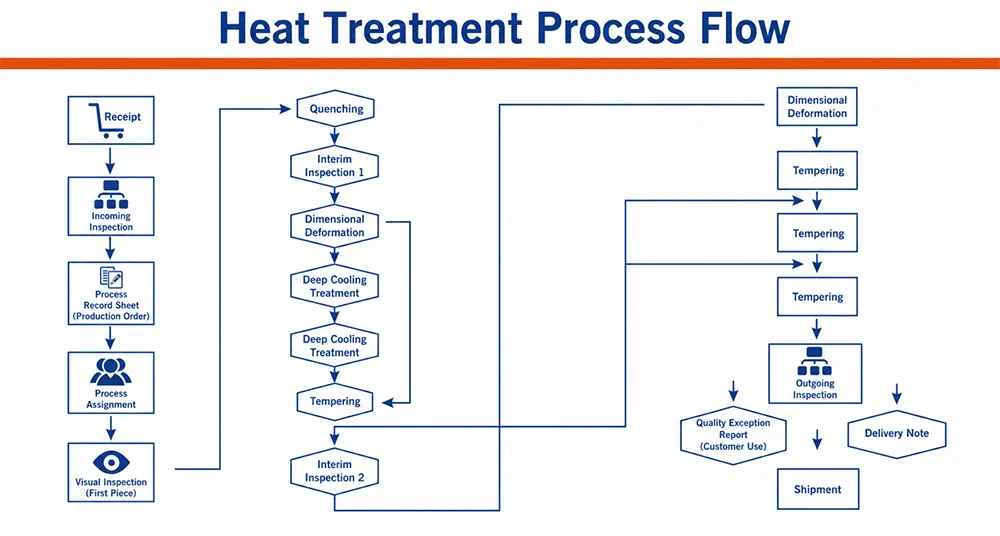
Heat Treatment Process Flow
Conclusion
To conclude, different heat treatment processes deliver distinct improvements to mold steel workpieces.
Quenching raises workpiece hardness and wear resistance, while tempering eliminates quenching internal stress and adjusts mechanical toughness;
Nitriding optimizes surface wear resistance, fatigue resistance, and corrosion resistance.
Deep cryogenic treatment consumes residual austenite to stabilize dimensional accuracy and boost material strength.
Oxidation generates a dense surface oxide film, providing anti-welding properties, friction reduction, and corrosion protection.
A reasonable selection of heat treatment solutions based on service requirements can significantly enhance mold hardness, extend service cycles, and increase production output.
Properly implemented heat treatment is therefore an indispensable step to maximize the utilization efficiency of mold steel.