
Thin-walled shells offer advantages such as thin walls, light weight, a high aspect ratio, high specific strength, and a compact structure, making them increasingly widely used in the aerospace industry.
Drilling Jig Design and Machining Accuracy Optimization
However, during the machining process of thin-walled shells, their complex structure makes it difficult to ensure the machining accuracy of end-face holes.
Since the machining quality of these end-face holes significantly impacts the overall performance, safety, and reliability of the engine, addressing the machining accuracy of thin-walled shell end-face holes holds significant practical importance.
Machining Accuracy Requirements and Existing Problems
In a certain model of thin-walled shell, the radial holes and end-face holes have a strict angular relationship.
Both the end-face holes and radial holes require high machining dimensional accuracy.
Since the thin-walled shell contains a large number of end-face holes, operators must determine the machining positioning references for the radial holes and end-face holes based on the 0° reference line to ensure machining accuracy.
During machining, visually aligning with the 0° reference line can lead to inconsistencies in the machining reference for radial and end-face holes, resulting in excessive angular deviations between the end-face holes and the 0° reference line.
This fails to meet the machining accuracy requirements for thin-walled housings, thereby affecting machining quality and production schedules.
Drilling Jig Design and Research Focus
Therefore, it is necessary to design a drilling jig for the end-face holes.
Optimizing the alignment method for the 0° reference line of the end-face holes to resolve the issue of excessive angular deviation between the end-face holes and the 0° reference line during machining is key to achieving high-precision, high-volume production of thin-walled shells.
This paper discusses and analyzes the machining processes for end-face and radial holes in thin-walled shells, as well as the design and improvement of the drilling jig for end-face holes.
Structural Composition and Characteristics of the Part
Structural Composition of the Part
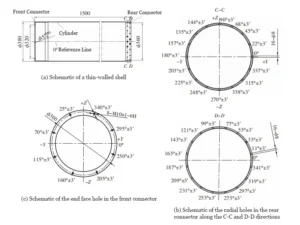
As shown in Figure 1, the thin-walled shell consists of a front connector, a cylindrical body, and a rear connector, and manufacturers use D406A material to produce it.
Manufacturers form the thin-walled shell using automatic TIG welding, perform heat treatment, and then machine it through CNC turning and CNC milling.
The total length of the shell is 1500 mm, the outer diameter is φ380 mm, and the wall thickness is 2 mm.
Analysis of Part Characteristics
1) This part is a thin-walled shell with a total length of 1,500 mm and a wall thickness of only 2 mm.
Due to its high length-to-diameter ratio and thin walls, the shell has low rigidity and is prone to vibration during machining, which can lead to unstable dimensional accuracy.
Therefore, specialized tooling must be designed.
2) The angular deviation for the radial hole in the rear connector and the end-face hole in the front connector must be within ±3′. Due to the shell’s considerable overall length, it is difficult to
secure during machining, making it challenging to control machining accuracy and increasing the difficulty of the process.
Consequently, the radial hole must be machined using a CNC milling machine, while the end-face hole requires a custom-designed drilling jig and manual machining methods to meet the shell’s machining accuracy requirements.
3) After machining, the end-face holes of the front connector must fit the front engine section.
Therefore, it is essential to ensure the angular machining requirements between holes in the circumferential direction of the front connector’s end face.
Additionally, the positional tolerance of the end-face holes relative to the 0° datum must be strictly maintained within ±3′ to meet the overall assembly requirements of the engine.
Analysis of Machining Methods and Processes for Thin-Walled Shells
Due to the high aspect ratio of thin-walled shells, their thin walls and low rigidity make it difficult to accurately locate machining reference points.
If a five-axis machining center is used for processing, the complexity of its CNC system and machining programs places high demands on the operator’s programming skills and operational experience.
Consequently, operators face significant challenges during actual operation, resulting in poor consistency in workpiece quality.
Furthermore, five-axis machining centers are expensive, making them economically unfeasible.
For these reasons, the machining workshop currently lacks the capacity to utilize a five-axis machining center, and the practical machining of thin-walled shells using such equipment is not feasible.
Three-Axis CNC Milling Machining Method
In actual production, the rear connecting components of the thin-walled shells are machined using a three-axis CNC milling machine equipped with a rotary indexing table.
This method is simple to operate, ensures machining accuracy, and guarantees consistent machining quality.
Therefore, when machining the radial holes of the rear connector for the thin-walled shell, a three-axis CNC milling machine equipped with a rotary table is used.
Prior to machining, the milling operation first marks the 0° and 180° machining reference lines on the shell.
The CNC milling process employs a vertical milling method: first, operators install the milling plug fixture for the rear connector of the thin-walled shell and provide flexible support in the middle of the shell.
Then, operators use a horizontal indexing head and tail support to align the shell with one clamp and one support, ensuring the runout of the outer circles at both ends of the shell remains within 0.1 mm.
Operators machine the radial holes on the machining center according to the 0° reference line and mill the 16-φ8 radial holes on the milling machine based on the C-C and D-D views.
End Face Hole Machining and Inspection
After machining the radial holes in the connector following the thin-walled housing, the next process involves a machinist operation to machine the end face holes of the front connector.
The machinist operation requires drilling the end face threaded holes 8-M10×1-6H in sequence, based on the 0° reference line marked during the previous milling process.
After machining is complete, use a coordinate measuring machine to inspect the angular deviation of the radial holes in the rear connecting piece and the end-face holes in the front connecting piece relative to the 0° reference line.
Ensure that all angular deviations are within ±3′ to meet machining accuracy requirements.
Requirement for Drill Jig Design
In actual machining, when drilling the end face holes of the front connector, the machinist cannot align with the 0° reference line on the housing to achieve high-precision machining of the end face holes.
Therefore, a drilling jig for the front connector must be designed to accurately align with the 0° reference line and improve machining accuracy.
Design of Drilling Jigs
Design Principles for Drilling Jigs:
1) Dimensional Accuracy Requirements.
When designing drilling jigs, the dimensional accuracy and positional accuracy of the jig must be strictly controlled.
The dimensional accuracy of the end face holes on the drilling jig must exceed the machining accuracy requirements for the end face holes on the workpiece.
This ensures that the dimensional and positional accuracy of the end face holes meet the machining process requirements, thereby guaranteeing that the quality stability of the final product meets the specified standards.
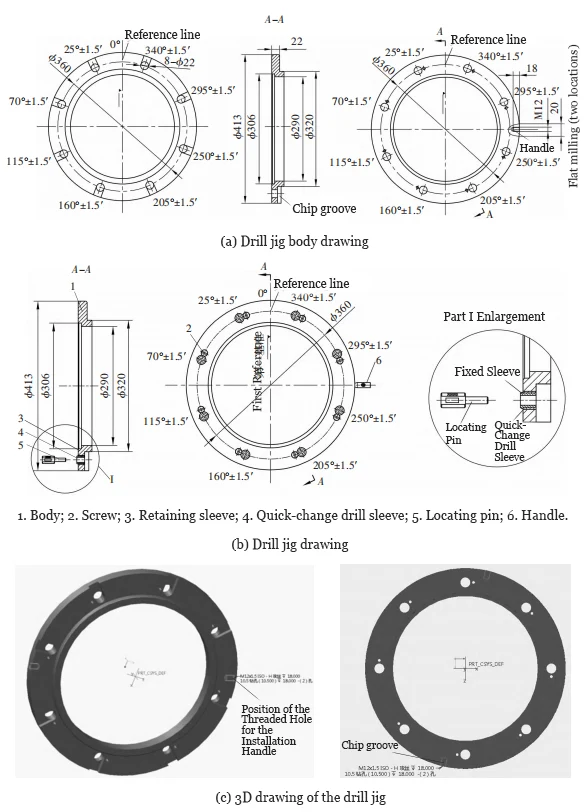
As shown in Figure 2, the end face hole accuracy of the front connector drilling jig designed in this paper is within ±1.5, and the machining accuracy exceeds the angular accuracy requirement of ±3′ for the front connector end face hole.
Therefore, the final machining accuracy of the front connector end face hole can be guaranteed.
2) Operability.
When designing drilling jigs, designers must consider the actual conditions of the production site to ensure quick installation and removal during use, thereby reducing operational difficulty and improving production efficiency.
As shown in Figure 2, designers reserve two holes on both sides of the drilling jig. Inserting a φ12 handle facilitates the installation and removal of the jig, simplifying the process and reducing the difficulty of operation.
3) Reliability.
When designing the drilling jig, it is essential to ensure that machining dimensions do not deviate due to vibration during use.
4) Cost-effectiveness.
When designing the drill jig, materials with good mechanical properties and low cost should be selected to ensure the jig’s long-term usability and reduce production costs.
In this paper, the material used for the drill jig is 30CrMnSiA alloy structural steel.
This steel offers good machinability, minimal machining deformation, high strength, good toughness, and a moderate price, thereby meeting the jig’s operational requirements.
5) Use of Drill Sleeves.
Drill sleeves are specialized components used during the drilling process to guide the feed direction of the cutting tool, enhance tool rigidity, establish the relative position between the hole and the machining reference, improve hole machining accuracy, prevent hole deviation or deformation, and ensure machining quality.
The drilling jig described in this paper works together with interchangeable and quick-change drill sleeves, as shown in Figure 2.
Based on the selection standards for machine tool fixtures and components, designers selected a 9F7×15 M6×16 quick-change drill sleeve and an A15×16 fixed sleeve, and secured the jig with a φ9 locating pin.
Operators use M6 screws to secure the drill sleeves, prevent loosening during hole machining, and ensure machining accuracy and consistent quality.
The drill sleeves and the drilling jig are connected via an interference fit, allowing them to be directly pressed into the drilling template; the tight fit of the drill sleeves on the jig further ensures machining accuracy and consistent quality.
Additionally, to prevent chips from entering the drill sleeve holes during machining, each hole on the drill jig corresponds to a chip evacuation groove, ensuring a smooth machining process.
In summary, the design of the drill jig must ensure the machining accuracy of the end face holes while also facilitating easy installation, removal, and operation.
As shown in Figure 2, the drill jig described in this paper consists of the drill jig body 1, screws 2, retaining sleeves 3, quick-change drill sleeves 4, locating pins 5, and handles 6.
Drilling and Positioning Procedure
Before machining the end face holes of the connecting component, the fitter places the thin-walled housing vertically in a pit and uses a radial drill to drill the holes.
Operators use a dial indicator to check the perpendicularity of the end face (within 0.10 mm).
Then, operators align the 0° reference line marked on the drilling jig with the 0° reference line marked by the miller on the thin-walled housing.
Operators visually adjust the 0° reference line and use a radial drill to machine two reference positioning holes φ9 at 0° and 180° (corresponding to 25°±1.5′ and 205°±1.5′ in the figure, respectively).
Subsequently, operators drill the remaining φ9 end-face thread pilot holes sequentially based on these two reference holes.
After removing the drilling jig, operators tap the 8-M10×1-6H thread pilot holes. After machining, inspectors use a coordinate measuring machine to inspect the thin-walled housing.
Machining Accuracy Inspection Results
The angular deviation of the rear connector’s radial hole from the 0° reference line was within ±3′.
The positional accuracy between the circumferential threaded holes on the front connector met the machining requirements;
However, the angular deviation of the front connector’s end-face threaded hole from the 0° reference line was approximately 1°, exceeding the machining process’s ±3′ angular deviation requirement and failing to meet the machining accuracy requirements.
Existing Issues
After milling the radial holes in the front connector of a thin-walled shell, fitters use a drilling jig to drill the end face holes of the front connector, but visual alignment of the 0° reference line produces significant errors.
This results in inconsistencies between the 0° reference lines of the radial holes and the end face holes of the front connector after machining, causing an angular deviation of approximately 1° between the end face holes and the 0° reference line.
Therefore, it is necessary to optimize the design of the front connector structure of the shell and subsequently improve the front connector drilling jig to enhance the machining positioning accuracy of the 0° reference line and increase machining efficiency.
Tooling Improvements
In actual machining, it is difficult to accurately align the 0° reference line by visual inspection, making it challenging to ensure that the machining accuracy of the end face holes on the front connecting piece remains within ±3′.
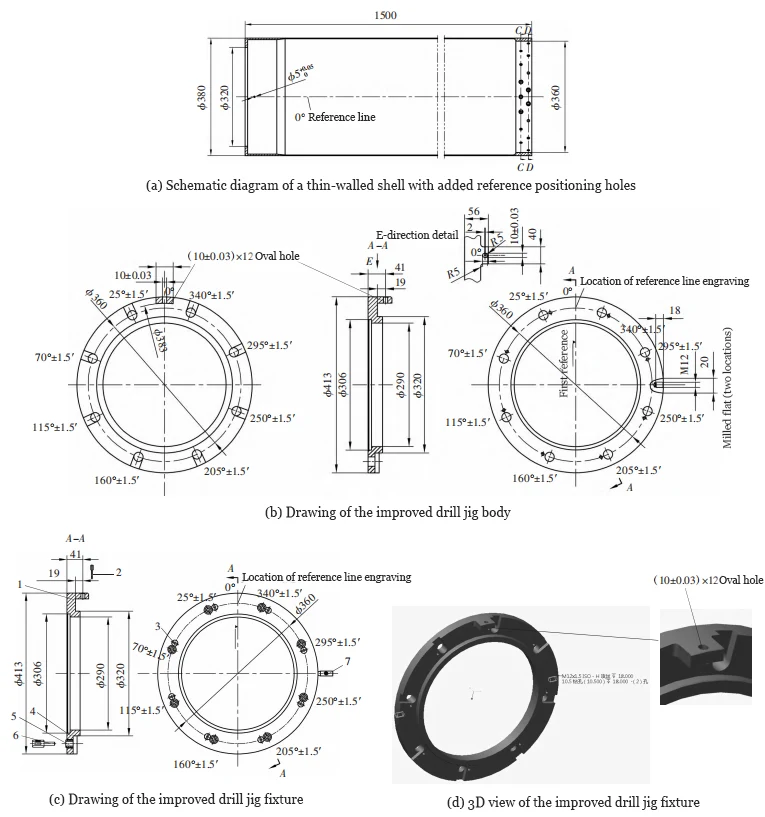
After comprehensive analysis, a radial φ5+0.050 positioning oblong hole was added at the 0° reference position of the front connecting piece of the thin-walled shell, as shown in Figure 3(a).
The drilling jig directly uses the φ5+0.050 positioning slot to align with the 0° reference line, enabling precise alignment of the 0° reference line and ensuring machining accuracy.
During the design of the drilling jig, designers added a (10±0.03)×12 slot to the end face to optimize the alignment method for the rear connector drilling jig.
Figures 3(b) and (c) show schematic diagrams of the jig structure.
Before machining the end face holes of the connecting component, operators accurately align the 0° reference line by inserting φ5-0.01-0.03 locating pins into the (10±0.03)×12 oblong holes on the drilling jig.
At this point, the 0° reference line on the drilling jig directly aligns with the 0° reference line on the housing, eliminates machining errors caused by manual visual alignment of the 0° reference line, and improves the alignment accuracy of the machining reference.
After machining the end face hole of the front connecting piece on the thin-walled housing, a CMM inspection confirmed that the angular deviation between the end face hole and the 0° reference line was within the machining process tolerance of ±3′.
Therefore, the improved drilling jig meets the machining accuracy requirements.
Machining Results
Prior to machining the end face holes of the connecting components, an oblong hole measuring (10±0.03) × 12 was added to the thin-walled housing.
Following the optimization and improvement of the drilling fixture, the fixture now aligns directly with the 0° reference line via the φ5+0.050 oblong hole on the housing.
This ensures that the machining reference for the end face holes of the front connecting component is consistent with that of the radial holes in the rear connecting component.
This effectively resolved the angular deviation issue between the end face holes and the 0° reference line, reducing the deviation from approximately 1° to within ±3′.
It improved the assembly dimensional accuracy of the front connector’s end face holes relative to the engine’s front nacelle, ensured compliance with machining accuracy requirements for critical dimensions, met the part’s design and machining specifications, and satisfied the overall engine’s performance, safety, and reliability requirements.
Following verification through first-article machining and small-batch production, this approach has eliminated hidden machining risks associated with thin-walled housings and reduced their manufacturing costs.
Conclusion
Given the difficulty in controlling the machining accuracy of end face holes in thin-walled shells, we optimized the design of the front connecting piece by adding machining reference holes.
This allowed us to rationally improve the drilling fixture for the front connecting piece, thereby optimizing the alignment method for the machining reference of the end face holes.
Verified through actual production, this approach effectively improves the machining accuracy of the end face holes in thin-walled shells.
It resolves the issue of inconsistent machining reference angles between the end face holes of the front connector and the radial holes of the rear connector, thereby meeting the high-precision machining requirements for critical dimensions of thin-walled shells.
The machining method is simple and efficient, reduces production costs, and provides valuable practical guidance for machining hole positions with strict angular relationships in thin-walled shells.