The geometric accuracy of the V1325 bushing in automotive transmissions directly affects the efficiency and service life of the drivetrain.
High-Precision Laser Triangulation Inspection System
If the roundness and cylindricity of the bushing exceed tolerance limits, transmission efficiency can decrease by 12% to 18%, leading to approximately 32% of premature transmission failures.
Limitations of Traditional Contact Inspection Methods
While the principles of contact-based inspection methods are intuitive, the 0.5–1.2 N normal force generated by the contact probe can easily create a 0.2–0.5 μm micro-damage zone on the bushing surface, shortening the component’s fatigue life by 17%–23%.
Non-contact inspection technologies have overcome accuracy challenges through innovation, with laser measurement technology offering unique advantages in precision inspection due to its 0.1-micrometer resolution and 2,000 points-per-second sampling rate.
Chinese research teams have achieved a series of breakthroughs: the ultrasonic inspection system developed by Su Zebin et al. achieved a defect recognition rate of 98.7%;
The SIFT algorithm improved by Song Yuning’s team raised the accuracy of surface defect detection to 99.2%.
However, existing technologies still have measurement blind spots in the simultaneous detection of multi-dimensional geometric tolerances and lack dynamic coupling analysis with the machining platform.
Innovative Laser Triangulation Inspection Architecture
This study proposes an innovative architecture for an intelligent inspection system based on the principle of laser triangulation, with technical breakthroughs in three dimensions:
① Developing a modular inspection mechanism that establishes a stable measurement reference through a two-stage (coarse-fine) positioning system;
② Constructing a multi-degree-of-freedom inspection system that integrates high-precision ball screws and servo motors to achieve micrometer-level displacement control of the laser displacement sensor along the axial direction;
③ Designing an axial rotation module that acquires full circumferential contour data through equal-angle segmented measurements, thereby providing a comprehensive quality assurance solution for the entire high-precision bushing manufacturing process.
Design of the Mechanical Structure for the Inspection Platform
Design of the Inspection Method
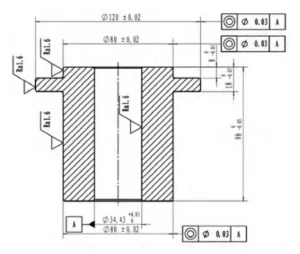
The inspection target is the V1325 bushing rotary component, whose key dimensional features and tolerance ranges are shown in Figure 1.
This solution employs laser triangulation, using a high-precision ball screw to drive the sensor in axial motion while simultaneously controlling circumferential rotation, thereby acquiring dimensional and geometric tolerance data non-contact.
The basic inspection process is as follows: rough positioning → fine positioning and clamping → axial scanning → circumferential rotation and indexing for repeated measurements.
Design of a Motion Transmission System for a Detection Device
The operating principle of a laser displacement sensor is as follows: its built-in CCD linear camera receives a red laser beam focused by a lens; this beam is projected onto the surface of the target object and reflected.
The camera captures the spot formed by the reflected laser from different angles.
By analyzing the angles of the spots, the distance between the camera and the laser source can be calculated, and a digital signal processor then computes the actual distance between the sensor and the target object.
Based on this principle, this study employs a high-precision ball screw to drive the laser sensor in uniform axial motion along the sleeve, simultaneously collecting displacement data.
Combined with multidimensional scanning from a circumferential rotation module, this approach enables efficient, comprehensive inspection of all parameters related to the sleeve’s axial dimensional tolerances and radial geometric tolerances.
Design of the Rough Positioning Scheme
After the mechanical gripper transfers the bushing to the inspection platform, staged positioning is required to ensure the precision of the workpiece’s position.
Given the structural characteristics of the center bore of the rotary bushing, the positioning scheme employs a two-stage progressive approach consisting of rough and fine positioning:
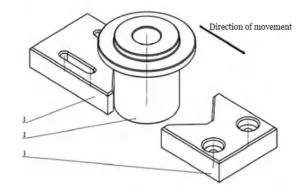
During the coarse positioning stage, the system employs a dual-V-block adaptive positioning mechanism based on the geometric features of the outer circumference.
The fixed-end V-block serves as the reference surface and restricts radial degrees of freedom, while linear guides drive the movable-end V-block to achieve positional compensation, control errors within ±0.5 mm, and eliminate placement errors caused by the mechanical gripper.
When selecting the reference for fine positioning, the design comprehensively considers both machining benchmarks and measurement reliability, giving priority to the inner bore positioning scheme.
For tolerance compatibility design, the fine positioning stage introduces a three-jaw pneumatic chuck to address positioning clearance issues caused by internal bore machining tolerances.
Synchronous retraction of the radially distributed jaws aligns the workpiece axis with the measurement reference within 0.5 seconds and achieves a repeatability of ±0.003 mm.
This meets the laser measurement system’s requirements for reference stability.
A schematic diagram of the design is shown in Figure 2.
Design of a Precision Positioning Solution
Regarding dimensional tolerance issues during the machining of bushing parts, the original V-block positioning solution struggled to meet inspection accuracy requirements.
Process analysis led to an improved positioning solution.
The positioning optimization adopted the inner bore axis as the process reference based on the principle of unified reference points.
In line with production requirements, the design comprehensively considered the following three factors:
(1) the impact of the workpiece’s inner diameter dimensional tolerances on positioning accuracy;
(2) process requirements for positioning reliability during the inspection process;
(3) Rapid clamping to meet production line demands.
After comparing multiple options, the design adopted a combined positioning solution integrating a pneumatic three-jaw chuck with a rotary mechanism.
The self-centering clamping mechanism precisely aligns the inner bore reference of the workpiece and works together with a rotary inspection fixture to perform multi-angle measurements.
Mechanical Modeling of the Inspection Platform
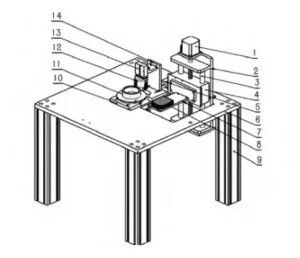
The 3D diagram of the V1325 bushing inspection platform is shown in Figure 3.
This inspection system features a modular design that integrates precision motion control and intelligent inspection functions.
It consists of motion execution, positioning and gripping, measurement and sensing modules, and a structural support system.
Static Analysis
To support the static simulation of the bushing machining and inspection platform, the completed model requires structural simplification before analysis.
Optimization measures improve simulation efficiency and accuracy while reducing computational demands.
Minor spindle features with limited influence on overall performance, including chamfers, fillets, and threaded holes, remain omitted during model preprocessing.
The simulation process also removes the threaded sections of the hex bolts to simplify calculation procedures.
After completing the platform model, conversion to an XT file format enables import into Ansys Workbench for further detailed analysis.
Basic Loads and Design Conditions
When the cylinder is at rest, it primarily bears the gravitational force exerted by the cylinder and the pneumatic finger;
During cylinder movement, it is subject to the inertial force of the cylinder and the pneumatic finger, the direction of which depends on the cylinder’s operating state.
The total mass of the cylinder and the pneumatic finger is 1.98 kg.
Inertial force: Fg=F0=52.8(N)
Total load force: FJ=G=mg=1.98×9.8=19.4(N)
FX=G+Fg=19.4+52.8=72.2(N)
FS=G-Fg=19.4-72.2=-33.4(N)
In summary, the bracket experiences the maximum load when the cylinder moves downward, with a total load of 72.2 N.
Mesh Generation (Element Type, Number of Elements)
The complex overall geometry of the model required tetrahedral elements for mesh generation.
A 1 mm mesh size ensured independence from mesh density while balancing computational efficiency and analysis accuracy.
High mesh smoothness and gradual mesh transitions achieved a refined mesh structure.
The model contains a total of 1,724,065 nodes and 1,170,734 mesh elements.
Boundary Conditions
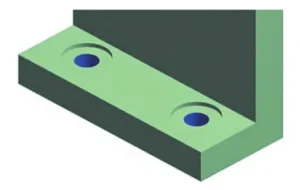
A “bonded” constraint connects the cylinder bracket and the cylinder base plate.
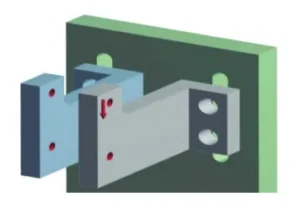
Constraints restrict the two holes on the bottom surface of the cylinder base plate, while loads act on the mounting holes of the cylinder bracket.
Figure 4 illustrates the constraint configuration, and Figure 5 presents the load application.
6061-T6 aluminum alloy forms the cylinder bracket and cylinder mounting plate.
The mechanical properties of this material are as follows: material designation 6061, Young’s modulus 68.9 GPa, density 2.70 g/cm³, elongation at break 12%–25%, tensile strength 290 MPa, and Poisson’s ratio 0.33.
Calculation Results
Following constraint model construction, load application, mesh generation, and material property definition, the analysis process proceeds to numerical calculation.
The calculations evaluate the strain, displacement, and stress produced in the structure under external loading conditions.
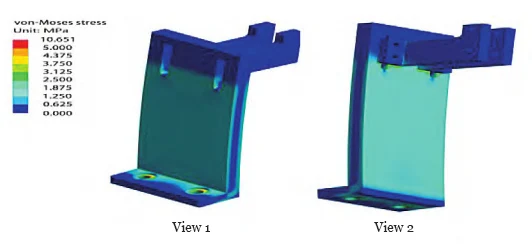
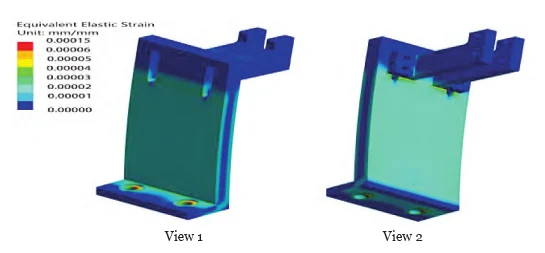
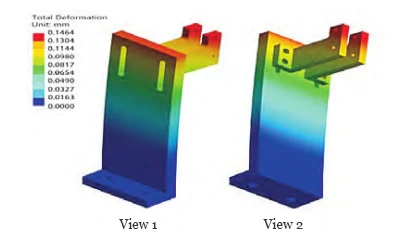
Under the applied loads, Figure 6 shows the stress distribution contour plot of the fine-positioning mechanism, Figure 7 presents the strain distribution contour plot, and Figure 8 reveals the displacement distribution contour plot.
Stress Distribution Analysis
Figure 6 illustrates the stress distribution contour of the precision positioning mechanism. The mechanism generates a maximum stress of 10.651 MPa under excitation.
The lower mounting holes and the lower contact region with the cylinder bracket concentrate most of the stress. The stress level remains within the allowable material limit.
Strain and Displacement Analysis
The strain distribution contour plot of the fine positioning mechanism shown in Figure 7 indicates that the maximum strain value generated by the mechanism under excitation is 0.00015 mm.
The areas with higher strain show a high degree of overlap with the stress concentration zones.
Figure 8 illustrates the displacement distribution contour of the fine-positioning mechanism.
The mechanism reaches a maximum displacement of 0.1464 mm in the upper region. Overall displacement remains minimal throughout the structure.
Fatigue Analysis and Reliability Evaluation
After completing the basic static analysis of the mechanism, fatigue analysis followed.
The alternating response mode operated with stress variations ranging from 50% to 150% and a stress cycle of 10⁹ cycles.
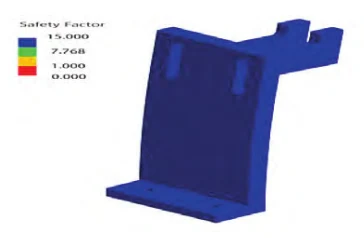
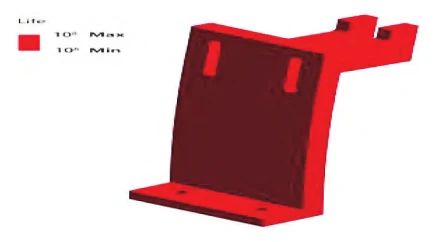
Based on the above parameters, Figure 9 shows the strength factor of the fine-positioning mechanism;
Figure 10 shows its life distribution plot. The maximum safety factor is 15, indicating high consistency in the mechanism’s lifespan, capable of withstanding 10⁸ cycles of alternating stress.
Considering both material limits and operating conditions, the fixed structure of the fine-positioning mechanism meets the design requirements.
Conclusion
In response to the need for high-precision inspection of V1325 bushings used in automotive transmissions, this study innovatively proposes an intelligent inspection system based on laser triangulation.
The system’s structural design and static performance verification have been successfully completed.
The main conclusions are as follows:
① The innovative inspection architecture overcomes the bottleneck of multidimensional measurement.
The system establishes a modular mechanism. The system constructs a multi-degree-of-freedom inspection system. The system integrates an axial rotation module.
Micron-level displacement control covers the entire circumference of the bushing.
Dense data acquisition supports the inspection process. These functions lay a solid foundation for quality assurance in high-precision bushing manufacturing.
② Mechanical structure optimization and reliability verification yielded significant results.
A combined solution using V-blocks for coarse positioning and three-jaw pneumatic cylinders for fine positioning was adopted to eliminate bushing placement errors;
The rotatable inspection platform supports repeatable measurements at multiple angles, enhancing data consistency.
Finite element analysis confirmed that the stress and displacement of key components remain below material tolerance limits, with a fatigue life of 10⁸ cycles, meeting reliability requirements for engineering applications.
Future work will further enhance the application of machine learning algorithms.
Real-time data processing efficiency will improve continuously. Inspection systems and machining systems will establish a broader closed-loop feedback mechanism.
Manufacturing and inspection will achieve deeper integration. Severe operating conditions will support stability verification. Environmental adaptability will increase comprehensively.