The widespread adoption of multi-function spring coiling machines (commonly known as “octopus machines” or “universal machines”) has significantly improved spring manufacturing efficiency.
Conventional springs, such as tension springs, compression springs, and torsion springs, can now be fully produced automatically using multi-functional spring coiling machines due to their simple structures and straightforward manufacturing methods.
However, for many special-shaped springs with unique structures, automation remains unfeasible due to the limitations of multi-functional spring coiling machines.
Currently, special-shaped springs must be formed using specialized tooling equipment.
For non-standard springs with specific application requirements, corresponding heat treatment is necessary after forming to achieve optimal performance.
Consequently, the forming process and control of heat treatment deformation have become critical factors in the production of non-standard springs.
As for long, thin-section non-standard springs, their production has long been a challenge for spring manufacturers;
Process deformation control and tooling design are the key technologies for addressing these issues.
Part Analysis
The shape of the special-shaped spring part is shown in Figure 1. It is made of T8A steel, with a material thickness of 0.3 mm.
The spring is 348 mm long and approximately 11.5 mm high, and is a long, thin strip spring.
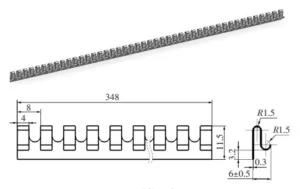
The technical specifications for this part require a hardness of 40–48 HRC, necessitating heat treatment.
The heat treatment process consists of quenching at 770–810°C, followed by tempering at 370 ± 20°C. This part has a thin structure and requires high dimensional accuracy.
To ensure the part meets these dimensional requirements, specialized sheet metal dies must be used for cold bending to achieve the desired shape and precision.
To meet technical performance requirements, the part must undergo quenching and tempering heat treatment.
The repeated heating and cooling process can easily cause deformation in the curved sections and along the length of the cold-bent leaf spring.
Therefore, measures to control heat treatment deformation must be considered in subsequent production.
Analysis of the Part Forming Process
Based on the process analysis, cold stamping is adopted for the part forming.
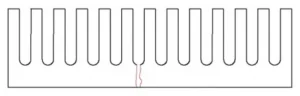
Wire cutting is used to blank the sheet metal, resulting in a comb-shaped structure, as shown in Figure 2.
Replacing conventional sheet metal punching with wire cutting helps reduce stress during the blanking of thin sheet metal and control dimensional deviations, ultimately ensuring the quality of the formed part.
Given the structural characteristics of the leaf spring, which features two U-shaped structures at different angles, a single-step bending process would require the design of a complex multi-stage composite bending die.
Furthermore, cold-bending two U-shaped structures with different angles within a single die set can cause mutual interference, making it difficult to ensure positional accuracy between them.
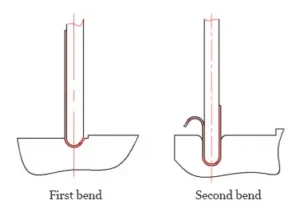
Therefore, a two-step bending process is adopted for the leaf spring, with the corresponding bending process and sheet metal bending die structure shown in Figure 3.
This process involves bending the outer U-shaped structure first, followed by the inner U-shaped structure.
The first bending step ensures the dimensional accuracy of the outer U-shaped structure, while also providing reliable positioning for the subsequent bending step and facilitating the control of positional accuracy between the two;
Furthermore, the subsequent bending step has virtually no effect on the shape of the previously bent section.
Control of Heat Treatment Distortion
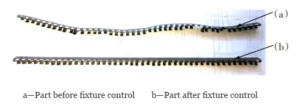
Figure 4a shows the shape of a leaf spring after cold bending and quenching in the free state.
The leaf spring exhibits severe twisting, taking on an “S” shape, with distortion occurring in both the curved sections and along the length.
During the heat treatment process, specialized fixtures must be designed to control the twisting distortion in the curved sections and along the length of the leaf spring.
Design of the Heat Treatment Fixture
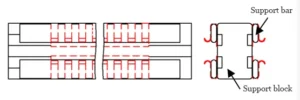
Figure 5 shows a schematic diagram of the designed heat treatment fixture for the leaf spring.
The fixture consists of support bars and support blocks. The support bars are inserted into the curved sections of the leaf spring to control deformation in both the curved and longitudinal directions.
The leaf spring and support bars are secured to the support blocks to further control any potential twisting deformation of the leaf spring.
Cr20Ni80 heat-resistant steel was selected as the jig material.
This steel exhibits minimal deformation at high temperatures and maintains its shape even under rapid cooling or heating, ensuring the leaf spring retains its fixed geometry throughout the various cooling stages of the heat treatment process.
Stress-Relief and Process Optimization Strategy
A stress-relief tempering step is added prior to heat treatment to reduce residual stresses from bending and prevent deformation caused by the accumulation of stresses during quenching.
For the quenching heating and cooling stages—where plastic deformation is greatest and most likely to occur—the simple jig shown in Figure 5 ensures minimal deformation.
Furthermore, the parts are tempered together with the jig to ensure timely release of quenching stresses, preventing further deformation after the jig is removed, and utilizing the jig for final shaping.
Final Form Accuracy and Production Result
Figure 4b shows the shape of the part after quenching under the control of the specialized fixture.
As can be seen from the figure, the leaf spring appears straight, with minimal deformation in the curved sections.
Currently, this approach is being used for the mass production of leaf springs, with a total of 200 units produced and a pass rate exceeding 95%.
Conclusion
By employing specialized sheet metal dies for cold bending and designing custom heat treatment fixtures to control deformation during the heat treatment of the leaf springs, we successfully produced high-quality long, thin, and irregularly shaped springs.