Aircraft control surfaces are a critical component of the flight control system, and the quality of their structural connections directly affects the precision of their motion and operational reliability.
As a key connecting element between the control surface and the load-bearing structure, the hinge mount is responsible for load transfer and rotational restraint.
Under the influence of alternating loads and complex operating conditions, it imposes high demands on manufacturing precision and structural consistency.
As aircraft structures evolve toward lightweight and highly integrated designs, hinge seats are increasingly characterized by thin walls, multiple hole positions, and high assembly interdependence.
Traditional machining methods have revealed shortcomings in terms of stability and consistency.
The drilling process, as a fundamental step in hinge seat manufacturing, directly affects hole positioning, assembly integrity, and operational performance.
To address the issue of precision fluctuations encountered in engineering practice, it is necessary to conduct targeted research on the drilling process of hinge seats in conjunction with structural characteristics, to enhance the manufacturing quality and process reliability of these critical structural components.
Structural Analysis of Aircraft Control Surface Hinge Mounts
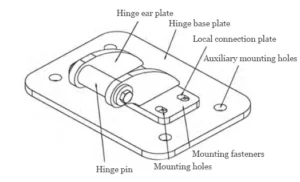
Aircraft control surface hinge mounts typically consist of a base plate, hinge support components, and rotational connection components.
The overall structure exhibits plate-like load-bearing characteristics, with hinge lugs provided locally to form a rotational joint.
As shown in Figure 1, the hinge mount base plate serves as the primary load-bearing component, forming a fixed connection with the control surface or related structures.
The plate surface features multiple mounting holes and auxiliary locating holes, which are used to constrain assembly positioning and transmit loads.
The hinge support is located in the central region of the base plate and, in conjunction with the hinge pin, forms the rotation center of the control surface.
Its spatial position relative to the hole axis directly influences the motion state of the control surface.
Due to the relatively limited thickness of the base plate and the large number of holes, there are variations in local stiffness distribution within the structure.
During manufacturing, this makes the part susceptible to minor deformation caused by clamping methods and cutting loads.
The relative positional relationship between the hinge hole and the mounting holes constitutes a key geometric feature of the hinge mount, and its precision level directly affects assembly quality and operational stability.
High-Stability Drilling Process for Aircraft Control Surface Hinge Mounts
Design of Locating Reference Constraints
The construction of the drilling positioning system for the hinge mount begins with structural geometry.
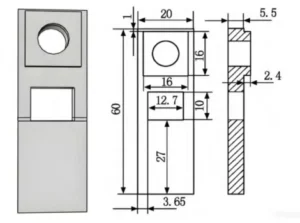
Figure 2 presents a complete dimensional framework showing the relationships between the flange plate thickness, width, hole center positions, and the base plate height; the reference design uses this as its spatial starting point.
Once the outer surface of the base plate engages with the fixture’s support surface, it forms a large-area contact.
The support area extends across the width, ensuring the part’s orientation stabilizes during the initial clamping stage.
Lateral Constraint and Hole Axis Control
The outer edge curve of the flange plate and the side of the stop block form a set of lateral constraint surfaces; when these two surfaces contact, the hole’s axial direction is immediately fixed and guided.
The distance from the hole center to the boundary provides a clear reference for the arrangement of locating points, ensuring that locating elements have a stable geometric basis within the support zone.
Stability of Positioning Chain During Pre-Drilling
Once the machining process enters the pre-drilling stage, the positioning chain remains fixed, ensuring that the machining operations for the hole cluster are consistently performed in a uniform orientation.
The contact surface of the base plate, the side surface of the flange plate, and the auxiliary limiting zone form a spatial constraint triad.
The distances between these three elements are determined by the layout of the hole cluster, providing the spatial framework with a stable geometric reference.
The geometric configuration of the positioning area determines the distribution of clamping force paths.
The clamping force is transmitted along the thicker sections of the base plate, ensuring the structure maintains stable support under drilling loads.
Localized contact elements are added to the flange plates to keep the outer edge curve fixed under lateral loads, preventing the hole axes from being disturbed by external torques during drilling.
Control of Enhanced Clamping Rigidity
The design of the hinge seat clamping solution is based on the distribution of structural rigidity.
The main surface of the base plate acts as the core load-bearing area for clamping. The system arranges support points around the region of maximum overall rigidity to distribute the clamping force uniformly across the thickness.
The system adjusts the number of support units individually according to the distribution of the hole clusters. It ensures balanced stress distribution within the structure during the clamping phase.
Engineers install local wrap-around limiting structures at the flange plate positions. These structures provide stable spatial constraints for the rotating joint area during the drilling phase.
The clamping force direction maintains a fixed relationship with the flange plate axis. This configuration ensures clear control of the hole axis orientation during the clamping phase.
The clamping system applies a single-fixation strategy throughout the machining of the hole clusters. It ensures that multiple holes are machined under a unified clamping orientation.
Each support unit maintains full contact with the base plate within the clamping structure. This condition keeps the orientation stable and prevents changes caused by cutting loads.
The lateral limiting structure performs the task of maintaining orientation during the drilling phase; the structural profile and limiting components form a stable interface under the impact of drilling forces.
The width of the contact surfaces in the clamping area has been expanded to ensure greater continuity of the contact zone.
The drilling sequence proceeds from the symmetrical sections of the structure, allowing cutting forces to diffuse continuously within the structure and preventing load concentration in a single direction.
Optimization of Drilling Parameter Matching
Drilling parameters for hinge seats are selected based on the material’s machining characteristics and the geometry of the hole.
Spindle speed, feed rate, and cutting depth form a coordinated parameter system.
A slow feed rate operates during the initial stage of hole formation. It ensures a stable and gradual contact between the cutting edge and the material.
Feed rate changes according to the wall geometry as the hole depth increases. It maintains continuous metal removal in the cutting zone.
Drill geometry adapts through adjustments of rake angle, clearance angle, and cross-edge length based on the material’s hardness characteristics. It ensures a stable cutting path at different depths.
Material friction parameters determine the selection of the drill coating type. It maintains consistent edge sharpness during multi-hole machining.
Structural distribution drives the re-planning of the machining sequence for hole clusters. Symmetrical starting positions create a complementary distribution of cutting forces within the structure.
The drilling rhythm remains uninterrupted, ensuring a stable temperature field in the cutting zone at all times.
The system directs coolant into the drill bit channels. It maintains a linear temperature rise trend along the hole walls.
The process sets drilling depth in stages within the flange thickness range. It ensures stable cutting conditions at the cutting edge during the flange section.
The drill bit retraction employs a step-by-step approach, maintaining smooth contact with the hole walls during the retraction phase.
Application Analysis
Case Background
During the mass drilling phase of a batch of rudder hinge mounts, the process shows a slight tendency toward hole cluster dispersion.
Under drilling loads, the thin-walled sections of the flanges experienced positional shifts, and the hole axis direction exhibited inconsistent variations across multiple workpieces.
The production floor reports various sources of variation. The testing process establishes three machining scenarios to address these variations.
These scenarios simulate drilling behavior under different structural stresses. They also simulate drilling behavior under different clamping orientations.
Scenario A employed a conventional clamping force path, with support points arranged along the thick section of the base plate, and the drilling rhythm maintained at the original settings;
B applied enhanced lateral restraint to ensure the outer edge of the flange remained tightly secured during drilling, with the feed rhythm adjusted slightly;
C varied the combination of tool protrusion and feed rate to create differentiated stress conditions in the deep-hole section.
Analysis of Machining Results
1. Test on the Stability of Hole Position Accuracy
Table 1 lists the center-of-hole offsets for the three holes under three machining scenarios.
In Scenario A, the offsets for Hole 1, Hole 2, and Hole 3 were 0.18 mm, 0.27 mm, and 0.22 mm, respectively, with a maximum difference of 0.09 mm among the three holes;
Hole 2 exhibited the most significant offset.
This hole is located in a thin-walled area of the ear plate; during drilling, lateral restraint was insufficient, causing the hole axis to oscillate locally under cutting loads.
In Scenario B, the offset values for the three holes decreased to 0.14 mm, 0.21 mm, and 0.17 mm, respectively.
The offset for Hole 2 decreased by 0.06 mm compared to Scenario A, and the difference between the other two holes narrowed to 0.03 mm.
The lateral support structure continuously provides constraint during the drilling stage, maintaining the stability of the ear plate’s orientation and controlling the hole axis direction.
In Scenario C, the offsets increased to 0.23 mm, 0.31 mm, and 0.26 mm, with Hole 2 showing an increase of 0.10 mm compared to Scenario B.
The increased tool protrusion lengthened the cutting force arm, amplifying the hole center offset in the thin-walled section.
| Scenario | Hole Position 1 Offset (mm) | Hole Position 2 Offset (mm) | Hole Position 3 Offset (mm) |
|---|---|---|---|
| A | 0.18 | 0.27 | 0.22 |
| B | 0.14 | 0.21 | 0.17 |
| C | 0.23 | 0.31 | 0.26 |
Table 1. Test Results of Hole Center Offset in Three Scenarios (mm)
2. Comparative Analysis of Machining Consistency
Table 2 presents the results for hole diameter deviation, roundness error, and wall runout under the three machining scenarios.
In Scenario A, the three metrics were 0.08 mm, 0.16 mm, and 0.11 mm, respectively, indicating an overall moderate level of performance.
Under Scenario B conditions, the hole diameter deviation, roundness error, and wall runout decreased to 0.06 mm, 0.12 mm, and 0.09 mm, respectively, showing varying degrees of improvement compared to Scenario A.
Notably, the roundness error decreased by 0.04 mm, indicating that the lateral limiting structure remained engaged throughout the drilling process, resulting in a more uniform force distribution in the flange area and maintaining cutting edge stability.
In Scenario C, the three metrics increased to 0.10 mm, 0.19 mm, and 0.14 mm, with hole wall runout and roundness error amplifying simultaneously.
Changes in cutting loads in the deep-hole section led to reduced tool stability and exacerbated hole contour deviation.
| Scenario | Hole Diameter Deviation (mm) | Roundness Error (mm) | Hole Wall Fluctuation (mm) |
|---|---|---|---|
| A | 0.08 | 0.16 | 0.11 |
| B | 0.06 | 0.12 | 0.09 |
| C | 0.10 | 0.19 | 0.14 |
Table 2. Machining Consistency Test Results for Three Scenarios (mm)
3. Results of Assembly Fit Verification
Table 3 shows the changes in pin insertion force, fit clearance, and axial deviation under the three machining scenarios.
In Scenario A, the change in insertion force was 13.24 N, the fit clearance was 0.21 mm, and the axial deviation was 0.10 mm; all indicators fell within the moderate range.
In Scenario B, the corresponding values decreased to 10.87 N, 0.17 mm, and 0.07 mm, respectively.
The insertion force variation was reduced by 2.37 N compared to Scenario A, and the axial deviation narrowed by 0.03 mm.
The improved stability of the bore axis ensured a continuous pin insertion path, resulting in reduced fluctuations in assembly resistance.
In Scenario C, the variation in insertion force increased to 15.36 N, the clearance expanded to 0.24 mm, and the axial deviation widened to 0.12 mm.
The offset of the hole axis was further amplified during the assembly stage, and fluctuations in insertion force significantly increased.
| Scenario | Insertion Force Variation (N) | Fit Clearance (mm) | Axis Deviation (mm) |
|---|---|---|---|
| A | 13.24 | 0.21 | 0.10 |
| B | 10.87 | 0.17 | 0.07 |
| C | 15.36 | 0.24 | 0.12 |
Table 3. Assembly Compatibility Verification Results for Three Scenarios
Conclusion
The hinge seat shows hole center drift, hole axis deviation, and hole wall contour fluctuations during the drilling stage.
Different scenarios control these variations stably. Reference reconstruction improves geometric consistency.
Clamping path adjustment enhances positional stability. Parameter optimization reduces machining deviation.
The positioning chain maintains a fixed orientation. It ensures continuous force application to the flange area during the cutting stage. The clamping structure reinforces lateral constraints.
It provides stable support for thin-walled sections. The parameter combination maintains a linear rhythm in the deep-hole section. It enables hole clusters to form consistent trajectories within the spatial coordinates.