
With the development of 5G communications, high-performance computing, and portable electronic devices, the power density of electronic components continues to rise.
This increase places extremely demanding requirements on their thermal management systems.
Heat sinks are evolving toward ultra-thin designs with deep fins and high density.
Due to its excellent machinability, corrosion resistance, and high toughness, 6061 aluminum alloy has become the ideal material for manufacturing such heat sinks.
Machining Challenges of Ultra-Thin Structures
However, when the fin thickness is only 1 mm and the fin height reaches 55 mm, the aspect ratio increases dramatically.
The relative rigidity of the part decreases significantly during the milling process, making it highly prone to cutting vibrations and deformation, and making it difficult to ensure machining quality and stability.
Traditional machining methods face three major challenges. First, long tool overhang leads to insufficient rigidity, which causes chatter and degrades the machined surface.
Second, the combined effects of cutting forces and cutting heat can cause thin-walled sections to deform or even fracture at the root.
Aluminum alloys are soft and prone to chip buildup, which disrupts cutting stability and scratches the machined surface.
Currently, research on thin-walled components largely focuses on general approaches such as toolpath optimization and high-speed milling strategies.
However, systematic research on layered milling processes for special structures where “wall thickness ≤ 1 mm” and “tooth height ≥ 50 mm” coexist remains insufficient.
Dedicated process solutions for 6061 aluminum alloy also require further exploration.
To this end, this paper takes 6061 ultra-thin heat sinks as the research object and reveals their failure modes and mechanisms through traditional process experiments.
Based on this, a “multi-layer progressive five-step milling” process scheme is proposed.
Its effectiveness and reliability in controlling deformation and improving yield rates are verified through process comparisons.
The aim is to provide practical references for the precision machining of similar high-difficulty parts.
Analysis of Part Structure, Material Properties, and Manufacturing Challenges
Part Structure Analysis
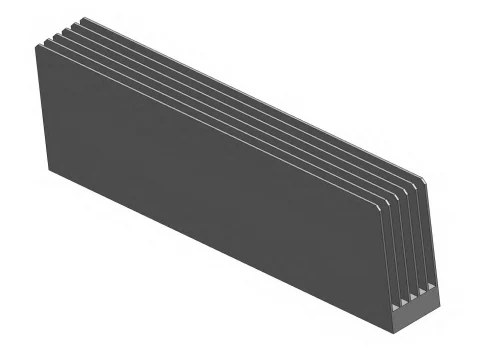
The subject of this study is a laminated aluminum alloy heat sink (Fig. 1), whose key feature is a series of parallel cooling fins milled into the substrate.
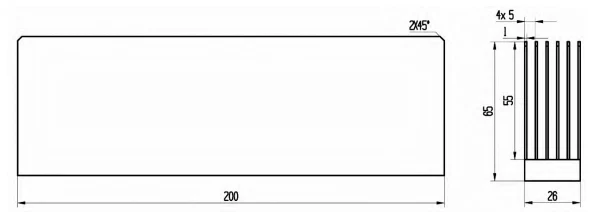
The total length of the part is 200 mm (Fig. 2). The key challenge lies in the structural dimensions of the individual fins: the fin thickness is only 1 mm, the fin height is 55 mm, and the fin spacing is 5 mm.
Calculations show that the height-to-width ratio reaches 13.75, far exceeding the commonly accepted threshold of 10:1 for structures with high aspect ratios.
This places it in the category of extremely difficult-to-machine parts.
The extremely high depth-to-width ratio results in significant tool overhang during machining, which severely compromises system rigidity.
At the same time, the thin-walled teeth that have already been machined cannot provide effective support for the tool.
This makes them highly susceptible to chattering and plastic deformation under cutting forces, which is the main challenge facing the process.
Analysis of the Properties of 6061 Aluminum Alloy
This heat sink is made of 6061 aluminum alloy, which belongs to the Al-Mg-Si series of heat-treatable
Its primary components are 0.8%–1.2% Mg and 0.4%–0.8% Si, with the remainder being Al.
In the T6 condition, this material has a tensile strength of approximately 272.9 MPa, a yield strength of 303 MPa, and an elongation of 11.7%.
In terms of machinability, 6061 aluminum alloy has low hardness and good plasticity; although this helps reduce cutting power, it tends to cause chip adhesion, leading to the formation of built-up edges.
Chip buildup alters the tool’s geometric angles, causing fluctuations in cutting forces.
When it detaches, it can easily scratch the machined surface, severely affecting the quality of the finished part.
Furthermore, although this alloy has good thermal conductivity, heat dissipation is limited under deep-groove closed-milling conditions.
Localized temperature rise may still cause material softening, which exacerbates the tendency for deformation.
Analysis of Machining Challenges
Based on structural and material characteristics, the machining of this heat sink presents three major challenges:
First, the tool’s length-to-diameter ratio exceeds 13, resulting in severe rigidity deficiency.
Under the influence of cyclic cutting forces, this can easily trigger chattering, which affects surface quality and may lead to tool failure.
Second, the cooling fins, with a thickness of only 1 mm, are prone to bending and deformation under radial cutting forces.
As the machining depth increases, accumulated stress may cause overall warping or root fracture.
Furthermore, chip evacuation is difficult during deep grooving operations, and 6061 aluminum alloy tends to stick to the tool, forming built-up edges.
This triggers a vicious cycle of surface scratching and secondary tool sticking, severely affecting machining quality and yield rates.
Experiments on Conventional Machining Processes and Failure Analysis
Experiments on Conventional Processes
To validate the above analysis and establish a baseline for optimization, experiments were first conducted using two conventional machining methods.
(1) Scheme 1: Single-pass layered cutting scheme.
A solid aluminum-grade extended three-flute end mill with a diameter of Ø4 mm, an overhang length of 60 mm, and a cutting edge length of 25 mm was selected.
A layered reciprocating cutting path strategy was adopted, with a cutting depth of 0.5 mm per layer, a spindle speed of S = 10,000 rpm, and a feed rate of F = 3,000 mm/min.
(2) Scheme 2: Two-Tool, Two-Depth Layered Cutting Scheme.
Given that Option 1 may fail due to the tool being too long, a two-stage machining approach is attempted.
In the first stage, a Ø4 mm solid aluminum extended three-flute end mill with a 40 mm overhang and a 25 mm cutting edge length is used to mill to a depth of 35 mm;
In the second stage, switch to a Ø3.8 mm solid aluminum extended three-flute end mill with an overhang of 60 mm and a cutting edge length of 20 mm to continue milling to the final depth of 55 mm.
The cutting parameters are similar to those in Scheme 1.
Failure Results and Analysis
Neither of the two conventional machining methods produced acceptable parts.
In Approach 1, the heat sink exhibited significant warping at a machining depth of approximately 40 mm. Root fracture then occurred at 45 mm.
In Approach 2, significant deformation and fracture also occurred in the later stages.
The failure mechanism stems primarily from three factors:
First, the tool’s excessive length-to-diameter ratio and insufficient cutting edge length, combined with poor system rigidity, caused severe chatter;
Second, cutting heat accumulates in the deep groove, causing the material to soften.
This makes it more susceptible to deformation under radial forces, thereby creating a vicious cycle of force–heat coupling.
Furthermore, stress concentrations exist at the geometric transition points at the base of the heat sink fins, which are prone to exceeding the material’s fatigue limit under alternating loads.
Tests have shown that traditional machining strategies with long tools and short cutting edges cannot meet the machining requirements for such structures with high aspect ratios.
Optimized Design of a Multi-Layer Progressive Milling Process
Optimization Approach
Based on lessons learned from traditional machining failures, this optimization focuses on “enhancing rigidity, distributing loads, and controlling stress.”
Specifically, this includes selecting tools with a cutting edge length greater than the groove depth to enhance rigidity.
It also involves machining the 55 mm total height in layers to distribute cutting forces and heat.
Additionally, a tapered tool diameter strategy is adopted to reduce interference between the tool and the machined side walls.
This effectively controls radial cutting forces and suppresses workpiece deformation.
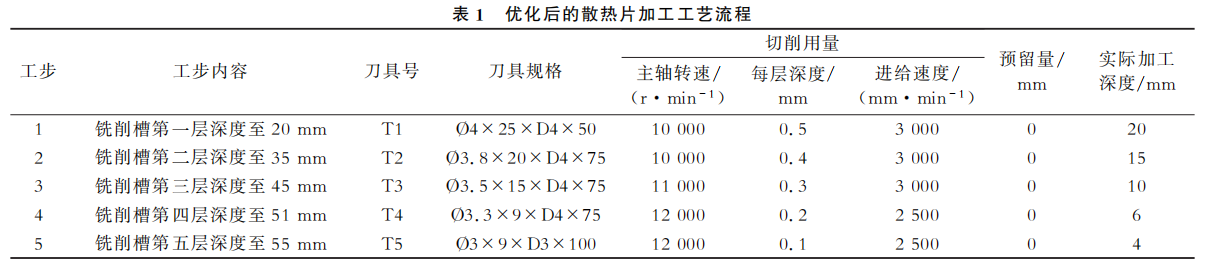
Process Plan (Table 1)
Criteria for Tool and Parameter Selection
(1) Tool Selection: A 65° iridescent-coated three-flute end mill for aluminum is selected for all steps.
The three-flute design ensures adequate chip clearance while providing excellent cutting stability.
The 65° Shimmer Coating is a physical vapor deposition (PVD) coating specifically designed for machining aluminum alloys.
Its surface is extremely smooth, with an extremely low coefficient of friction, which significantly reduces the adhesion of aluminum chips and effectively prevents the formation of built-up edges.
(2) Spindle speed parameters:A higher spindle speed of 10,000–12,000 rpm is adopted.
This helps form thinner chips and allows more of the cutting heat to be dissipated through the chips, thereby reducing the heat transferred to the workpiece.
(3) Per-pass cutting depth parameters: A strategy of gradually decreasing the cutting depth is adopted, reducing it from 0.5 mm to 0.1 mm.
During the shallow-cutting stage (the first two passes), a larger cutting depth is used to improve efficiency.
As the depth increases and the structure weakens, the cutting depth is gradually reduced to lower the cutting load on each cutting edge and to control cutting forces and vibrations.
(4) Feed Rate Parameters:Maintain a relatively high feed rate (3000 mm/min) during the first three passes.
During the final two finishing operations, the feed rate is appropriately reduced (2500 mm/min) to achieve a better surface finish and further reduce cutting forces.
Comparison and Analysis of Optimization Results
Machining Results
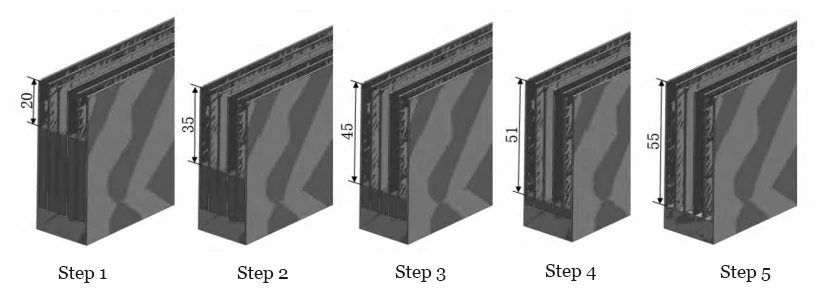
By applying the optimized five-step process described above (Fig. 3), complete heat sink components can be produced. Inspection revealed that all heat sinks were intact, with no visible bending, deformation, or fractures.
Comparative Analysis
The results of the optimized process show a marked contrast to those of the traditional process.
In terms of quality, workpieces produced using the traditional process generally exhibit warping, deformation, or fractures.
In contrast, the optimized process yields conforming products with precise dimensions and intact structures.
Quantitative data shows that the pass rate for the traditional method is extremely low, whereas the pass rate for the optimized method remains stable at over 95%.
The overall efficiency and cost-effectiveness of the optimized method are significantly superior to those of the traditional method, demonstrating superior process feasibility.
Analysis of the Mechanism of Effectiveness
The effectiveness of the optimized process primarily stems from the following mechanisms:
First, selecting tools with a cutting edge length greater than the groove depth for each machining step significantly enhances system rigidity and reduces interference and chatter.
Second, layered cutting distributes the total load across multiple stages, avoiding force and heat concentration, and ensuring that the instantaneous load remains below the critical value for thin-wall buckling.
Furthermore, the “tapered” tool diameter strategy creates a micro-gap between the tool’s side edge and the machined surface.
This effectively reduces friction and squeezing, thereby actively controlling the radial cutting forces that cause deformation.
In addition, specialized coated tools for aluminum possess excellent anti-gluing properties.
They ensure smooth chip evacuation, suppress the formation of built-up edges, and maintain cutting process stability and surface quality.
Conclusion
This paper systematically analyzes the machining processes for ultra-thin heat sinks made of 6061 aluminum alloy.
The results indicate that traditional “single-pass” or “two-pass” machining processes struggle to achieve stable machining of structures with high aspect ratios.
This is due to insufficient system rigidity and concentrated cutting forces.
The proposed “multi-layer progressive five-step milling” process, through layered machining, gradual reduction of tool diameter, and optimization of cutting parameters, effectively disperses cutting forces and heat.
It also controls radial forces and chatter, significantly improving the machining yield rate.
This approach has significant engineering application value and provides a reliable reference for the machining of similar thin-walled structures.
Future research could incorporate cutting force monitoring and finite element simulation to further optimize parameters and expand the process’s applicability.