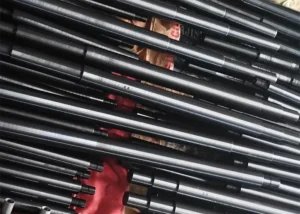
We call blackening the process in which steel parts undergo oxidation treatment to form a black oxide film on their surfaces.
We can classify blackening into two types based on oxidation temperature: high-temperature oxidation blackening and room-temperature blackening.
Compared with high-temperature oxidation blackening, room-temperature blackening uses a less stable and toxic solution.
It demands more rigorous pretreatment. Besides, the blackened coating produced by this process has inferior adhesion, corrosion resistance and wear resistance.
Wind turbine bearing components work under harsh operating conditions.
Manufacturers adopt high-temperature oxidation blackening modification technology on the rings and rolling elements of these components to satisfy such service requirements.
High-temperature oxidation blackening does not affect the machined dimensions of the parts, and the blackened layer bonds firmly to the base metal.
After modification, the original metal’s fundamental properties—such as mechanical properties, strength, and magnetic properties—remain unchanged, and the material exhibits good high-temperature stability.
Workers perform oxidation and blackening treatment on wind turbine bearing rings and rolling elements.
This treatment improves bearing performance under poor lubrication conditions.
It boosts the bearings’ resistance to corrosion and contamination. Also, it lowers the risk of wear, fine pitting, and cracking.
The process mitigates damage induced by corrosive lubricant additives. In addition, it reduces friction and wear.
Principles of Surface Oxidation and Blackening of Wind Turbine Bearing Components
There are various methods for blackening bearing surfaces.
High-temperature oxidation blackening involves immersing steel in a concentrated sodium hydroxide solution and subjecting it to an oxidation treatment at high temperatures ranging from 130 to 150°C.
The blackened film consists primarily of magnetic iron oxide (Fe₃O₄).
The color of the film depends on the composition of the steel material, its surface condition, and the specifications of the oxidation blackening process.
Reaction Mechanism of Blackening and Film Formation: The steel workpiece undergoes a chemical reaction with the hot oxidizing solution, forming an oxide film on the workpiece surface.
Operators complete the main process through the following steps:
① Under the action of a hot alkaline solution and an oxidizing agent, sodium ferrite is formed on the steel surface (3Fe + 5NaOH + NaNO₂ → 3Na₂FeO₂ + H₂O + NH₃ ↑);
② Sodium ferrite further reacts with the oxidizing agent in the solution to form sodium ferrate (6Na₂FeO₂ + NaNO₂ + 5H₂O → 3Na₂Fe₂O₂ + 7NaOH + NH₃ ↑);
③ Na₂Fe₂O₂ and Na₂FeO₂ have high solubility in concentrated alkali, but when mixed together, they react to form Fe₃O₄ (Na₂Fe₂O₂ + Na₂FeO₂ + 2H₂O → Fe₃O₄ ↓ + 4NaOH);
④ Fe₃O₄ has low solubility in solution; when the concentration reaches saturation, it crystallizes out, first forming crystal nuclei, then growing into crystals, and eventually coalescing into a continuous film.
Once the oxide film completely covers the steel surface, it isolates the liquid from the substrate, thereby reducing both the dissolution of iron and the formation of the oxide film.
As Fe₃O₄ forms, sodium nitroprusside readily undergoes hydrolysis to form iron hydroxide, which appears as a reddish residue.
Part of this residue remains in the solution, while another portion adheres to the parts and is difficult to remove, thereby affecting surface quality.
Surface Oxidation and Blackening Process for Wind Turbine Bearing Components
Traditional Single-Step Oxidation and Blackening Process
Loading onto racks → Cleaning and degreasing → Cold water rinse → Acid pickling → Cold water rinse → Oxidation and blackening treatment → Cold water rinse → Hot water cleaning → Saponification → Oil immersion → Submission.
China’s Advanced Secondary Oxidation Blackening Process
Loading → Ultrasonic degreasing and cleaning → Degreasing → Cold water rinse → Cold water rinse → Hot water rinse → First blackening treatment → Cold water rinse → Second blackening treatment → Cold water rinse → Cold water rinse → Cold water rinse → Saponification → Dehydration and rust-preventive oil application → Submission.
To achieve high corrosion resistance and an oxide film free of red scale, wind turbine bearing components undergo a two-stage blackening process (using two blackening tanks).
The first tank primarily serves to form nucleation sites, which in turn create a dense oxide blackening film, while the second tank is mainly used to increase the thickness of the oxide blackening film.
The two blackening tanks are separate units, with the processing temperature of the second tank maintained approximately 5°C higher than that of the first.
Operators perform a cold water rinse between the two blackening tanks.
Currently, the two-stage blackening process at Luoyang LYC Bearing Co., Ltd. offers the following advantages:
Pre-treatment no longer requires acid pickling for activation, which significantly reduces quality risks associated with hydrogen embrittlement.
We compare the two-stage oxidation blackening process with the traditional single-stage blackening method.
It overcomes the drawbacks of the traditional process. This technique can effectively inhibit red scale formation and shorten blackening duration.
Moreover, it yields an oxidation blackening film featuring high wear resistance, high corrosion resistance and high luster.
Operators can control the thickness of the blackening film between 1 and 2 μm.
Test Materials
Researchers selected two different types of finished self-aligning rollers and rings for wind turbine bearings as test specimens for this test.
The materials used were high-carbon chromium bearing steel GCr15SiMn and carburized bearing steel G20Cr2Ni4A; their chemical compositions are shown in Table 1.
| Material Grade | C | Si | Mn | Cr | Mo |
|---|---|---|---|---|---|
| GCr15SiMn | 0.95–1.05 | 0.45–0.75 | 0.95–1.25 | 1.40–1.65 | ≤ 0.1 |
| G20Cr2Ni4A | 0.17–0.23 | 0.15–0.40 | 0.30–0.60 | 1.25–1.75 | ≤ 0.08 |
Table 1. Chemical Composition of Materials Used for Wind Turbine Shaft Bearing Components
Quality Inspection and Analysis of Black Oxide Coatings on Wind Turbine Bearings
Inspection of Basic Surface Morphology
Visual Inspection: Inspect the workpiece visually under good lighting conditions, with an illuminance of no less than 2,200 lx.
Visually inspect the appearance and morphology of the blackened coating.
The color of the blackened coating should be a uniform black or deep black (carbonized steel may exhibit a slight reddish tint after oxidation and blackening);
The oxidized blackened coating layer should be continuous, uniform, and intact, covering the entire surface of the part;
Green spots, rust, obvious color variations, coating damage, or unblackened areas are not permitted; red or green dust deposits are not permitted.
Adhesion Test
Wipe the blackened film layer repeatedly and evenly with a clean white paper towel or white, fine cloth.
The test is considered satisfactory if no black or other colors appear on the white paper or cloth.
Blackening Film Thickness (Film Weight) Test
Test specimens for the blackening film weight test consist of blackened bearing components (rollers) or specialized test specimens.
1. Test Specimen Requirements
The material, surface condition, and surface roughness of the specialized test specimens should be consistent with those of the blackened bearing components.
The test specimen dimensions may be 50 mm × 50 mm × 1 mm. Both the test specimens and the bearing components undergo the blackening treatment under identical conditions.
2. Gravimetric Test Procedures
Operators measure coating weight using the gravimetric method: After blackening, they dry the test specimen and cool it directly to room temperature.
The specimen is weighed (m1), then immersed in the blackening coating weight test solution until the blackened layer is completely dissolved and removed.
It is then rinsed, dried, cooled to room temperature, and weighed again (m2);
Determine the weight loss of the blank test (m0).
Weigh a sample made of the same material that has not undergone blackening treatment (the sample is cleaned with anhydrous ethanol or by other means and dried) to obtain m3.
Immerse it in the blackening film weight test solution for the same duration as the blackened sample, then rinse, dry, and cool to room temperature before weighing it again (m4).
3. Calculation and Acceptance Specification
(1) Calculation of the film weight per unit area (mA). Formula for calculating the mass loss of the blank test (m0) (mg): m0 = m3 – m4.
Formula for calculating the mass of the coating lost by the test specimen (Em) (mg): Em = m1 – m2 – m0.
Formula for calculating the mass of the film per unit area (mA) (g/m²): mA = 10(Em/A), where A is the area of the oxidized blackening film on the test specimen (m²), and 10 is the unit conversion factor.
Measure the film mass mA in three replicate tests and take the arithmetic mean as the test result.
(2) After secondary blackening, the mass per unit area (film mass) of the oxidation blackening film on the rollers of wind turbine bearing components is generally controlled between 4.5 and 7.5 g/m², with a film thickness of 1 to 2 μm.
Testing the Porosity and Continuity of the Blackening Film
In this experiment, a fresh 3% copper sulfate solution was used.
Operators applied drops of the solution to the surface of a blackened roller that had not been oil-soaked.
Operators then wiped away the droplets with filter paper. They examined the film surface under a 10× microscope to check for red spots or red patches that indicate film damage.
The test lasted more than 20 minutes, and operators observed no red spots or red patches indicating film damage.
Corrosion Resistance Testing of Blackened Coatings
1. Acetic Acid Resistance Test at Room Temperature
After blackening, the test specimen is dried immediately and cooled to room temperature.
Three drops of test solution (20% aqueous acetic acid solution) are applied to a flat surface of the specimen.
The test solution should show no noticeable color change; the test duration must exceed 40 minutes, and there should be no noticeable color change at the droplet sites.
2. Oxalic Acid Resistance Test at Room Temperature
After the test specimen turns black, dry it immediately and cool it to room temperature.
Apply 3 drops of the test solution (5% aqueous oxalic acid solution) to a flat surface of the specimen.
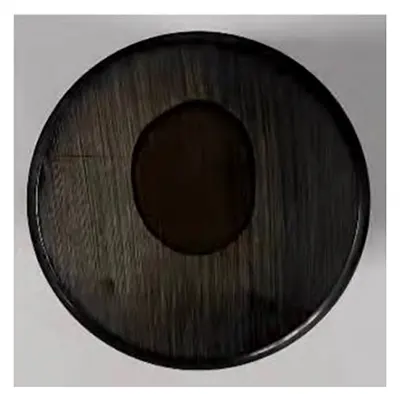
After wiping away the test solution droplets, the appearance of the tested area should be black to dark brown with a ring-shaped pattern.
If the film in the tested area turns gray with a light gray ring, the oxidized blackened film is deemed substandard.
When the test duration exceeds 20 minutes, the area where the drops were applied should appear black to dark brown with a ring-shaped pattern, as shown in Figure 1.
Factors Affecting the Quality of the Oxidized Black Coating on Wind Turbine Bearings
The Effect of Oxidizing Solution Composition
High-temperature oxidizing solutions generally consist of sodium hydroxide and an oxidizing agent; sodium nitrite is commonly used as the oxidizing agent.
The resulting oxide coating is black and has a good luster. The sodium hydroxide content affects the oxidation rate of steel;
For high-carbon steel, which oxidizes rapidly, a concentration of 550–650 g/L can be used.
At higher sodium hydroxide concentrations, the oxide film is thicker but becomes loose and porous, making it prone to red scaling.
If the sodium hydroxide concentration exceeds 1,100 g/L, magnetic iron oxide is dissolved and cannot form a film;
If the concentration is too low, the oxide film is thin with a mottled surface and offers poor corrosion protection.
A high oxidizing agent concentration accelerates the oxidation rate and produces a dense, robust film;
When the oxidizing agent concentration is insufficient, the oxide film is thick but loose.
A certain amount of iron ions is required in the oxidizing solution to produce a dense film with good adhesion; this is generally controlled at 0.5–2 g/L.
Excessive iron ion content can slow down the oxidation rate and lead to the formation of red scale.
Effects of Oxidation Temperature and Time
If the oxidation temperature is too high, the reaction rate is very fast, and red or yellow-green scale is likely to adhere to the oxide film;
If the oxidation temperature is too low, the reaction rate is slow, making it difficult to form a dense oxide film with poor adhesion—or resulting in no film formation at all and scale shedding;
If the oxidation time is too short, the oxide film is prone to mottling, with uneven color, a thin film, or even no film formation at all.
Factors Affecting Product Surface Quality
The cleanliness of the surface of steel workpieces prior to oxidation directly affects the quality of the oxide film.
During the oxidation process, if the surface of the steel workpiece is contaminated with oil, the oil will isolate the metal surface from the oxidizing solution, thereby hindering a normal reaction between the workpiece and the solution.
This prevents the oxidation reaction from proceeding uniformly across the entire surface, resulting in significant variations in appearance and color.
Consequently, the oxide film may exhibit mottling, uneven coloration, localized areas without a film, or localized peeling of the oxide film.
Atmospheric corrosion or heat treatment may form oxides or salts on metal surfaces.
These contaminants directly block the reaction between the base metal and oxidizing solution. As a result, an oxide film cannot form on the metal surface.
Therefore, before undergoing blackening treatment, finished bearing parts must be ground to remove any oxides or salts covering the surface.
Various defects may arise in prior machining operations.
Typical examples include grinding burn marks, incompletely quenched local regions, uneven carbon concentration within the surface structure, impact damage, and inconsistent surface finish.
All these defects can cause non-uniform color of the oxidation film.
The Effect of Steel Types
Base metals with different compositions exhibit significant differences in their oxidation reactions.
Medium- and high-carbon steels oxidize more easily;
The higher the carbon content, the faster the oxidation rate, the shorter the oxidation time, and the darker the color of the oxide film.
Alloy steels and low-carbon steels oxidize more slowly, with longer oxidation times;
The appearance and color of the oxide film vary significantly depending on the content and distribution of carbides and alloying elements in the steel.
Therefore, the composition of the oxidation bath and the process parameters selected for different steel components also differ.
The Impact of Production Equipment
Mass production requires an automated blackening line.
The automated control system ensures strict adherence to process requirements, parameters, and cycle times.
Ultrasonic degreasing improves the quality of part cleaning and reduces the impact of product cleanliness on the quality of the blackening process.
The bath temperature can be adjusted automatically. Its control accuracy reaches ±2°C, which guarantees a stable blackening temperature.
Automated production operations strengthen management and monitoring capabilities.
This improves the quality of the bearing blackened oxide film and maintains stable oxidation process performance.
Automated production lines effectively avoid various appearance defects in the blackening process.
These defects include uneven shaking induced by manual operation, contact marks on the oxidation film caused by collisions, as well as scratches and abrasions on the film surface.
Furthermore, automated production significantly improves the overall efficiency of the blackening process.
Conclusion
The aforementioned process can be adopted for secondary oxidation blackening of wind turbine bearing components.
It enables precise control over the weight of the blackened coating.
The coating weight ranges from 4.5 to 7.5 g/m², and the coating thickness is maintained at 1 to 2 μm.
The blackened coating features high density and outstanding corrosion resistance.
It satisfies the performance standards for oxidation blackening applied to wind turbine bearings.
In addition, it meets the technical demands of both domestic and international customers.