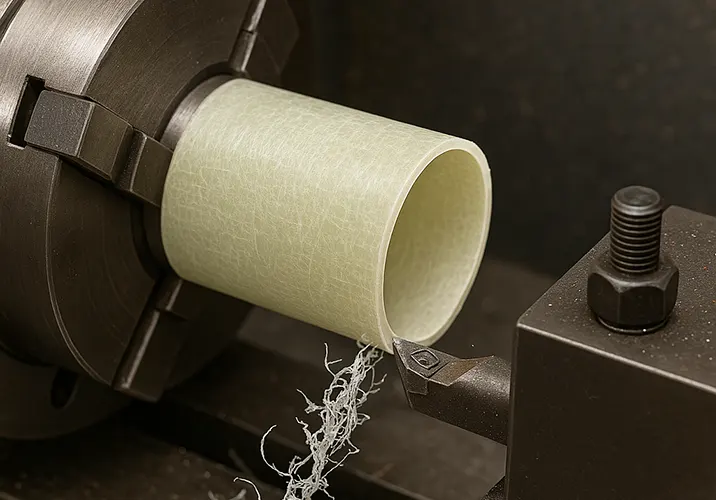
How to turning thin-walled fiberglass parts ?
with the development of industrial technology, more and more new materials with thin walls have been applied in industrial production on a large scale
FRP Machining refers to the machining and shaping of Fiber-Reinforced Plastics (FRP)—composite materials made of a polymer matrix reinforced with fibers such as glass fiber (GFRP), carbon fiber (CFRP), or aramid fiber (Kevlar).
FRP materials are widely used for their high strength-to-weight ratio, corrosion resistance, and design flexibility, but they are difficult to machine due to their abrasive fibers and layered structure.
As a result, FRP machining requires specialized tools, cutting conditions, and strategies.
FRP is not homogeneous like metals. It has:
A matrix (epoxy, polyester, thermoplastic)
Reinforcement fibers (glass, carbon, aramid)
A laminated or woven structure
This causes unique machining challenges:
Abrasion leads to rapid tool wear
Heat buildup can damage the polymer matrix
Fibers may break out, fray, or delaminate
Used for trimming, pockets, and contours.
Requires:
Diamond-coated cutters
High spindle speed
Low feed per tooth to avoid tearing
FRP drilling is prone to:
Delamination at entry/exit
Fiber pull-out
Oversized holes
Solutions include:
Brad-point drills
Carbide or PCD drills
Backup plates and optimized peck cycles
Non-thermal cutting method ideal for FRP, avoiding matrix burning.
Used for thin thermoplastic composites, but may overheat thermoset FRP.
Diamond grinding wheels help control edge quality.
FRP requires abrasion-resistant tools, such as:
PCD (Polycrystalline Diamond) cutters
CVD diamond-coated tools
Carbide tools for low-volume runs
Tool geometries:
High rake angle
Sharp cutting edge
Chipbreaker geometry for fiber control
FRP machining focuses on minimizing heat and delamination:
High spindle speed
Low feed rate
Shallow depth of cut
Low cutting force
Good dust extraction (FRP dust is hazardous)
Coolant is generally avoided for CFRP and GFRP—air blast is preferred.
| Defect | Cause | Prevention |
|---|---|---|
| Delamination | Excessive thrust, poor tool condition | Use PCD tools, optimize feed, backup support |
| Fiber Pull-Out | Dull tools | Use sharp, diamond-coated tools |
| Matrix Burning | High heat buildup | Use air cooling, reduce speed/feed |
| Surface Chipping | Aggressive cuts | Use small depth of cut |
| Tool Wear | Abrasive fibers | Diamond-coated tooling |
✔ Aerospace: Fairings, bracketry, UAV components
✔ Automotive: Lightweight structural parts
✔ Marine: Decks, hull sections
✔ Industrial Equipment: Covers, supports, insulators
✔ Electronics: Non-conductive frames, housings
Lightweight and strong parts
Corrosion-resistant components
Capable of intricate shapes
No rust, low maintenance
Excellent performance in harsh environments
with the development of industrial technology, more and more new materials with thin walls have been applied in industrial production on a large scale