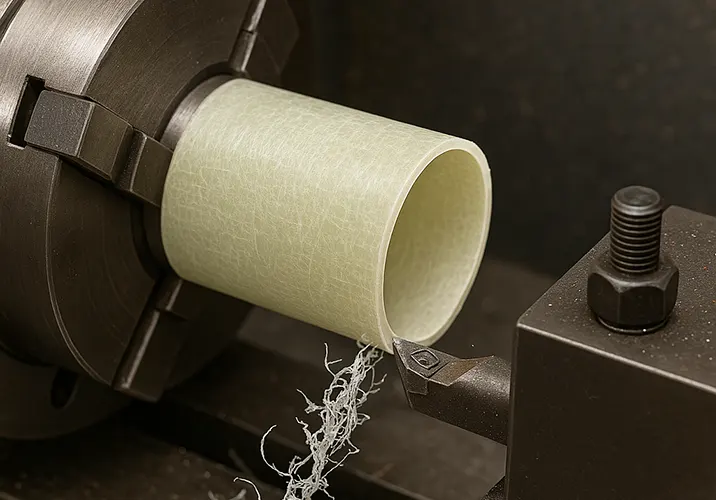
FRP Machining
FRP Machining refers to the machining and shaping of Fiber-Reinforced Plastics (FRP)—composite materials made of a polymer matrix reinforced with fibers such as glass fiber (GFRP), carbon fiber (CFRP), or aramid fiber (Kevlar).
FRP materials are widely used for their high strength-to-weight ratio, corrosion resistance, and design flexibility, but they are difficult to machine due to their abrasive fibers and layered structure.
As a result, FRP machining requires specialized tools, cutting conditions, and strategies.
1. Characteristics of FRP Materials
FRP is not homogeneous like metals. It has:
-
A matrix (epoxy, polyester, thermoplastic)
-
Reinforcement fibers (glass, carbon, aramid)
-
A laminated or woven structure
This causes unique machining challenges:
-
Abrasion leads to rapid tool wear
-
Heat buildup can damage the polymer matrix
-
Fibers may break out, fray, or delaminate
2. Common FRP Machining Processes
✔ 1. CNC Milling
Used for trimming, pockets, and contours.
Requires:
✔ 2. CNC Drilling
FRP drilling is prone to:
Solutions include:
✔ 3. Waterjet Cutting
Non-thermal cutting method ideal for FRP, avoiding matrix burning.
✔ 4. Laser Cutting (special cases)
Used for thin thermoplastic composites, but may overheat thermoset FRP.
✔ 5. Grinding & Finishing
Diamond grinding wheels help control edge quality.
3. Tooling for FRP Machining
FRP requires abrasion-resistant tools, such as:
Tool geometries:
4. Recommended Machining Parameters
FRP machining focuses on minimizing heat and delamination:
Coolant is generally avoided for CFRP and GFRP—air blast is preferred.
5. Common Defects in FRP Machining
| Defect |
Cause |
Prevention |
| Delamination |
Excessive thrust, poor tool condition |
Use PCD tools, optimize feed, backup support |
| Fiber Pull-Out |
Dull tools |
Use sharp, diamond-coated tools |
| Matrix Burning |
High heat buildup |
Use air cooling, reduce speed/feed |
| Surface Chipping |
Aggressive cuts |
Use small depth of cut |
| Tool Wear |
Abrasive fibers |
Diamond-coated tooling |
6. Applications of FRP Machined Parts
✔ Aerospace: Fairings, bracketry, UAV components
✔ Automotive: Lightweight structural parts
✔ Marine: Decks, hull sections
✔ Industrial Equipment: Covers, supports, insulators
✔ Electronics: Non-conductive frames, housings
7. Advantages of FRP Machining
-
Lightweight and strong parts
-
Corrosion-resistant components
-
Capable of intricate shapes
-
No rust, low maintenance
-
Excellent performance in harsh environments