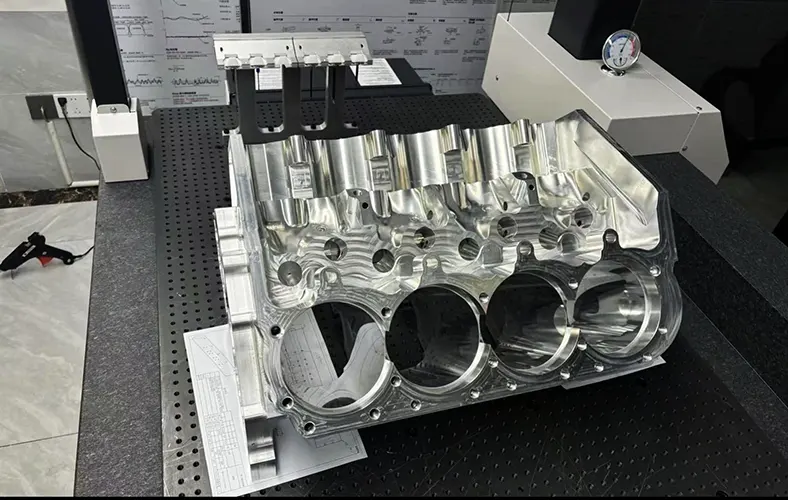
free-form surface machining
Free-form surface machining refers to the CNC machining process used to manufacture complex, curved, and non-uniform 3D surfaces that cannot be defined by simple geometric shapes such as planes, cylinders, or cones.
These surfaces—often called sculptured surfaces—feature continuously changing curvature, requiring advanced multi-axis CNC machines, precise CAM toolpath strategies, and high-stability fixturing to achieve the desired accuracy and finish.
Free-form surface machining is essential for industries where aerodynamics, ergonomics, fluid dynamics, and aesthetics drive the design.
1. Core Characteristics
✔ Complex 3D Geometry
Free-form surfaces have:
No constant curvature
Smooth transitions
Multi-directional slopes
Local micro-features
✔ Requires Multi-Axis Machining
Typically performed on 4-axis or 5-axis CNC machines, which allow the tool to tilt and rotate to follow the surface contour smoothly.
✔ Precision Toolpath Generation
CAM systems must compute:
2. How Free-Form Surface Machining Works
Step 1: CAD Surface Modeling
Parts are modeled using:
Step 2: CAM Toolpath Generation
Specialized free-form toolpaths include:
Surface machining / scallop machining
Raster (zigzag) machining
Constant Z-level finishing
3D contour machining
Flowline machining
Projection toolpaths
Step 3: Multi-Axis CNC Machining
The machine controls:
Simultaneous X/Y/Z movement
Continuous A/B/C rotary axis rotation
Stable chip load and constant surface contact
Step 4: Finishing Operations
3. Tools Commonly Used
Ball nose end mills – For smooth curved surfaces
Torus / bull-nose end mills – Better surface finish, higher efficiency
Tapered ball mills – Special for mold/die small features
High-speed spindles – Reduce scallops and improve accuracy
4. Applications of Free-Form Surface Machining
✔ Aerospace
✔ Automotive
Body panels
Headlight reflectors
Engine housings
✔ Medical Devices
✔ Mold & Die Industry
✔ Consumer Electronics
✔ Industrial Design & Art
Sculptures
Ergonomic products
5. Advantages of Free-Form Surface Machining
High geometric flexibility
Superior surface finish with multi-axis motion
Reduced polishing time for molds
Improved aerodynamic/ergonomic performance
Capability to manufacture highly complex components
6. Challenges
Requires expensive 5-axis CNC equipment
CAM programming complexity
Difficult to maintain constant scallop height
Requires high rigidity to avoid chatter
Demands skilled machinists and programmers
Short SEO Meta Description (optional)
Free-form surface machining is the CNC process used to create complex, curved 3D surfaces using multi-axis machines and advanced CAM strategies—ideal for aerospace, automotive, mold-making, and medical components.