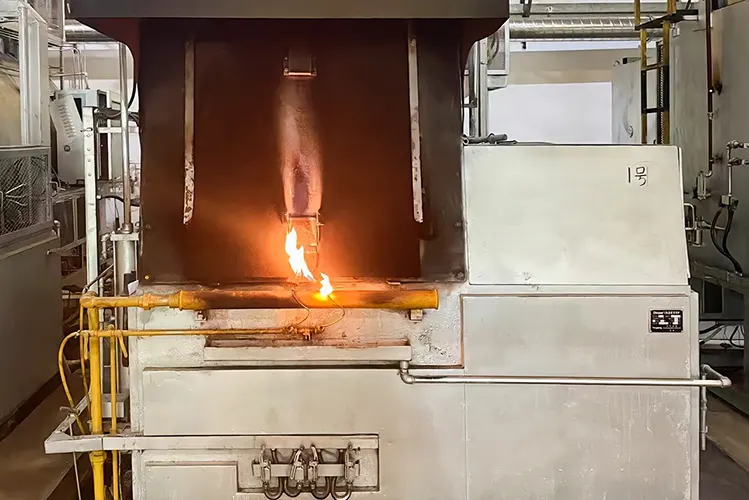
Forging Deformation
Forging deformation refers to the plastic deformation of metal under compressive forces during the forging process, where the material is shaped into a desired geometry by hammering, pressing, or rolling.
In forging, the metal is forced to flow into a new shape without cracking, while its internal grain structure becomes more compact and aligned—significantly improving strength, toughness, and fatigue resistance.
1. Core Concept
Forging deformation is a form of plastic flow, meaning:
-
The metal permanently changes shape
-
Internal grains elongate and refine
-
Original defects reduce or close
-
Mechanical properties improve
The process occurs at:
-
Hot forging temperatures (above recrystallization temperature)
-
Warm forging temperatures (between cold and hot)
-
Cold forging temperatures (room temperature, high force required)
2. How Forging Deformation Works
Forging deformation involves three fundamental stages:
Stage 1: Elastic Deformation
Stage 2: Plastic Deformation
-
Material yields and begins to flow
-
Grains stretch and reorganize
-
Shape changes permanently
Stage 3: Strain Hardening & Dynamic Recrystallization
-
Work hardening occurs (in cold forging)
-
New fine grains form (in hot forging)
-
Material becomes stronger and more ductile
3. Types of Forging Deformation
✔ Upsetting (Compressive Shortening)
-
Increasing diameter, reducing height
-
Common in bolt heads, flanges
✔ Drawing/Elongation
-
Reducing section thickness, increasing length
-
Used for shafts, axles, rods
✔ Bending
✔ Flattening
✔ Closed-Die Flow
4. Key Elements Influencing Forging Deformation
Material Properties
-
Ductility
-
Flow stress
-
Strain rate sensitivity
Temperature
Strain Rate
Lubrication
Die Design
5. Effects of Forging Deformation on Microstructure
Forging deformation dramatically improves material performance:
-
Grain refinement
-
Directional grain flow aligned with part geometry
-
Elimination/reduction of porosity
-
Improved mechanical properties, including:
-
Tensile strength
-
Fatigue resistance
-
Impact toughness
-
Wear resistance
This is why forged parts outperform cast or machined-from-solid parts in critical applications.
6. Common Defects in Forging Deformation
| Defect |
Cause |
Prevention |
| Laps / Folds |
Poor material flow |
Die redesign, controlled temperature |
| Cracks |
Low ductility, cold zones |
Preheating, proper strain distribution |
| Underfill |
Insufficient deformation |
Adjust die design, increase tonnage |
| Residual Stress |
Uneven deformation |
Controlled cooling |
| Fiber Flow Mismatch |
Incorrect forging direction |
Optimize forging layout |
7. Applications of Forging Deformation
Forging deformation is used to manufacture high-strength components in:
Aerospace
-
Turbine disks
-
Landing gear components
Automotive
-
Crankshafts
-
Connecting rods
-
Gear blanks
Energy & Oil/Gas
Industrial Machinery
Forged components are chosen when extreme strength, reliability, and fatigue resistance are required.