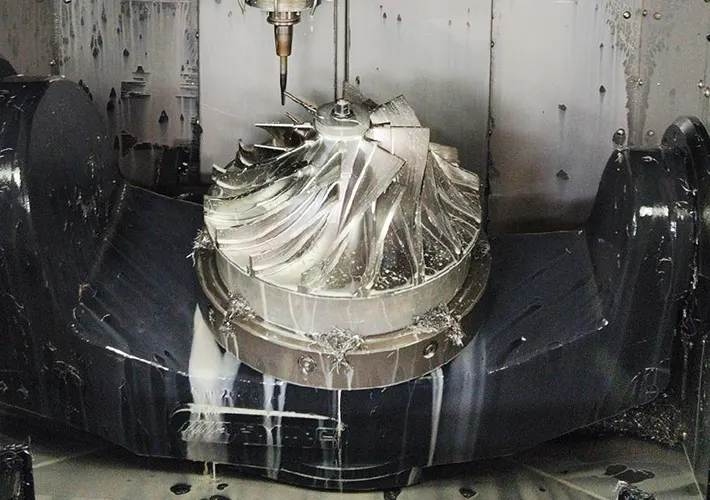
Five-Axis CNC Machining for UAV Components
Five-axis CNC machining is a critical technology in aerospace manufacturing, especially for Unmanned Aerial Vehicle (UAV) components, where complex geometries, tight tolerances, and lightweight designs are common. By moving the cutting tool along five different axes simultaneously, manufacturers can achieve high-precision, efficient machining of complex parts.
1. Understanding Five-Axis CNC Machining
2. Workflow for UAV Component Machining
Step 1: Design and CAM Programming
-
Import CAD model of the UAV component into CAM software.
-
Generate five-axis toolpaths considering:
-
Apply simulation to detect collisions and optimize machining strategy.
Step 2: Material Preparation
-
Common UAV materials: aluminum alloys, titanium, magnesium, and carbon fiber composites.
-
Secure the workpiece with high-precision fixtures to minimize vibration and deflection.
Step 3: Rough Machining
Step 4: Semi-Finishing
-
Refine features while leaving a small allowance for finishing.
-
Ensure geometrical accuracy for critical UAV surfaces such as wings, fuselage frames, or propeller hubs.
Step 5: Finishing
-
Use ball-end or tapered tools for smooth surface finish on complex contours.
-
Apply high-speed, low-depth finishing passes to achieve tight tolerances (±0.01 mm) and optimal surface roughness.
Step 6: Inspection and Quality Control
3. Key Considerations for UAV Components
-
Material Handling
-
Tool Selection
-
Fixturing
-
Error Compensation
-
Surface Finish
4. Benefits of Five-Axis CNC for UAV Manufacturing
-
Reduced Setup Time: Fewer setups needed due to multiple-axis machining.
-
High Precision: Tight tolerances achievable on complex geometries.
-
Efficient Material Removal: Optimized tool paths reduce cycle time and waste.
-
Complex Geometries: Machining of intricate UAV components impossible with 3-axis machines.
-
Improved Surface Finish: Minimizes post-processing and polishing requirements.
5. Applications in UAV Manufacturing
-
Structural Components: Fuselage frames, wing spars, bulkheads.
-
Propulsion Parts: Propeller hubs, engine mounts, gearbox housings.
-
Control Surfaces: Ailerons, rudders, and actuator mounts.
-
Custom Fixtures: Lightweight brackets and specialized connectors.
Five-axis CNC machining is essential for UAV components because it combines precision, efficiency, and flexibility, allowing manufacturers to produce lightweight, complex, and high-performance parts critical for aerospace applications.