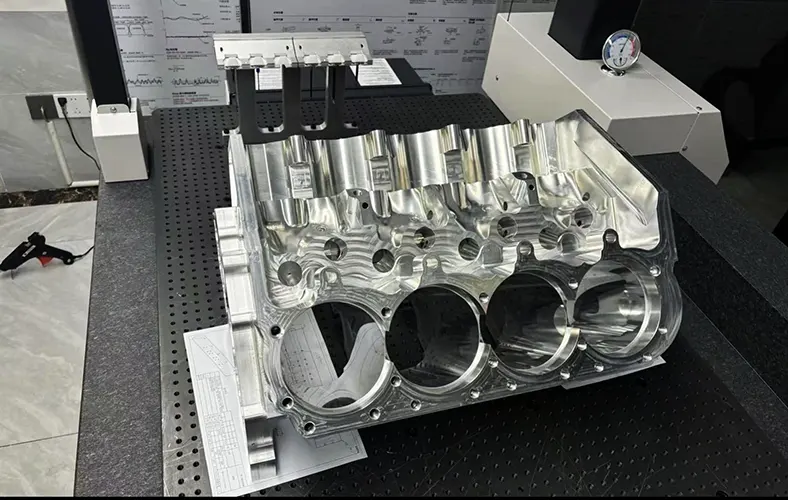
engine cylinder block machining
Engine cylinder block machining is a complex, high-precision process that ensures the cylinder block meets stringent dimensional, surface, and alignment requirements. The cylinder block is a structural core of an engine, housing cylinders, oil passages, and coolant channels. Proper machining is essential for engine efficiency, durability, and reliability.
1. Pre-Machining Preparation
Inspection of Raw Casting
Check for casting defects, warpage, cracks, or porosity.
Measure critical dimensions and ensure the block is suitable for machining.
Cleaning
Remove sand, scale, or residues from casting.
Clean oil passages and coolant channels.
Fixturing
2. Key Machining Operations
A. Deck Surface Machining
Flatten the cylinder block deck to ensure proper head gasket sealing.
Usually performed with milling machines or CNC machining centers.
Apply surface finish requirements, typically Ra 0.8–1.6 µm.
B. Cylinder Bore Machining
Boring
Honing
Use cylinder hone or diamond honing tool to achieve precise diameter, surface roughness, and crosshatch pattern for oil retention.
Typical tolerance: ±0.01 mm or tighter depending on engine design.
C. Main Bearing and Camshaft Bore Machining
D. Threaded Holes and Oil/Coolant Passages
Tap holes for bolts, sensors, and accessories.
Drill and chamfer oil and coolant passages for smooth fluid flow.
E. Surface Finishing and Chamfering
3. Machining Considerations
Tool Selection
Use high-speed steel, carbide, or coated tools for durability and precision.
Consider boring bars, end mills, drills, reamers, and honing tools.
Cutting Parameters
Adjust speed, feed, and depth of cut according to material (cast iron, aluminum alloys, or composite materials).
Coolant and Lubrication
Error Compensation
Quality Control
Measure cylinder bore diameter, deck flatness, and alignment using CMM, bore gauges, or dial indicators.
Verify surface finish and tolerances per design specifications.
4. Post-Machining Operations
Clean oil passages and coolant channels.
Apply protective coatings if required (e.g., anti-corrosion treatments).
Perform final inspection and dimensional verification before assembly.
5. Applications
Automotive Engines: Passenger cars, trucks, and motorcycles.
Aerospace Engines: High-precision piston engines or auxiliary power units.
Industrial Engines: Heavy machinery, generators, and marine engines.
Engine cylinder block machining requires careful planning, precision fixturing, proper tooling, and quality verification. Advanced CNC machining centers combined with honing, boring, and error compensation techniques ensure high dimensional accuracy, surface quality, and alignment, which are critical for engine performance and longevity.