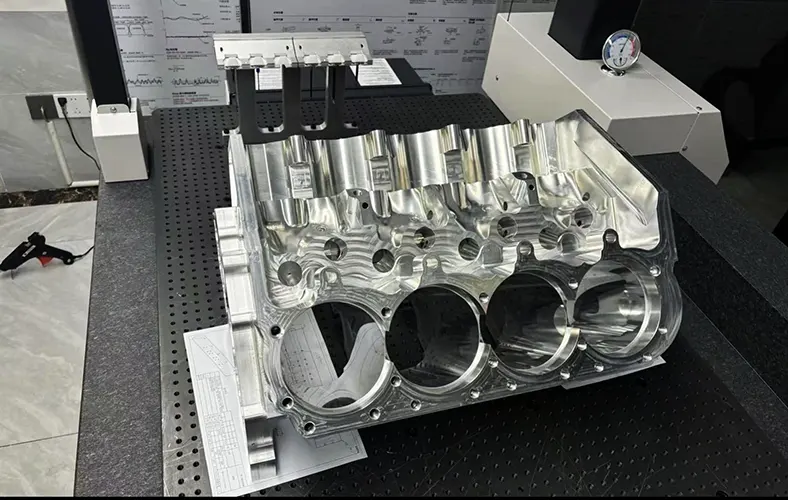
engine block CNC machining
Engine block CNC machining is a critical process that ensures the core component of an engine—the engine block—meets high precision, dimensional accuracy, and surface finish requirements. CNC machining allows for repeatable, high-accuracy operations, making it ideal for automotive, aerospace, and industrial engines.
1. Pre-Machining Preparation
-
Inspection of Raw Casting
-
Check for casting defects such as warpage, cracks, or porosity.
-
Measure critical dimensions to determine stock removal requirements.
-
Cleaning
-
Remove sand, scale, or residual casting materials.
-
Clean oil and coolant passages thoroughly.
-
Fixturing
2. CNC Machining Operations
A. Deck Surface Milling
-
Flatten the cylinder block deck to ensure proper head gasket sealing.
-
Use a CNC milling machine with a face mill or end mill.
-
Achieve surface finish of Ra 0.8–1.6 µm, depending on engine specifications.
B. Cylinder Bore Machining
-
CNC Boring
-
Precisely enlarge cylinder bores using a CNC boring head or bar.
-
Maintain cylindricity, taper, and diameter tolerances.
-
Honing
C. Main and Camshaft Bore Machining
D. Threaded Holes and Passages
-
Drill, tap, and chamfer holes for bolts, sensors, and accessory mounting.
-
Drill oil and coolant channels for smooth fluid flow using CNC-drilled paths.
E. Surface Finishing
-
Chamfer all sharp edges and remove burrs.
-
Optional secondary operations: deburring, polishing, or coating.
3. CNC Machining Considerations
-
Tooling
-
Use carbide, coated, or high-speed steel tools for durability and precision.
-
Common tools: end mills, drills, reamers, boring bars, and honing tools.
-
Cutting Parameters
-
Adjust spindle speed, feed rate, and depth of cut based on material (cast iron, aluminum alloy, or composites).
-
Coolant and Lubrication
-
Error Compensation
-
Inspection and Quality Control
-
Measure deck flatness, cylinder bore diameter, cylindricity, and alignment using CMM, bore gauges, or laser measurement tools.
-
Verify surface finish and tolerances against engine design specifications.
4. Post-Machining Operations
-
Clean oil and coolant passages.
-
Apply anti-corrosion coating if required.
-
Perform final inspection before assembly.
5. Applications
-
Automotive Engines: Cars, trucks, motorcycles.
-
Aerospace Engines: Precision piston engines.
-
Industrial Engines: Generators, construction machinery, marine engines.
Engine block CNC machining ensures high-precision, repeatable, and reliable production of engine blocks. By combining deck milling, cylinder boring, honing, and error compensation, CNC machining achieves tight tolerances, optimal surface finish, and perfect alignment, which are essential for engine performance and longevity.