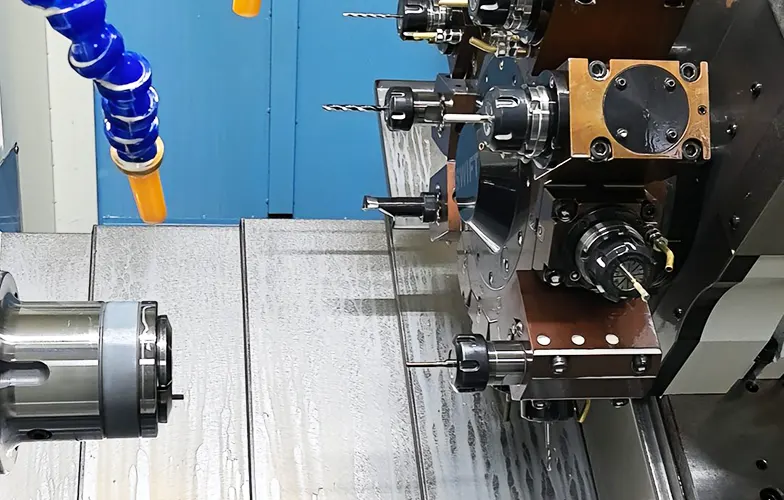
Automated CNC Turning and Milling
Automated CNC Turning and Milling refers to the use of Computer Numerical Control (CNC) machines equipped with automation technologies — such as robotic loading, tool changers, sensors, and integrated software — to perform turning and milling operations with minimal human intervention.
Here’s a full breakdown 👇
⚙️ 1. What It Means
| Term | Description |
|---|
| CNC Turning | Machining process where the workpiece rotates while a stationary cutting tool removes material (used for cylindrical parts). |
| CNC Milling | Process where the cutting tool rotates and moves across a stationary workpiece to remove material (used for prismatic parts). |
| Automation | Integrating robots, conveyors, tool changers, and sensors to handle material, monitor quality, and manage production autonomously. |
In short: Automated CNC turning and milling = smart machining cells that run parts automatically, often 24/7 (“lights-out manufacturing”).
🤖 2. Key Automation Components
🔄 a. Robotic Arm or Gantry Loader
🧠 b. Tool Management System
📡 c. Machine Monitoring & Sensors
IoT-based sensors track spindle load, vibration, and temperature.
Enables predictive maintenance and real-time quality control.
💾 d. CAM & DNC Integration
⚙️ e. Automatic Pallet Systems
🧩 3. Applications
| Industry | Typical Components | Benefit |
|---|
| Aerospace | Turbine shafts, housings, fittings | High precision, repeatability |
| Automotive | Engine parts, gearboxes, axles | High-volume efficiency |
| Medical | Implants, surgical tools | Precision & cleanliness |
| Electronics | Connectors, heatsinks, housings | Micron-level tolerances |
| Energy / Oil & Gas | Valves, couplings | Heavy-duty, durable machining |
💡 4. Advantages
✅ Higher Productivity – Machines can run 24/7 with robotic loading (“lights-out”).
✅ Consistency & Precision – Automation minimizes human error.
✅ Lower Labor Cost – One operator can manage multiple machines.
✅ Faster Turnaround – Automated setups reduce idle time.
✅ Data-Driven Quality Control – Integrated sensors catch defects early.
⚠️ 5. Challenges
⚙️ High Initial Cost – Robots, sensors, and integration are expensive upfront.
🧩 Complex Setup – Requires skilled programming and maintenance.
🔍 Process Planning – Not all parts are suitable for full automation.
🛠️ Downtime Risk – A software or sensor fault can stop the entire cell.
🚀 6. Example: Automated CNC Machining Cell
Workflow Example:
Robot loads raw blank into CNC lathe → turning operation.
Robot transfers semi-finished part to CNC mill → milling operation.
Part passes through in-line inspection → good parts to bin, rejects flagged.
Data logged automatically for traceability and quality assurance.
This setup is common in modern Industry 4.0 smart factories.
🏭 7. Leading Technologies and Brands
Machine Builders: DMG MORI, Mazak, Okuma, Haas, Doosan, FANUC, Tsugami
Automation Systems: ABB, FANUC Robotics, Universal Robots, Erowa, Fastems
Software & Monitoring: Siemens SINUMERIK, FANUC i-Series, MTConnect, Autodesk Fusion 360, Mastercam