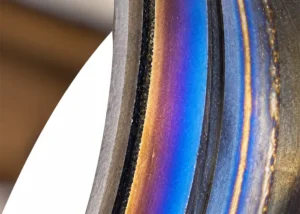
Bluing is a type of chemical conversion coating used in surface engineering. The principle behind it is that, through chemical treatment, a uniform, dense, and highly corrosion-resistant blue-black oxide film is formed on the surface of steel components.
We find this oxide film relatively thin. It can protect the surfaces of precision metal instruments from corrosion while preserving their aesthetic appearance.
Currently, the two most commonly used bluing methods are high-temperature alkaline bluing and room-temperature acidic bluing.
The oxide film produced by high-temperature alkaline bluing is black, bright, and aesthetically pleasing, and is relatively wear-resistant;
However, it suffers from drawbacks such as high energy consumption, low efficiency, a complex process, and environmental pollution.
Although the room-temperature bluing process is simple and easy to operate, we still need to improve the adhesion and wear resistance of the blued film.
This study developed and implemented a novel quenching and bluing process that improves operational efficiency. The formed oxide film displays a blue appearance. This surface layer has an attractive, uniform and compact structure.
It delivers favorable wear resistance and corrosion resistance. The material suits bluing treatment for carbon steel components widely.
Test
Test Specimen
We conducted the quenching and bluing test on 10 mm × 10 mm × 3 mm Q235 low-carbon steel specimens.
The chemical composition of the Q235 steel specimens was as follows: wC ≤ 0.20%, wMn ≤ 1.4%, wSi ≤ 0.35%, wS ≤ 0.045%, wP ≤ 0.045%.
Bluing Process
1. Quenching and Bluing Process Flow
The quenching and bluing process flow is as follows: Grinding → Degreasing → Alcohol Cleaning → Water Rinsing → Surface Inspection → Bluing Treatment → Water Rinsing → Saponification Treatment → Water Rinsing → Oil Immersion Treatment.
2. Process Description
(1) Pretreatment
Pretreatment is an essential step in the bluing process and determines the quality of the bluing film.
First, sand the low-carbon steel progressively with sandpaper (600–2000 grit) until the surface is smooth, removing surface defects such as oxide scale and scratches.
Next, we perform degreasing by either heat degreasing or ultrasonic degreasing. Finally, we rinse the steel sheets with alcohol and clean water to ensure smooth and clean surfaces.
(2) Bluing Treatment
We place the pretreated low-carbon steel sheets into a muffle furnace preheated to 573–610 K for 10–15 min.
Then we take them out and quench them in a quenching bath. The composition of the quenching bath is: 70 g/L NaNO₃ + 230 g/L NaNO₂ + 35 g/L KNO₃.
The steel sheets are held in the quenching bath for 3–5 min, then thoroughly rinsed with clean water. When heating in a muffle furnace, control the heating time, as it determines the color of the bluing film.
Additionally, take care to prevent the quenching solution from splashing during quenching.
(3) Post-treatment
Thoroughly clean the blue-hardened steel pieces and place them in soapy water for saponification. The temperature should be 353–363 K, and the duration should be 10–20 min.
The saponification solution reacts with the oxides on the surface of the bluing film to form iron stearate, which is insoluble in water. This seals the pores in the bluing film, thereby improving its corrosion resistance.
After saponification and filling treatment, we clean and blow-dry the steel plates, then immerse them in oil.
The temperature for immersion in machine oil or spindle oil is 373–393 K, and the duration is 5–10 min.
Performance Testing of Bluing Coatings
1. Appearance and Thickness Testing
We characterized the appearance of the bluing coating following GB/T 15519-2002 “Specifications and Test Methods for Chemically Converted Oxide Coatings on Steel”.
An SU-1500 scanning electron microscope was used to analyze the bluing film thickness.
2. X-ray Diffraction (XRD) Spectral Analysis
We analyzed the crystal structure of the bluing film using a D/MAX-2005 X-ray diffractometer from Rigaku Corporation, Japan.
3. Continuity and Porosity Testing
We determined the continuity and porosity of the coating via the CuSO₄ droplet test in accordance with GB/T 15519 –2002 “Specifications and Test Methods for Chemical Conversion Coatings.”
4. Wear Resistance Testing
Abrasion resistance of the blued coating is generally assessed through repeated forceful rubbing using white cloth or filter paper. The number of rubbing cycles is recorded.
The coating meets the test criterion when it withstands more than 200 cycles, without stains on the white cloth or surface alteration of the steel workpiece.
5. Corrosion Resistance Testing
A CHI660C electrochemical workstation collects test data. Researchers measure Tafel polarization curves and EIS spectra.
Salt spray tests serve as another evaluation method. These tests assess the corrosion resistance of the blued coating.
Results and Discussion
Appearance and Thickness of the Bluing Layer
Macroscopic observation of the surface of the steel plate after quenching and bluing under ample natural light revealed that the surface appeared blue with a continuous, uniform color, free of obvious mottling or rust stains.
The SEM image of a cross-section of the bluing film is shown in Figure 1.
As can be seen from the figure, after the bluing treatment, a distinct bluing film formed on the surface of the low-carbon steel.
The thickness of the bluing film was approximately 2 μm, and it adhered tightly to the low-carbon steel substrate, with no obvious transition layer at the interface;
We observed that the blued film has a dense microstructure with no obvious pores or cracks. This demonstrates that the blued film offers good protection for the low-carbon steel substrate.

X-ray Diffraction Patterns
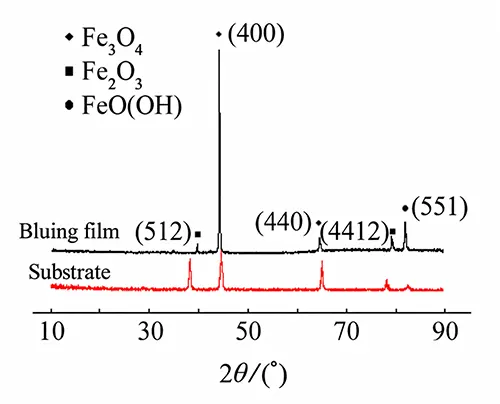
The XRD patterns of the blued film and the low-carbon steel matrix are shown in Figure 2. Researchers compare the microstructures of the low-carbon steel substrate and the blued film.
The blued film mainly contains Fe₃O₄, Fe₂O₃ and FeO(OH). These substances form distinct crystalline structures.
Blanking treatment generates a thin oxide layer on the steel surface. This layer is dominated by Fe₃O₄, Fe₂O₃, and FeO(OH).
Diffraction peak intensities were further analyzed and compared, enabling clear identification of the diffraction peak for the Fe₃O₄ (400) plane.
Its intensity far exceeds the peaks of Fe₂O₃ and FeO(OH). Fe₃O₄ crystals constitute the main component of the blued film.
Film Continuity and Porosity
Under identical test conditions, we wiped three parallel blued and saponified specimens with an ethanol-soaked cotton ball.
After the specimen surfaces had dried, three drops of a 3% (by mass; The same applies below) anhydrous copper sulfate solution were applied to each specimen surface.
The specimen surfaces were subsequently inspected, and the interval from reagent application to red rust formation was recorded.
After 30 s, the droplets were removed using filter paper, and none of the three parallel samples exhibited red rust stains.
Continuing the droplet test, red rust stains began to appear on the specimen surfaces after 600 s, indicating that copper sulfate had penetrated the bluing film and reacted with the iron in the substrate.
According to the *Specifications and Test Methods*, if no red rust spots appear within 30 seconds after the copper sulfate droplet test, the bluing film is deemed to meet the requirements for continuity and porosity.
Therefore, the bluing film produced by this bluing process exhibits good continuity and porosity.
Abrasion Resistance of the Coating
We determined the abrasion resistance of the blued coating by repeatedly rubbing it vigorously with a white cloth and recorded the number of rubbing cycles.
After reaching 300 rubbing cycles, we inspected the surface of the steel part. We observed no obvious wear on the surface and found no stains on the white cloth.
This indicates that the blue-patina coating’s wear resistance meets national standards and exhibits good adhesion.
Corrosion Resistance of the Coating Layer
1. Electrochemical Testing
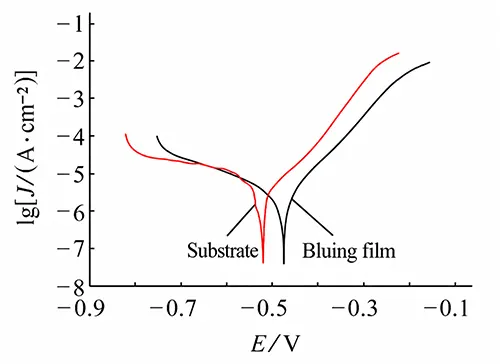
As shown in Table 1 and Figure 3, the self-corrosion potential of the specimens after bluing is more positive, and the self-corrosion current density is lower.
This result proves the improvement of corrosion resistance after bluing treatment. The test environment is a 3.5% NaCl solution.
The blued film grows on the low-carbon steel surface. It separates the steel substrate from the corrosive NaCl solution.
This oxide film itself has better corrosion resistance than the base steel.
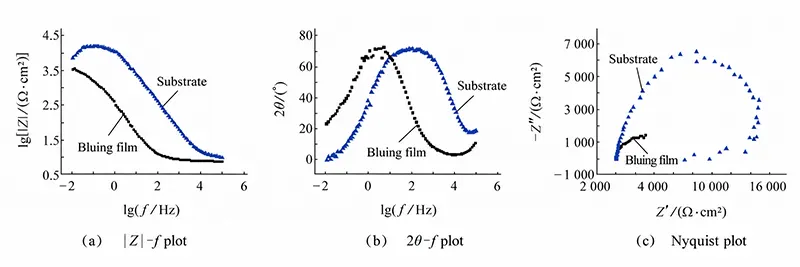
As shown in Figure 4, the impedance values and phase angle of the specimens after the bluing treatment underwent significant changes; The phase angle shifted toward the high-frequency region, indicating differences in the surface state of the specimens;
Both the blue-tempered film and the substrate exhibit capacitive arcs at high frequencies in their impedance spectra; However, the radius of the capacitive arc in the blue-tempered film is larger than that in the low-carbon steel substrate.
The blue-tempered film delivers higher charge transfer resistance. It maintains a lower current level in NaCl solution. These features endow the film with superior corrosion resistance compared to the substrate.
This conclusion matches the polarization curve test results.
Sample | E_corr (V) | J_corr (μA·cm⁻²) |
|---|---|---|
Shipped Sample | −0.47 | 2.42 |
Substrate | −0.52 | 4.19 |
Table 1. Fitting Results of Polarization Curves of the Blue Film
2. Neutral Salt Spray Test
Untreated and blued low-carbon steel specimens were positioned at the same angle within a salt spray chamber to conduct the neutral salt spray test.
Surface corrosion at various exposure durations was examined, and the results are listed in Table 2.
As shown in Table 2, the surface of the untreated low-carbon steel specimen was completely corroded within 12 hours;
In contrast, the blued low-carbon steel specimen did not begin to show a small number of corrosion spots until after 24 consecutive hours of salt spray testing.
This indicates that blued low-carbon steel exhibits better corrosion resistance than the untreated low-carbon steel substrate.
This is primarily because the surface of untreated low-carbon steel lacks the protection of a bluing film, resulting in faster corrosion;
We cover the low-carbon steel surface with an Fe₃O₄ bluing film.
This film delivers better corrosion resistance than the substrate and reduces the corrosion rate.
Sample | 2 h | 6 h | 12 h | 24 h |
|---|---|---|---|---|
Untreated Low-Carbon Steel | Extensive rust spots appeared | 90% of the surface was corroded | Completely corroded | Completely corroded |
Blue Film-Coated Low-Carbon Steel | No rust spots | No rust spots | No rust spots | A small amount of rust spots appeared |
Table 2. Corrosion Results of the Salt Spray Test
Conclusions
(1) A new quenching and bluing process was adopted: the heating temperature was
573–610 K, the holding time was 10–15 min, and the quenching solution composition was: 70 g/ L of NaNO₃ + 230 g/L of NaNO₂ + 35 g/L of KNO₃.
This process produced a 2 μm-thick blue oxide film on the surface of Q235 low-carbon steel, with Fe₃O₄ as its main component.
(2) The continuity, porosity, and wear resistance of the bluing film all met the requirements of national standards.
(3) Electrochemical tests and salt spray tests indicated that the bluing film can slow the corrosion rate of the low-carbon steel substrate and effectively enhance the substrate’s corrosion resistance.