
With the rapid development of modern manufacturing, precision machining requirements for mechanical metal parts are becoming increasingly stringent.
CNC technology significantly enhances machining efficiency and accuracy, establishing itself as a key technology in the field of mechanical manufacturing.
This paper addresses challenges in precision machining processes for mechanical metal parts, explores the application of CNC technology within these processes, and conducts process optimization design. It aims to provide reference and guidance for relevant practitioners.
Overview of CNC Technology
CNC technology is an automated technique utilizing computer numerical control. It achieves precise regulation of machine tool feed movements, spindle speeds, and other parameters through programmed instructions.
A CNC system primarily consists of three components: the numerical control unit, the servo drive system, and the machine tool itself.
Taking a CNC milling machine as an example, through G-code programming, the CNC system can control the milling cutter to move along the X, Y, and Z axes while regulating spindle speed, thereby accomplishing complex surface machining tasks.
Mainstream CNC systems like the FANUC 0i-MF employ a high-speed, high-precision Reduced Instruction Set Computer (RISC) Central Processing Unit (CPU) .
With a basic instruction processing cycle of just 1 millisecond, combined with memory management techniques and optimized algorithms, it achieves nanometer-level interpolation accuracy.
Current State of Precision Machining Processes
The current state of precision machining processes for mechanical metal parts can be summarized as high-speed, high-efficiency, high-precision, and intelligent.
In the field of High Speed Machining (HSM), precision machining techniques for mechanical metal parts have gained widespread application.
For instance, when machining hardened steel with a hardness of 60 HRC using Cubic Boron Nitride (CBN) tools, cutting speeds reach 200~300 m·min⁻¹, significantly boosting production efficiency.
For high-efficiency machining, roughing processes commonly employ combinations of large feed rates (2~3 mm·r⁻¹) and deep cutting depths (5~10 mm).
When paired with specially designed tool geometries—such as enhanced positive rake angle designs—these parameters can substantially increase material removal rates.
In high-precision machining, the application of ultra-precision technologies has achieved nanometer-level machining accuracy.
For instance, when machining optical lens molds with single-crystal diamond tools, surface shape accuracy can reach 10 nm with surface roughness below 5 nm.
In terms of intelligence, concepts like digital twins and industrial internet have driven the development and application of technologies such as monitoring systems and adaptive control.
This enables intelligent perception and optimized decision-making among machine tools, machining processes, and workpieces, propelling precision machining technology toward intelligent development.
Optimization Design of Precision Machining Processes
Design and Programming
The primary stage of precision machining for mechanical metal parts is design and programming. This stage is critical, directly impacting the efficiency and quality of subsequent manufacturing processes.
After acquiring the part’s 3D model, designers should conduct preliminary process planning in Computer-Aided Manufacturing (CAM) software to determine the blank, operations, fixtures, cutting tools, and cutting parameters.
Taking a typical complex curved surface part as an example: – Rough machining: Select a Φ20 mm end mill with spindle speed controlled at 3,000~4,000 r·min⁻¹, feed per tooth at 0.10~0.15 mm·z⁻¹, and cutting depth at 2~4 mm. Employ efficient, stable 3-axis toolpaths such as equal-distance offset or surface streamline.
For semi-finishing, a Φ10 mm ball-nose end mill is selected with a spindle speed of 5,000~6,000 rpm⁻¹, feed per tooth of 0.05~0.08 mm·z⁻¹ and cutting depth of 0.3~0.5 mm. We employ point machining paths to ensure uniform residual height.
For the finishing stage, the operator selects a Φ2 mm ball-nose end mill. They control the spindle speed between 12,000 and 15,000 rpm, maintaining a feed rate per tooth of 0.02 to mm·z⁻¹.
The operator sets the cutting depth between 0.05 and 0.10 mm. They employ a helical machining path to achieve optimal surface quality.
Note that machining parameters should be selected to maximize material removal rate without compromising tool life.
Furthermore, during subsequent processing, optimize parameters such as tool axis vector, tool position point, and feed rate based on machine tool kinematic characteristics.
Where necessary, incorporate path smoothing commands to enhance the continuity and smoothness of the machining trajectory.
Material Preparation and Fixturing
The second critical step in precision machining of mechanical metal components is material preparation and workholding.
First, the workpiece blank should undergo rough machining per drawing specifications—such as turning or milling—to approximate the final part’s dimensions and shape, thereby reducing the cutting volume required during CNC machining.
Second, to ensure machining quality and efficiency, the blank surface must be free of defects like cracks or inclusions, with uniform hardness throughout.
Third, CNC machines must undergo rigorous calibration to ensure their positioning accuracy and repeatability meet machining requirements.
For example, the YKZ7530A gantry machining center achieves positioning accuracy of 0.012 mm and repeatability of 0.008 mm.
Fourth, fixture design must balance stability, accessibility, and versatility.
For complex irregular parts, multi-station adjustable fixtures can be employed with corresponding locating blocks and clamping mechanisms to enable rapid switching between different machining surfaces.
Fifth, fixture design must account for cutting forces and chip evacuation, rationally arranging support and clamping points.
Where necessary, additional support ribs or sacrificial layers should be added to vulnerable areas to prevent deformation and vibration.
For high-precision parts, sufficient temperature stabilization in a constant-temperature environment (20°C ± 1°C) should be performed prior to clamping to eliminate residual stresses and thermal deformation.
CNC Machining
CNC machining constitutes the core process in precision machining of mechanical metal parts, typically comprising three stages: roughing, semi-finishing, and finishing.
The primary objective of the roughing stage is rapid removal of stock to enhance machining efficiency.
For machining TC4 titanium alloy, a Φ20 mm carbide end mill can be selected with a spindle speed of 3,000~4,000 r·min⁻¹, a cutting depth of 1~3 mm, a radial depth of cut of 8~12 mm, and a feed rate per tooth of 0.10~0.15 mm·z⁻¹. The cutting speed vc is calculated as:

where: d₀ is the tool diameter (mm); n is the spindle speed (r·min⁻¹).
Under these parameters, the cutting speed for TC4 typically ranges from 60 to 100 m·min⁻¹. Rough machining employs efficient toolpaths, such as three-axis equidistant offset or five-axis surface streamline, to minimize idle cutting time and enhance machining efficiency.
> Semi-Finishing and Finishing Stages: Enhancing Accuracy and Surface Quality
The semi-finishing stage aims to further enhance surface quality and geometric accuracy beyond rough machining, preparing the workpiece for subsequent finishing operations.
For this stage, a Φ10 mm carbide ball-nose end mill is recommended. Spindle speed is increased to 5,000~6,000 r·min⁻¹, cutting depth reduced to 0.3~0.5 mm, radial depth of cut set at 0.3~0.5 mm, feed per tooth at 0.05~0.08 mm·z⁻¹ , and cutting speed calculated per Equation (1), typically ranging from 80 to 120 m·min⁻¹.
Semi-finishing generally employs point machining or line cutting to achieve uniform residual surface roughness.
The finishing stage aims to achieve the part’s final dimensional accuracy and surface quality requirements.
For this stage, a Φ2~4 mm carbide ball-end mill is selected. The spindle speed is further increased to 8,000~12,000 r·min⁻¹, the cutting depth is reduced to 0.05~0.10 mm, the radial depth of cut is set to 0.05~0.10 mm, with a feed rate of 0.01~0.03 mm·z⁻¹ per tooth. Cutting speeds typically range from 100 to 150 m·min⁻¹.
Finishing employs complex machining paths such as helical, circular, or bow-shaped trajectories to achieve optimal surface roughness and profile accuracy.
Quality Inspection and Post-Processing
The final stage of precision machining for mechanical metal components is quality inspection and post-processing.
Following CNC machining, comprehensive inspection of critical quality characteristics—including dimensional and geometric tolerances—should be conducted using precision measurement equipment such as a Coordinate Measuring Machine (CMM).
Taking the Hexagon Global S five-axis CMM as an example, its spatial measurement accuracy reaches the micrometer level, with a minimum probe trigger force of just 0.01 N, meeting the inspection requirements for most precision parts.
During inspection, strictly adhere to corresponding measurement procedures and operational standards. Arrange measurement points rationally and perform multiple repeat measurements to ensure the accuracy and reliability of results.
> Surface Treatments for Enhanced Performance and Durability
Measurement results must be documented in corresponding quality reports and compared against drawing specifications. Items exceeding tolerances should be promptly reported to upstream processes for corrective action.
Qualified parts require necessary surface treatments and finishing based on functional requirements and operating environments to enhance performance and extend service life.
Common surface treatment methods include heat treatment, chemical plating, and Physical Vapor Deposition (PVD) coatings, which can significantly improve part hardness, wear resistance, corrosion resistance, and other properties.
Taking PVD TiAlN coating as an example, its microhardness measured by the Vickers hardness method under a test load of 0.05 kgf ranges from 3,000 to 3,200 HV—3 to 5 times that of the base material—significantly extending tool life when machining composite materials.
> Achieving Precision with Post-Processing Techniques
Additionally, for high-precision components, finishing processes such as grinding, polishing, and laser marking should be performed to eliminate surface defects and achieve higher dimensional accuracy and surface finish.
The relationship between surface roughness Ra and machining parameters can be expressed as:

where: f is the feed rate, mm·r⁻¹; rε is the tool tip radius, mm; C₁ and C₂ are constants related to the process system.
This indicates that reducing the feed rate and increasing the tool tip radius are effective methods for lowering surface roughness.
Experimental Verification
Experimental Setup
To validate the practical effectiveness of the proposed optimized process, a precision piston from a hydraulic system was selected as the experimental subject.
Fabricated from 42CrMo material (quenched and tempered to 30~32 HRC), the piston featured key machining characteristics: a precision-fit cylindrical surface with Φ48 mm ±0.006 mm tolerance, a 60° ±5′ tapered surface, and a surface roughness requirement of 0.4 μm.
Experiments were conducted on a YK7145A CNC vertical machining center, comparing the traditional process with the optimized process proposed in this paper.
The traditional process employed a conventional two-step finishing milling sequence:
First, roughing was performed using a Φ12 mm coated milling cutter (spindle speed: 2,200 r·min⁻¹ cutting depth of 1.5 mm, feed rate of 0.10 mm·z⁻¹), followed directly by finishing with a Φ6 mm finishing cutter (spindle speed of 3,500 r·min⁻¹, cutting depth of 0.2 mm, feed rate of 0.05 mm·z⁻¹).
The optimized process proposed in this paper employs a three-stage precision machining sequence:
Stage 1: Rough machining (Φ16 mm coated end mill, spindle speed 2,800 r·min⁻¹, cutting depth 2.50 mm, feed per tooth 0.12 mm·z⁻¹), Stage 2: Semi-finishing (Φ8 mm coated end mill, spindle speed 4,500 r·min⁻¹, cutting depth 0.40 mm, feed per tooth 0.06 mm·z⁻¹), Third stage: finishing (Φ4 mm polycrystalline diamond finishing cutter, spindle speed 8,000 r·min⁻¹, cutting depth 0.05 mm, feed per tooth 0.015 mm·z⁻¹).
Both processes took place in a temperature-controlled workshop (20°C ± 1°C), where we used identical adjustable centering fixtures and machined five specimens per group.
We measured specimen accuracy using a Mahr MarForm MMQ400 form measuring instrument and a Taylor Hobson PGI 1240 roughness tester.
Results and Analysis
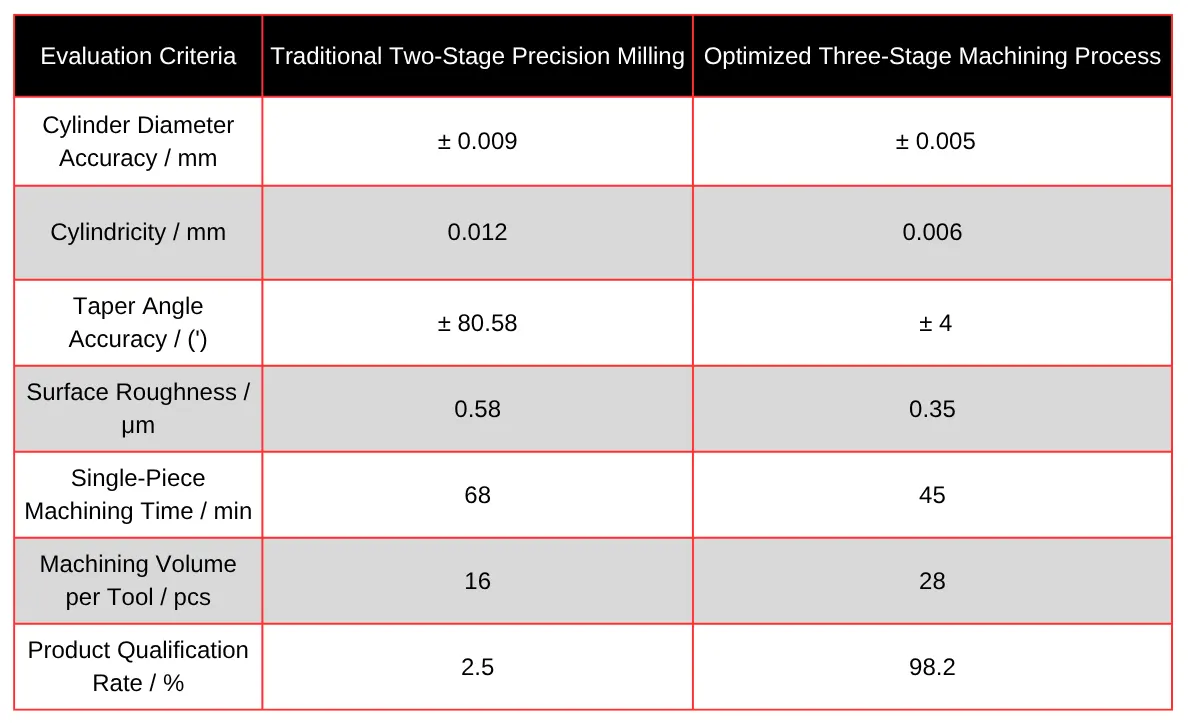
The comparative experimental results of the two process schemes are shown in Table 1. As indicated in Table 1, the traditional two-step finish milling process lacks a semi-finishing transition step, resulting in excessive and uneven finishing allowances. This leads to unstable machining accuracy and surface quality.
In contrast, the three-stage precision machining process proposed in this paper, through rational layered machining and optimized cutting parameters, significantly enhances machining quality.
The traditional process results in cylindrical diameter accuracy of ±0.009 mm, whereas the optimized process improves it to ±0.005 mm.
The optimized process also enhances cylindricity from 0.012 mm to 0.006 mm. It improves taper angle accuracy from ±8′ to ±4′ and reduces surface roughness from 0.58 μm to 0.35 μm.
Simultaneously, the optimized cutting parameter combination reduced single-piece machining time from 68 min to 45 min under traditional processes.
Tool life increased from 16 parts per tool to 28 parts per tool, substantially lowering tooling costs. Product qualification rate rose from 92.5% to 98.2%.
Conclusion
This paper investigates the application of CNC technology in precision machining of mechanical metal parts, proposing a process optimization scheme based on three-stage precision machining.
This approach not only significantly enhances machining accuracy and surface quality but also substantially reduces processing time and tooling costs.
Future research should further optimize cutting parameters, explore applicability to additional materials, and develop more intelligent machining control systems to meet evolving market demands.