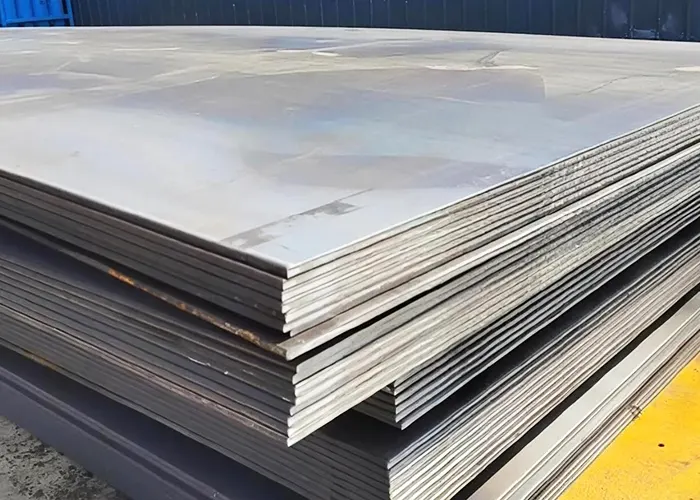
Hot rolling and cold rolling are both processes for forming steel plates or sections, significantly impacting the microstructure and properties of steel.
What exactly are the differences between them? Today, we’ll delve into the details.
Steel rolling primarily relies on hot rolling, while cold rolling is typically reserved for producing small-sized sections and thin plates requiring precise dimensions.
Common steel products and their rolling methods:
Wire rod: Diameter 5.5–40 mm, coiled form, exclusively hot-rolled. After cold drawing, it becomes cold-drawn material.
Round bar: Generally hot-rolled except for precision-sized bright steel; also includes forged stock (with visible forging marks).
Strips: Both hot-rolled and cold-rolled exist, with cold-rolled strips typically thinner.
Plates: Cold-rolled plates are generally thinner than automotive sheets. Hot-rolled plates are mostly medium-to-thick plates with a distinctly different appearance.
Angle bars: All hot-rolled.
Pipes: Both welded hot-rolled and cold-drawn types exist.
Channels and H-beams: Hot-rolled.
Rebar: Hot-rolled material.
Hot Rolling
By definition, steel ingots or billets are difficult to deform and process at room temperature. They are typically heated to 1100°C–1250°C for rolling, a process known as hot rolling.
The termination temperature for hot rolling is typically 800°C to 900°C, followed by cooling in air. Consequently, the hot-rolled condition is equivalent to normalized treatment. Most steel products are manufactured using hot rolling.
Steel delivered in the hot-rolled condition develops a layer of iron oxide scale on its surface due to high temperatures, imparting some corrosion resistance and enabling outdoor storage.
However, this scale also results in a rough surface and significant dimensional variation.
Therefore, steel requiring a smooth surface, precise dimensions, and superior mechanical properties must be produced by cold rolling using hot-rolled semi-finished or finished products as raw material.
Fast forming speed, high production capacity, and no damage to coatings. Can be formed into a wide variety of cross-sectional shapes to meet application requirements.
Cold rolling induces significant plastic deformation in steel, thereby increasing its yield strength.
1. Although no hot plastic compression occurs during forming, residual stresses remain within the cross-section, inevitably affecting the material’s overall and local buckling characteristics.
2. Cold-rolled steel sections typically feature open cross-sections, resulting in lower torsional stiffness.
This makes them prone to torsion under bending loads and to buckling under compression, resulting in poor torsional resistance.
3. Cold-formed steel sections have thin walls, and corners where plates meet lack thickening, making them vulnerable to localized concentrated loads.
Cold Rolling
Animation of Cold-Rolled Galvanized Line Production Process
Cold rolling refers to a rolling method where steel is shaped by applying pressure from rollers at room temperature.
Although the process may cause slight heating of the steel plate, it is still termed cold rolling. Specifically, cold rolling uses hot-rolled steel coils as raw material.
After acid pickling to remove scale, pressure processing is applied, yielding hard-rolled coils as the finished product.
Generally, cold-rolled steels like galvanized and color-coated sheets require annealing, resulting in superior plasticity and elongation. They are widely used in the automotive, home appliance, and hardware industries.
Cold-rolled sheets exhibit a certain surface finish, feeling smooth to the touch—primarily due to the acid pickling process.
Hot-rolled sheets typically fail to meet surface finish requirements, necessitating cold rolling of hot-rolled steel strips.
Additionally, the minimum thickness achievable for hot-rolled steel strips is generally 1.0mm, whereas cold rolling can reach 0.1mm.
Hot rolling occurs above the crystallization temperature point, while cold rolling takes place below it. Cold rolling alters steel shape through continuous cold deformation.
The resulting work hardening increases the strength and hardness of the rolled coil while reducing its toughness and plasticity.
For end-use applications, cold rolling degrades stamping performance, making the product suitable only for parts requiring simple deformation.
It disrupts the cast structure of steel ingots, refines grain size, and eliminates microstructural defects.
This results in a denser steel structure and improved mechanical properties. The enhancement is primarily along the rolling direction, making the steel less isotropic to some extent.
Bubbles, cracks, and porosity formed during casting can also be welded together under high temperature and pressure.
1. Non-metallic inclusions (primarily sulfides, oxides, and silicates) within the steel are compressed into thin layers during hot rolling, causing laminations.
These laminations significantly degrade tensile properties along the thickness direction and may lead to interlaminar tearing during weld shrinkage.
Local strains induced by weld shrinkage often reach several times the yield point strain, far exceeding those caused by loading.
2. Residual stresses caused by uneven cooling.
Residual stresses are internally self-balanced stresses that exist without external forces. All hot-rolled structural steel sections exhibit such residual stresses, generally increasing with larger section dimensions.
Although self-balanced, residual stresses still affect the performance of steel components under external forces. They may adversely impact deformation, stability, and fatigue resistance.
Summary:
The primary distinction between cold rolling and hot rolling lies in the temperature during the rolling process. “Cold” refers to room temperature, while “hot” denotes high temperatures.
From a metallurgical perspective, the boundary between cold and hot rolling should be defined by the recrystallization temperature.
Rolling below this temperature is considered cold rolling, while rolling above it is hot rolling. The recrystallization temperature for steel ranges from 450°C to 600°C.
The primary differences between hot-rolled and cold-rolled steel are:
Appearance and Surface Quality
Cold-rolled steel is produced by subjecting hot-rolled steel to a cold-rolling process, which also includes surface finishing. Consequently, cold-rolled steel exhibits superior surface quality (e.g., surface roughness) compared to hot-rolled steel.
Therefore, cold-rolled steel is typically chosen when high standards for coating quality—such as subsequent painting—are required. Hot-rolled sheets are further categorized into pickled sheets and unpickled sheets.
Pickled sheets exhibit a natural metallic color due to acid treatment, but their surface quality remains inferior to cold-rolled sheets since they undergo no cold rolling.
Unpickled sheets typically feature an oxide layer, appearing dull or coated with a dark ferric oxide layer. Colloquially, they resemble fire-scorched surfaces and may develop rust if stored in poor conditions.
Performance
Generally, hot-rolled and cold-rolled steel sheets are considered equivalent in mechanical properties for engineering applications.
Although cold-rolled steel undergoes some work hardening during cold rolling (though this may not apply in cases with stringent mechanical property requirements, which would necessitate differentiation), cold-rolled steel typically exhibits slightly higher yield strength and surface hardness than hot-rolled steel.
The exact properties depend on the degree of annealing applied to the cold-rolled steel. Regardless of annealing, cold-rolled steel maintains higher strength than hot-rolled steel.
Formability
Given the minimal performance difference between hot-rolled and cold-rolled plates, formability is primarily influenced by surface quality.
Since cold-rolled plates exhibit superior surface quality, they generally achieve better forming results than hot-rolled plates when made from the same material.
Conclusion
Hot rolling and cold rolling represent two fundamentally different thermomechanical processing routes, distinguished primarily by whether deformation occurs above or below the steel’s recrystallization temperature (approximately 450°C–600°C).
This temperature difference governs not only the forming mechanics but also the resulting microstructure, surface condition, dimensional tolerance, and mechanical performance of the finished product.
Hot rolling, conducted at elevated temperatures (typically 1100°C–1250°C), enables large plastic deformation with high productivity and excellent structural homogenization.
It refines grains, eliminates casting defects, and produces medium-to-thick sections such as plates, rebar, channels, H-beams, and structural profiles.
However, oxide scale formation, lower dimensional precision, and residual stresses are inherent trade-offs.
Cold rolling, performed at or near room temperature using hot-rolled material as feedstock, prioritizes dimensional accuracy, surface finish, and enhanced strength through work hardening.
It is particularly suitable for thin sheets, precision strips, and applications in automotive, appliance, and hardware industries where appearance and coating quality are critical.
The trade-offs include reduced ductility, increased residual stress, and limitations in complex forming due to strain hardening.
In practical engineering selection, the decision between hot-rolled and cold-rolled steel should be based on:
-
Required surface finish and coating performance
-
Dimensional tolerance and thickness control
-
Strength versus ductility balance
-
Structural loading conditions (including buckling and torsional requirements)
-
Cost-efficiency and production scale
Ultimately, hot rolling is optimized for structural integrity and mass production of larger sections, while cold rolling is optimized for precision, surface quality, and controlled mechanical enhancement.
Understanding these distinctions ensures proper material specification, improved manufacturability, and enhanced end-product performance.