What Is Boring in Machining and Why Is It Used After Drilling?
TonZaMaking
In modern subtractive manufacturing, dimensional accuracy and surface integrity determine product performance, safety, and lifecycle cost. Among all internal hole-finishing operations, the boring machining process plays a critical role in achieving precision diameters, roundness, and concentricity beyond the capability of standard drilling. Also referred to as internal turning, boring is widely used in automotive, aerospace, heavy equipment, and energy industries for precision hole machining.
1️⃣ What Is Boring Machining?
Boring is a subtractive machining process used to enlarge and refine an existing hole using a single-point cutting tool. Unlike drilling, which creates the initial hole, boring improves dimensional accuracy, geometric tolerance, and surface finish.
According to manufacturing process standards used across ISO and ANSI machining frameworks, boring typically achieves tolerance ranges between IT6–IT8, with surface finishes reaching Ra 0.8–3.2 µm, depending on tool setup and machine rigidity.
Difference Between Boring, Drilling, and Reaming
Drilling uses a multi-point rotating tool to create an initial hole. However, due to tool deflection and chip evacuation limits, drilling alone rarely achieves high concentricity or surface finish quality.
Reaming follows drilling and removes a minimal amount of material, typically 0.1–0.5 mm, to improve surface finish and slightly refine diameter. Reaming cannot significantly correct hole alignment errors.
Boring, in contrast, uses a rigid boring bar with a single cutting insert that allows radial adjustment. This makes it ideal for correcting misalignment, improving roundness, and achieving tighter diameter control.
Boring is essential in precision manufacturing because it corrects axis deviation, enhances cylindricity, and controls geometric tolerances such as concentricity and perpendicularity—critical factors in bearing housings, hydraulic cylinders, and engine blocks.
Quick Visual Explanation of How Boring Works
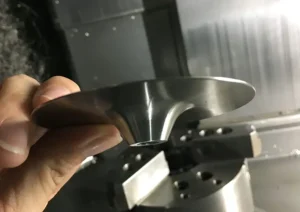
In internal turning, the workpiece rotates (on a lathe) or the tool rotates (on a milling machine), while the boring bar advances axially. The single cutting insert removes material from the internal wall of a pre-existing hole, gradually enlarging it to the specified diameter.
The fundamental machining equation used to determine cutting speed in boring is:
V=πDN/1000
Where:
V = Cutting speed (m/min)
D = Diameter of bore (mm)
N = Spindle speed (RPM)
Feed rate calculation:
F=f×N
Where:
F = Feed rate (mm/min)
f = Feed per revolution (mm/rev)
2️⃣ History and Evolution of Boring Machines
The development of boring technology is closely tied to the Industrial Revolution. In 1774, John Wilkinson developed a precision boring machine capable of machining accurate cannon barrels. His innovation dramatically improved internal diameter accuracy compared to previous casting methods.
This advancement directly enabled James Watt to produce steam engine cylinders with unprecedented sealing efficiency. Watt’s steam engines required tight piston-cylinder fits to prevent steam leakage, and Wilkinson’s boring technology provided the solution.
In the 19th century, Francis A. Pratt introduced screw-feed mechanisms that significantly improved feed precision and repeatability. These mechanical refinements laid the foundation for modern precision machine tools.
During World War I and World War II, the demand for aircraft engines and military hardware accelerated the development of jig boring machines. Jig boring introduced ultra-precise positioning systems capable of tolerances below 0.005 mm, crucial for aerospace assembly alignment.
The 1970s marked a turning point with the introduction of Computer Numerical Control (CNC). CNC boring machines improved repeatability, automated feed control, and allowed programmable multi-pass strategies. Today’s CNC horizontal boring mills routinely achieve tolerances within ±0.002 mm under controlled conditions.
This historical progression enhances technical credibility and reflects the engineering maturity of the boring machining process.
3️⃣ How Does the Boring Process Work?
The boring process begins with pre-drilling or casting preparation. In many industrial applications, holes are either cast slightly undersized or drilled approximately 0.5–2.0 mm smaller than the final dimension to allow material for finishing passes.
Tool setup involves mounting a boring bar fitted with a carbide or CBN insert. Tool overhang must be minimized to reduce vibration and deflection. A general engineering rule suggests maintaining a length-to-diameter ratio below 4:1 for optimal rigidity.
Boring can be performed on a lathe, where the workpiece rotates and the tool feeds axially, or on a milling machine or horizontal boring mill, where the tool rotates and feeds into a stationary workpiece.
Typical cutting speed ranges for steel components are:
Rough boring: 80–180 m/min
Finish boring: 120–250 m/min
Feed per revolution typically ranges between 0.05–0.30 mm/rev depending on surface finish requirements.
Depth of cut (ap) commonly varies between 0.2 mm (finish pass) and 3.0 mm (roughing pass).
Multi-pass strategies are used to reduce tool load and improve dimensional stability. Roughing passes remove bulk material, while finishing passes achieve final tolerance and surface finish.
Surface finish optimization depends on feed rate and tool nose radius. The theoretical surface roughness for turning-based processes can be approximated by:
Ra≈f2/32r
Where:
f = Feed per revolution
r = Tool nose radius
Reducing feed rate or increasing nose radius improves surface finish.
Common troubleshooting considerations include chatter vibration caused by excessive overhang, incorrect spindle speed, or insufficient rigidity. Solutions involve reducing cutting speed, increasing tool diameter, or applying vibration-damping boring bars.
4️⃣ Types of Boring Machining
Boring operations vary depending on machine configuration and workpiece size.
Horizontal boring is typically used for long or large components such as machine bases, engine blocks, and structural parts. The spindle is mounted horizontally, making it ideal for deep internal cavities.
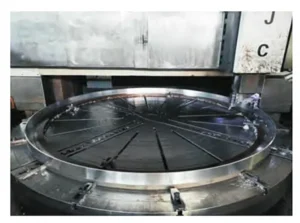
Vertical boring is suitable for heavy and large-diameter workpieces such as turbine housings and gear blanks. The workpiece sits on a rotary table, which improves stability for massive components.
Precision boring, often referred to as jig boring, is used for small, high-accuracy parts requiring extremely tight tolerances. Industries such as aerospace instrumentation and watchmaking rely on this process.
Comparison Table
| Type | Best For | Accuracy | Workpiece Size | Typical Industry |
|---|---|---|---|---|
| Horizontal Boring | Long or deep bores | ±0.01 mm | Medium to large | Heavy equipment, automotive |
| Vertical Boring | Large diameter parts | ±0.02 mm | Large, heavy | Energy, turbines |
| Precision (Jig) Boring | Ultra-precise holes | ±0.002–0.005 mm | Small to medium | Aerospace, instrumentation |
5️⃣ Boring vs. Drilling vs. Reaming: What’s the Difference?
From a tooling perspective, drilling uses a two-lip twist drill, reaming uses a multi-edge finishing tool, while boring uses a single-point adjustable insert mounted on a rigid bar.
In terms of accuracy, drilling generally achieves tolerances around IT10–IT12. Reaming improves this to IT7–IT9. Boring can reach IT6 or better under controlled CNC conditions.
Surface finish comparison shows drilling typically produces Ra 3.2–12.5 µm, reaming achieves 0.8–3.2 µm, while finish boring can reach 0.4–1.6 µm depending on feed and insert geometry.
Cost and productivity differ significantly. Drilling is fastest for hole creation, reaming is economical for moderate precision, and boring is preferred when alignment correction and high precision are required.
For manufacturers comparing “boring vs drilling differences” or evaluating “reaming vs boring accuracy,” the key takeaway is that boring uniquely provides both dimensional correction and superior geometric control, making it indispensable in high-precision mechanical assemblies.
acturing, precision hole machining is critical for structural and propulsion components. Aircraft engine casings, landing gear cylinders, and wing attachment points require strict cylindricity and positional accuracy to ensure structural integrity and fatigue resistance. For example, jet engine manufacturers such as Rolls-Royce machine turbine casings where bore concentricity directly influences rotor balance and vibration control. In aerospace assembly lines operated by Boeing, jig boring techniques are used to maintain hole position accuracy within microns to guarantee proper fastener alignment in fuselage sections.
In the automotive sector, boring is essential for engine block manufacturing. Cylinder bores must maintain strict roundness and surface finish to ensure piston ring sealing and oil control. Companies like Toyota Motor Corporation utilize multi-stage boring and honing processes to achieve dimensional tolerances often within ±0.01 mm. The internal geometry of crankshaft bearing housings also relies on boring for maintaining concentric alignment across multiple journals.
Heavy equipment housings in construction and mining machinery require large-diameter horizontal boring operations. Manufacturers such as Caterpillar Inc. depend on horizontal boring mills to machine pivot points and bearing bores in excavator arms and structural frames, where improper alignment would cause premature wear and mechanical failure.
Hydraulic cylinder production represents another major application. Cylinder tubes must achieve smooth internal finishes, typically below Ra 1.6 µm, to prevent seal damage and fluid leakage. Precision boring ensures dimensional consistency before honing operations refine the final surface.
In energy and power generation industries, turbine casings, generator housings, and pump bodies require vertical boring for large-diameter internal cavities. Companies such as Siemens Energy rely on vertical boring machines to maintain concentric alignment between rotating shafts and stationary housings, minimizing vibration and maximizing operational efficiency.
Across these industries, boring is not simply a finishing step; it directly impacts performance reliability, energy efficiency, and equipment lifespan.
7️⃣ Tools Required for Boring Machining
Successful internal turning depends heavily on machine rigidity, tool selection, and insert geometry.
A conventional engine lathe remains one of the most common platforms for boring operations, particularly for cylindrical components. In CNC environments, vertical and horizontal machining centers provide programmable precision and repeatability for multi-axis boring applications.
The boring bar is the core cutting tool. Solid boring bars are typically made of carbide or high-strength steel and are used for shorter reach applications. Modular boring bar systems allow adjustable heads and fine diameter control, increasing flexibility in production environments. For deep-hole machining where vibration risk increases, damped boring bars with internal vibration-absorbing mechanisms significantly reduce chatter and improve surface finish.
Cutting inserts are generally manufactured from cemented carbide due to its wear resistance and thermal stability. Coated carbide inserts, often with TiAlN or Al₂O₃ coatings, enhance heat resistance and tool life during high-speed machining. For hardened materials above 45 HRC, cubic boron nitride (CBN) inserts provide superior wear resistance and dimensional stability.
How to Choose the Right Boring Bar
Selecting the correct boring bar requires balancing rigidity, reach, and bore diameter. The length-to-diameter ratio should ideally remain below 4:1 to minimize deflection. For deep bores exceeding this ratio, damped bars are recommended.
The minimum bore diameter determines bar size, while required surface finish influences insert geometry and nose radius selection. For finishing operations, a larger nose radius improves theoretical surface finish according to:
Ra≈f2/32r
However, increasing nose radius also increases radial cutting forces, which must be considered in thin-walled components.
Material type further influences selection. Aluminum alloys require sharp, polished inserts with positive rake geometry, while alloy steels demand tougher carbide grades with wear-resistant coatings.
8️⃣ Key Boring Parameters and Optimization Tips
Process optimization in precision hole machining depends on proper control of cutting speed, feed rate, depth of cut, and vibration management.
For carbon steel, recommended cutting speeds generally range between 100–250 m/min depending on tool material. For cast iron, 80–200 m/min is typical, while aluminum alloys allow speeds above 300 m/min under stable conditions.
Depth of cut during rough boring often ranges from 1.0–3.0 mm, while finish passes typically remain below 0.5 mm to improve dimensional control. Excessive depth increases radial force and tool deflection, compromising roundness.
Chatter remains the most common issue in internal turning. It is typically caused by insufficient rigidity, excessive overhang, or incorrect speed selection. Reducing spindle speed, shortening tool overhang, or switching to a damped boring bar often resolves vibration problems.
Tool overhang control is crucial because deflection increases exponentially with length. Deflection δ can be approximated using beam theory:
δ=FL3/3EI
Where:
F = Cutting force
L = Overhang length
E = Modulus of elasticity
I = Moment of inertia
Because deflection is proportional to the cube of length, even small increases in overhang significantly affect accuracy.
Insert geometry selection also influences performance. Positive rake angles reduce cutting forces and heat generation, while neutral or negative rake inserts provide better edge strength for heavy-duty applications.
For machinists searching practical optimization strategies, combining controlled feed rates with stable tool clamping and high-quality inserts yields measurable improvements in surface finish and dimensional consistency.
9️⃣ Advantages of Boring Machining
Boring provides superior positional accuracy because it corrects pre-existing hole misalignment. Unlike drilling, which follows the path of least resistance, boring allows fine radial adjustment, ensuring concentric alignment with external features.
Surface finish quality is significantly higher compared to drilling. With proper parameter control, finish boring can achieve Ra values below 1.6 µm, reducing the need for secondary finishing operations.
Versatility is another major advantage. Boring can be performed on lathes, machining centers, and dedicated horizontal or vertical boring mills, accommodating small precision parts as well as multi-ton industrial components.
From a production efficiency perspective, replaceable carbide inserts reduce downtime compared to regrinding solid tools. In automotive engine manufacturing lines, optimized CNC boring cycles can reduce cycle time per cylinder bore by 15–25% compared to conventional multi-step finishing methods.
Efficient material removal during rough boring also improves process economics. By combining roughing and finishing passes within the same setup, manufacturers minimize repositioning errors and increase throughput.
In high-volume manufacturing environments, the boring machining process contributes directly to reduced scrap rates, improved part consistency, and extended component lifespan—making it a cornerstone of modern precision engineering.
🔟 Disadvantages and Limitations of Boring Machining
Although the boring machining process offers exceptional precision hole machining capability, it also presents several technical limitations that must be carefully managed in production environments.
Blind hole boring is inherently more complex than through-hole operations. Chip evacuation becomes difficult because chips cannot exit freely from the opposite side. Accumulated chips increase cutting temperature and risk surface damage. In deep blind holes, coolant penetration is limited, leading to localized heat buildup. A practical mitigation strategy involves using high-pressure through-tool coolant systems and programming intermittent retract cycles to break and evacuate chips effectively.
Tool deflection remains one of the most significant engineering challenges in internal turning. Because boring bars extend into the workpiece cavity, they behave mechanically like cantilever beams. As previously noted, deflection increases with the cube of overhang length. Even minimal radial displacement can cause dimensional errors, especially in long bores. To mitigate this risk, machinists should minimize overhang, select larger-diameter bars when possible, and use damped boring bars for extended reach applications.
Boring also requires skilled operators or advanced CNC programming knowledge. Unlike drilling, which is comparatively straightforward, boring demands careful adjustment of feed, speed, and radial positioning. Minor miscalculations can produce taper, chatter, or undersized diameters. Continuous operator training and standardized setup procedures reduce variability and improve consistency.
Chatter sensitivity is another limitation. The combination of internal cutting forces and limited rigidity creates a higher probability of vibration compared to external turning. Practical solutions include lowering spindle speed to move away from resonant frequencies, increasing tool rigidity, optimizing insert geometry, and applying variable spindle speed control in CNC environments.
While boring provides high precision, it is generally slower than drilling for initial hole creation. For high-volume operations, the additional finishing time must be balanced against tolerance requirements.
1️⃣1️⃣ Common Boring Problems and How to Fix Them
Professionals frequently search for solutions to recurring internal turning issues. Understanding root causes and corrective actions significantly improves productivity.
Chatter marks are the most common visible defect in bored holes. They appear as evenly spaced vibration patterns along the internal wall. Chatter is typically caused by excessive tool overhang, insufficient machine rigidity, or incorrect cutting parameters. Corrective actions include shortening the boring bar, reducing spindle speed by 10–20%, switching to a damped bar, or selecting inserts with a more positive rake angle to reduce cutting forces.
Tapered holes occur when the diameter varies along the bore length. This problem is usually caused by tool deflection or improper machine alignment. A bar that bends under load cuts slightly more material at the entry than at full depth. To resolve this, reduce feed rate, decrease depth of cut, and verify tailstock or spindle alignment. On CNC machines, compensation adjustments may also correct minor taper deviations.
Poor surface finish often results from excessive feed rate, worn inserts, built-up edge formation, or vibration. The theoretical surface roughness equation shows that reducing feed per revolution significantly improves finish quality. Additionally, using sharper inserts and ensuring adequate coolant flow minimizes built-up edge, especially when machining aluminum alloys.
Tool wear issues typically present as dimensional drift over multiple parts. Progressive flank wear enlarges bore diameter gradually. Regular insert inspection intervals and predictive tool life monitoring systems help maintain dimensional control. In hardened materials, switching to CBN inserts extends tool life considerably.
Alignment problems arise when the bored hole is not concentric with external features. This may stem from improper workpiece clamping, misaligned fixtures, or spindle runout. Dial indicator verification, proper fixture design, and machine calibration routines are essential preventive measures.
By systematically diagnosing these common boring problems, manufacturers reduce scrap rates and improve machining stability.
1️⃣2️⃣ CNC Boring vs Conventional Boring Machines
The evolution from manual to CNC-controlled equipment has transformed the boring machining process.
In terms of accuracy, conventional manual boring machines typically achieve tolerances around ±0.02 mm depending on operator skill and machine condition. Modern CNC boring machines routinely achieve ±0.005 mm or better under controlled conditions due to servo-controlled positioning and thermal compensation systems.
Automation provides significant advantages. CNC systems automatically control feed rate, spindle speed, and depth of cut based on programmed parameters. This eliminates human variability and allows multi-pass boring strategies within a single setup. Complex geometries and interpolated bores can also be produced efficiently.
Repeatability is one of the strongest advantages of CNC systems. Once a program is optimized, thousands of identical components can be machined with minimal dimensional deviation. This consistency is critical in automotive engine production, aerospace structural parts, and hydraulic systems manufacturing.
From a production efficiency perspective, CNC boring reduces setup time, improves cycle consistency, and integrates in-line measurement systems. Tool offsets can be automatically adjusted based on probe feedback, maintaining dimensional control throughout long production runs.
Considering return on investment (ROI), CNC boring machines require higher upfront capital expenditure compared to conventional machines. However, reduced labor costs, lower scrap rates, improved throughput, and shorter lead times typically justify the investment within two to five years in medium- to high-volume production environments. For manufacturers scaling operations or requiring tight tolerances, CNC technology significantly enhances long-term profitability.
1️⃣3️⃣ Future Trends in Boring Machining
The future of precision hole machining is shaped by digitalization, material innovation, and hybrid manufacturing strategies.
Smart tooling systems equipped with embedded sensors are becoming increasingly common. These tools monitor vibration, temperature, and cutting forces in real time, transmitting data to machine controllers for adaptive adjustment. This reduces unexpected tool failure and improves dimensional stability.
AI-driven CNC optimization represents another emerging trend. Machine learning algorithms analyze historical cutting data to optimize spindle speed, feed rate, and depth of cut dynamically. Predictive analytics help prevent chatter before it occurs, enhancing process reliability.
Advanced vibration-damping boring bars continue to evolve, using tuned mass dampers and composite materials to extend stable machining ranges. These innovations allow deeper bores at higher cutting speeds without sacrificing surface finish.
Hybrid additive and subtractive manufacturing processes are also gaining traction. In such systems, metal components are partially built using additive manufacturing techniques, then finished using CNC boring for high-precision internal features. This approach reduces material waste while preserving critical tolerance requirements.
As manufacturing increasingly integrates automation, data analytics, and advanced materials, the boring machining process will remain a cornerstone of precision engineering—continuously refined to meet tighter tolerances, higher productivity demands, and smarter production environments.