
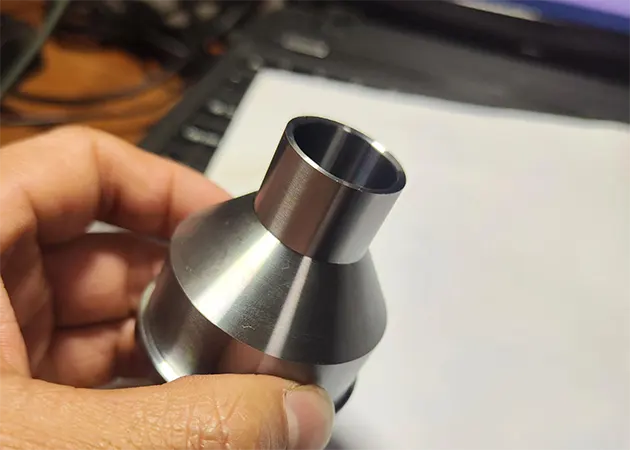
Currently, most molds used to manufacture O-rings feature a 45° parting line.
The inner ring grooves are machined using forming cutters that match the dimensions of the grooves.
According to the “2023 China Mold Industry Development Report,” over 90% of enterprises still adopt a “one groove, one tool” machining model.
When the diameter deviation of the inner ring groove cross-section exceeds ±0.1 mm, a new forming tool must be custom-made.
Limitations of Traditional Forming Turning Processes
Currently, the industry widely adopts the forming turning process, which is characterized by the use of specialized tools, multi-step machining, and precision limitations.
Due to the wide variety of rubber rings, a large number of forming tools must be manufactured to produce molds.
Furthermore, the shrinkage rate of rubber raw materials falls within a certain range.
As a result, the prototyping of rubber rings often requires the production of multiple sets of molds with different inner ring groove dimensions.
This, in turn, necessitates the use of multiple forming tools, thereby increasing the cost of mold production.
Although flexible cutting tools and intelligent compensation technologies have made significant progress in rubber mold manufacturing, existing research still has limitations.
Small and medium-sized enterprises also find it difficult to bear the high costs of CNC technological upgrades.
In view of this, this paper proposes a CNC turning tool for machining the inner ring grooves of O-ring molds with a 45° parting line.
A single tool specification can handle mold processing within a certain range of specifications.
Only a few tool specifications are needed to cover the vast majority of the company’s mold processing needs, offering low cost and high compatibility.
Analysis of the Molding Process for O-Ring Rubber Seals
-
Analysis of Mold Structure and Machining Challenges
Generally, high-precision sealing O-rings feature a 45° parting line, with the upper and lower mold cavities having convex and concave profiles, respectively.
These cavities are fixed to the upper and lower mold plates, which are secured by locating pins.
Conventional sealing rings feature a single “zero-to-zero” precision fit, specifically at the 45° tapered section of the upper and lower mold cavities.
Machining these surfaces with standard tools typically requires two setups and four tool-setting operations (see Figure 1).
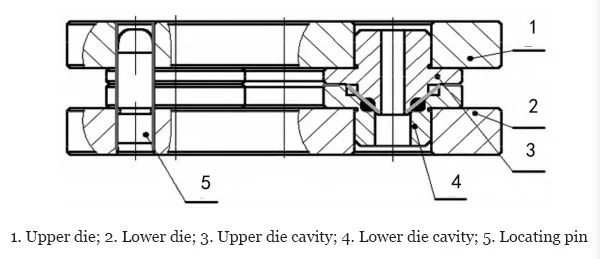
To manufacture high-precision sealing rings, the company has modified its molds.
The 45° taper of the upper and lower cavities, as well as the tool-setting surfaces and cross-sectional profiles of the sealing rings, are now formed in a single setup.
This eliminates the need for post-machining of the cross-sectional profiles, thereby reducing errors associated with clamping, tool alignment, and alignment.
The single-setup alignment process requires an error tolerance of within 0.005 mm.
-
Tool Compatibility
In the current field of rubber ring mold machining, the issue of poor tool compatibility is primarily manifested in the rigid matching of specialized tools to groove dimensions.
Industry research indicates that traditional forming tools can only cover a groove width tolerance range of ±0.06 mm, resulting in the need to custom-make specialized tools for every 0.1 mm difference in dimensions.
At one automotive sealing component manufacturer, redundant tools accounted for as much as 42% of the tool inventory.
-
Surface Quality of Mold Cavities
Surface quality defects in the turning process of rubber ring molds primarily manifest as two major issues: excessive residual micro-contour height and the formation of a surface degradation layer.
Research indicates that the residual height is determined jointly by the tool tip radius (R) and the feed rate (f), as shown in the theoretical formula in Equation (1):
.jpg "(1)")
When R = 0.3 mm and f = 0.08 mm/r, the residual height h is 0.013 mm, resulting in a surface roughness Ra of 0.4–0.6 μm, which exceeds the requirement of Ra ≤ 0.2 μm for high-end seals.
Design of a CNC Turning Tool for Machining the Inner Groove of an O-Ring Mold
-
Overall Structure of the Turning Tool
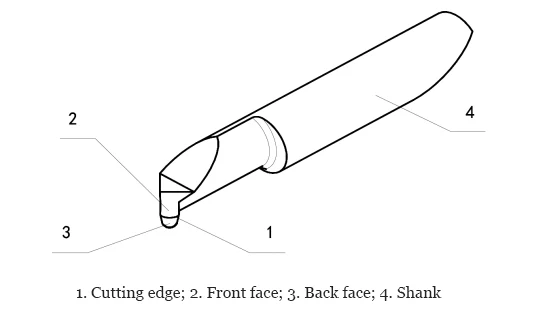
The CNC turning tool for machining the inner groove of an O-ring mold consists of a cutting section and a shank.
It is characterized by the following: the cutting section comprises a front face, a rear face, a cutting edge, and a shank (see Figure 2).
-
Selection of Cutting Tool Materials
The selection of materials for cutting tools used in the machining of rubber molds requires a comprehensive consideration of the mold material properties, machining accuracy requirements, cutting loads, and cost-effectiveness.
The material selection for these cutting tools must be systematically optimized based on mold hardness, machining accuracy, and economic feasibility.
High-hardness mold steel (HRC 50+) is best machined using ultra-fine-grained cemented carbide (e.g., YG10F, grain size ≤0.5 μm) combined with AlTiN/AlCrN coatings (3–5 μm), achieving an optimal balance between wear resistance and edge sharpness (R < 5 μm).
For semi-finishing of medium-hardness pre-hardened steel (HRC 30–45), high-toughness cemented carbide (YG15) paired with TiAlN/TiCN composite coatings (4–6 μm) is recommended for superior impact resistance.
For mirror finishing (Ra ≤ 0.4 μm), use diamond-coated substrates or CBN tools combined with DLC coatings (1–2 μm) to achieve low-friction cutting.
When machining high-temperature alloys, metal-ceramic (CT series) or CBN materials (BN700) should be selected due to their heat resistance of 1200–1400 °C.
Substrate pretreatment (sandblasting/pickling) and coating technology (HiPIMS) work together to enhance bond strength (critical load >50 N).
Costs are reduced by 30% through composite tool design (separate roughing and finishing sections) and regeneration technology.
Carbide-tipped turning tools offer good wear resistance and high-temperature resistance, are widely used, and are suitable for machining brittle materials.
To ensure the structural strength and durability of the tool, carbide is selected as the material.
-
Selection of Tool Coatings
Tool coatings are a key technology for enhancing cutting performance; their selection requires a comprehensive consideration of factors such as the workpiece material, cutting parameters, and machining environment.
Common coating types include titanium nitride (TiN), titanium carbonitride (TiCN), aluminum titanium nitride (AlTiN), and diamond-like carbon (DLC), each of which possesses unique physical and chemical properties.
TiN, as a base coating (2–4 μm), offers excellent wear resistance and a low coefficient of friction, making it suitable for machining ordinary steel parts and providing a significant cost-performance advantage.
The TiCN coating (HV3000) enhances surface hardness through the addition of carbon and performs exceptionally well in the machining of cast iron and alloy steel, though its high-temperature resistance (400°C) is relatively limited.
AlTiN coatings form a dense layer of aluminum oxide due to the oxidation of aluminum, significantly improving heat resistance (900°C).
They are particularly suitable for high-speed dry cutting and the machining of high-temperature alloys, but their cost is more than 40% higher than that of traditional coatings.
DLC coatings, with their diamond-like structure (HV 4000–6000) and extremely low coefficient of friction (0.05–0.15), effectively suppress built-up edge formation during the machining of sticky materials such as aluminum alloys and composites.
For heavy-duty intermittent cutting, multi-layer composite coatings (such as TiAlN+MoS₂) should be prioritized; their gradient structure balances wear resistance and lubrication requirements.
In precision machining applications, nanoscale superlattice coatings may be considered; their alternately deposited nanolayer structure can increase hardness to over HV4500.
The selection of coatings and thickness design for cemented carbide cutting tools must be closely aligned with machining conditions and tool performance requirements.
Optimal cutting results are achieved through material property matching and process parameter optimization.
Therefore, this turning tool employs a TiCN multi-layer composite coating with a thickness of 4–6 μm.
-
Design of Cutting Tool Geometric Parameters
A large rake angle results in a sharp cutting edge, reduced chip evacuation resistance, and minimal workpiece deformation.
However, an excessively large rake angle reduces the tool’s rigidity and strength, thereby shortening its service life.
The rake angle primarily affects the friction between the tool’s rear face and the machined surface.
Increasing the rake angle can reduce friction and improve surface finish quality; however, an excessively large rake angle will decrease the strength of the cutting edge and shorten the tool’s service life.
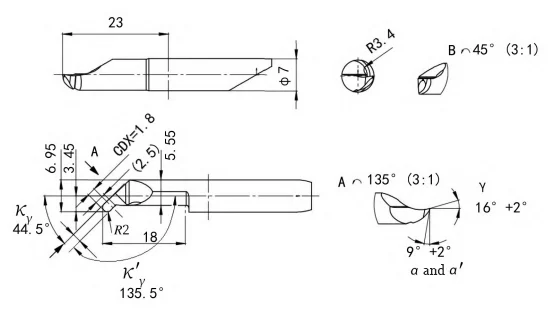
Since the surface roughness requirements for the inner ring groove of the rubber mold are high, a front angle γ of 16°–18° makes the tool sharper.
It reduces cutting resistance and heat generation, and facilitates the achievement of a better surface finish.
-
Design of Main and Secondary Rake Angles (α, α’)
The primary function of the main rake angle α is to reduce friction between the tool’s rake face and the machined surface of the workpiece, thereby improving surface finish and extending tool life.
Increasing the main rake angle can sharpen the cutting edge of the turning tool; however, a large rake angle not only weakens the tool’s strength but also worsens heat dissipation conditions.
Therefore, the main rake angle α and the secondary rake angle α’ are set to 9°–11°;
-
Main Cutting Edge Angle (κ’γ) Design
The main rake angle κ’γ primarily affects the tool’s heat dissipation, the magnitude of the cutting forces, changes in the machining direction, and variations in the cutting depth.
Theoretically, when machining a rubber mold with a 45° parting surface, a main rake angle κ’γ of 45° would satisfy the machining requirements.
However, to avoid the effects of uncertain factors such as material springback and machine tool accuracy, the main rake angle κ’γ is set to 44.5°;
-
Secondary Cutting Edge Angle Optimization
The secondary rake angle κ’γ primarily reduces friction between the secondary cutting edge and the machined surface of the workpiece, affecting the surface finish quality of the workpiece and the strength of the turning tool.
Theoretically, when machining a rubber mold with a 45° parting surface, a secondary rake angle κ’γ of 135° is sufficient to meet machining requirements.
However, to avoid the effects of material springback and uncertainties in machine tool accuracy, the secondary rake angle κ’γ is set to 135.5°.
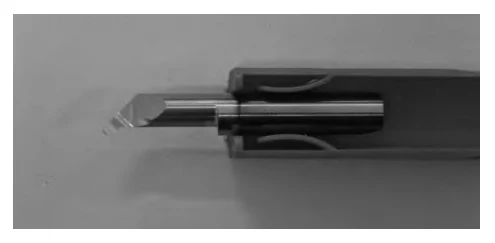
The tool geometry design is shown in Figure 3, and the 3D model of the tool is shown in Figure 4.
Tool Usage and Results
-
Tool Usage
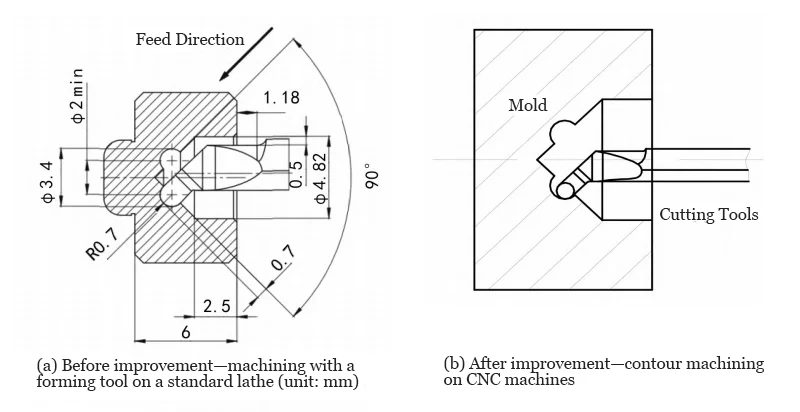
Using a CNC turning tool with a tool tip radius (R) smaller than the radius of the ring groove on the mold, combined with CNC programming techniques, the inner ring groove of the mold is machined using contouring.
The improvements to the mold cavity machining method are shown in Figure 5.
-
Tool Performance
A specialized CNC tooling system featuring a modular design, integrated with intelligent CNC contouring programs, enables flexible adaptation to the efficient machining of molds of various sizes and shapes.
Its unique cutting edge design is compatible with the machining requirements for inner grooves of O-ring molds within a specific size range.
Its innovative segmented cutting edge structure is made of cemented carbide and combined with micron-level surface coating technology.
When used with high-precision CNC machines, it enables the entire machining process from roughing to finishing and significantly reduces tool changes by up to 70%.
This not only lowers tool inventory costs but also increases machining efficiency by more than 30%.
Verified by coordinate measuring machine (CMM) testing, the roundness error of the inner ring grooves machined by this tool is consistently controlled within the range of 0.003–0.004 mm, with dimensional consistency deviation ≤0.008 mm.
The surface roughness uniformity meets technical specifications of Ra 0.12–0.18 μm, covering over 95% of a company’s rubber mold machining needs.
This solution reduces the machining cycle for a single mold by 4.2 hours, lowers tool inventory costs by 63%, and increases overall production efficiency by 37.6%.
It is particularly suitable for medium-to-large mold manufacturing enterprises with an annual output of 500,000 units or more.
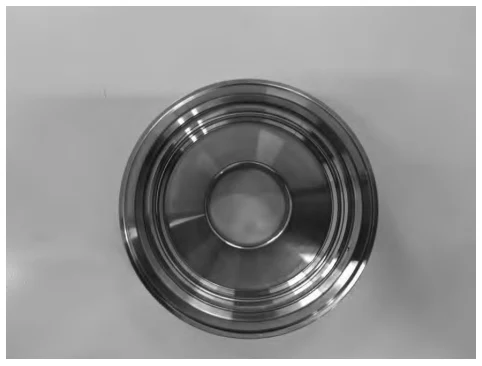
The machining results for the inner ring groove of an O-ring mold are shown in Figure 6.
Conclusion
CNC turning tools for machining the inner grooves of O-ring molds are simple to manufacture, cost-effective, and easy to use.
A single tool size can handle the machining of molds within a certain size range, and just a few tool sizes can cover the vast majority of the company’s mold machining needs.
This turning tool meets the requirements for mold manufacturing, achieving a cross-sectional out-of-roundness of ≤0.005 mm, a dimensional consistency deviation of ≤0.008 mm, and a surface roughness of Ra ≥0.2 μm.
A utility model patent has been granted, Patent No.: ZL202023232782.1.