
Modern society demands higher precision machining capabilities, particularly in aerospace, automotive, and precision machinery sectors where traditional mechanical cutting methods can no longer meet complex, high-quality processing requirements.
CNC laser cutting technology has emerged as the mainstream precision machining process due to its non-contact operation, absence of tool wear, and minimal deformation.
This paper primarily explores the physical mechanisms and system composition of CNC laser cutting machines, conducting an in-depth analysis of the functions and interrelationships of key technical modules.
It aims to provide additional theoretical foundations for equipment development and process improvement.
Principles of CNC Laser Cutting
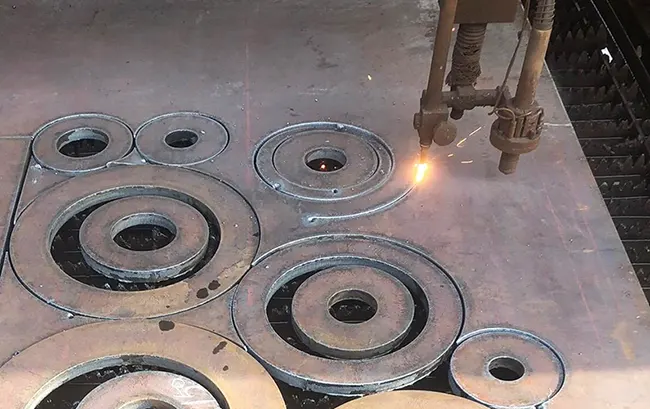
CNC laser cutting fundamentally operates as a material removal process based on the photothermal effect.
Its physical principle involves focusing a high-energy-density laser beam onto the workpiece surface, rapidly converting light energy into heat.
This causes localized melting, vaporization, or oxidation reactions in the irradiated area.
Auxiliary gases serve to blow away slag, catalyze chemical reactions, or cool the cut seam.
The interaction between laser and material adheres to the laws of energy conservation and heat transfer equations.
Effective cutting requires laser power density exceeding the material’s vaporization threshold.
This process involves complex thermophysical changes including material phase transitions, molten flow, and gas dynamics.
Laser cutting quality is influenced by numerous factors such as laser mode, power stability, focal position, and auxiliary gas parameters.
Structural Analysis of CNC Laser Cutting Machines
A CNC laser cutting machine is a complex system integrating optics, mechanics, electronics, and pneumatics.
Its overall performance relies on the coordinated operation and precision control of various subsystems.
Beyond static high precision, it must maintain excellent stability during dynamic processing.
Mechanical Frame and Bed Structure
The mechanical frame and bed provide fundamental support and serve as the motion reference for the entire equipment.
Beds are typically constructed from cast iron or welded steel structures, each offering distinct advantages.
Cast iron beds exhibit excellent damping properties, effectively suppressing vibration generation, while welded steel structures offer a higher strength-to-weight ratio.
Some high-end equipment utilizes mineral casting materials for the bed, which exhibit exceptional rigidity and thermal stability, mitigating thermal deformation effects to a significant degree.
Finite element analysis optimizes the bed structure; strategically placed stiffeners enhance natural frequency and prevent resonance with the motion system.
As the load-bearing component of the motion system, the crossbeam’s lightweight design is critical.
The application of aerospace-grade aluminum alloys significantly reduces motion inertia. Simultaneously, biomimetic design principles optimize weight while maintaining structural rigidity.
Carbon fiber composite beams can be employed to enhance acceleration capabilities and reduce moving mass.
Multi-Axis Motion Control System
As the nerve center of CNC laser cutting machines, the performance of the multi-axis motion control system directly impacts machining precision and efficiency.
Modern systems employ a distributed control architecture: the master controller handles trajectory planning and coordination, while individual axis drivers perform local closed-loop control.
This structure reduces communication latency and enhances system responsiveness.
The servo drive system employs high-performance permanent magnet synchronous motors paired with high-precision optical encoders or rotary transformers to form a semi-closed-loop control system.
To further enhance precision, linear encoders are typically installed at the final load end, creating a fully closed-loop control system.
This configuration compensates for errors such as backlash, elastic deformation, and thermal elongation within the transmission chain.
Motion control algorithms employ predictive processing methods.
Before motion execution, the processing path is analyzed in advance to optimize speed planning and acceleration curves, ensuring no overshoot or vibration occurs during high-speed movement.
Advanced control systems integrate adaptive control functions that automatically adjust control parameters based on load changes. Some systems utilize artificial intelligence algorithms.
Through deep learning of historical processing data, they continuously optimize motion trajectories and processing parameters, achieving intelligent machining.
Laser Generation and Transmission Systems
Lasers serve as the core energy source, with technological advancements directly driving improvements in cutting capabilities.
Fiber lasers have now become the mainstream choice. They utilize rare-earth-doped optical fibers as the gain medium, employing multiple laser diodes for pumping.
Their electro-optical conversion efficiency can exceed 30%, significantly surpassing the 10%–15% efficiency of CO₂ lasers.
The laser transmission system must maintain beam quality.
Fiber-optic transmission systems utilize flexible quartz fibers, where core diameter and numerical aperture require precise calculation to achieve single-mode or low-order mode transmission.
Multiple functional modules exist during transmission: beam shapers improve energy distribution within the spot, power detectors monitor laser output in real time, and shutter systems provide emergency shutdown capabilities.
High-power laser systems typically employ water-cooled fiber interfaces to prevent thermal damage to the fiber.
Cutting Head Sensor Assembly
The cutting head serves as the critical processing terminal, integrating multiple advanced sensors.
Its autofocus system utilizes servo motors to drive the focusing lens assembly, dynamically adjusting the focal position based on material thickness and process requirements.
Modern focusing systems measuring nozzle-to-workpiece distance with micron-level precision employ non-contact capacitive or laser displacement sensors.
The cutting process monitoring system includes plasma sensors and thermal imagers.
Plasma sensors detect specific wavelengths of light radiation generated during cutting to verify process integrity, while thermal imagers continuously monitor temperature distribution in the cutting zone, providing data for optimizing process parameters.
High-end cutting machines also incorporate vision positioning systems.
These utilize charge-coupled device (CCD) cameras to automatically identify material edges or pre-cut markings, enabling more precise positioning and facilitating rework.
The cutting head’s anti-collision protection system primarily consists of pressure sensors and infrared detection devices.
Upon unexpected contact between the cutting head and workpiece, movement immediately halts and retracts to prevent damage to valuable optical components.
The coordinated operation of these sensor systems effectively ensures cutting process reliability and stability.
Gas Supply and Cooling System
The gas system provides a controlled gas medium for the cutting process. After multi-stage pressure reduction and filtration, the output flow is regulated by a mass flow controller.
Modern gas systems utilize digital pressure regulators to achieve pressure control accuracy down to 104 Pa.
The system employs computational fluid dynamics (CFD) to design gas nozzles, creating stable laminar airflow that effectively protects the focusing lens and enhances cutting quality.
The cutting machine’s cooling system employs a dual-loop structure: the primary loop directly cools the laser head and lenses with water, while the secondary loop transfers heat to a cooling tower via a heat exchanger.
Temperature control utilizes PID (Proportional-Integral-Derivative) regulation, maintaining coolant temperature within ±0.5°C. Some high-end cooling systems additionally incorporate water quality monitoring equipment, continuously detecting conductivity and particle counts to ensure sustained, reliable operation.
Furthermore, optimized thermal management system design significantly impacts equipment stability and lifespan.
Computational fluid dynamics simulations can optimize heat dissipation channel layouts to enhance airflow and cooling efficiency, minimizing thermal deformation-induced accuracy loss.
Concurrently, the thermal management system automatically adjusts cooling intensity based on load changes to achieve maximum energy efficiency.
CNC Operating Platform
The CNC operating platform serves as the brain of modern laser cutting machines, integrating functions such as processing management, process optimization, and equipment monitoring.
Built on an industrial computer hardware platform with multi-core processors and a real-time operating system, it ensures efficient motion control for the cutting machine.
The human-machine interface employs multi-touch technology, providing users with an intuitive operating experience.
The process database stores a vast repository of validated processing parameters.
Operators need only select material type and thickness for the system to automatically generate optimal parameter combinations.
The system also possesses self-learning capabilities, continuously refining process parameters based on actual cutting results.
Remote monitoring functions leverage IoT technology to enable real-time collection and analysis of equipment status, facilitating predictive maintenance and remote fault diagnosis.
The integrated machining simulation module within the CNC operating platform detects program errors and collision risks in advance.
Virtual machining capabilities predict processing time and outcomes, enhancing equipment utilization, improving machining reliability, and reducing reliance on operator experience—embodying the advanced principles of digital manufacturing.
Conclusion
CNC laser cutting technology constitutes a vital component of modern precision manufacturing systems.
The efficiency and quality of CNC laser cutting processes heavily depend on the seamless coordination among the various control systems within CNC laser cutting equipment.
Therefore, it is essential to conduct in-depth research on the composition of CNC laser cutting, starting from its physical principles, system architecture, and the functions and technical implications of each subsystem.
The mechanical structure provides the foundational processing capability for the equipment, while the multi-axis motion control system enables precise tracking of complex trajectories.
The laser generation and transmission system ensures stable laser output, and the intelligent cutting head and sensor components guarantee processing accuracy and quality.
The pneumatic cooling system, in turn, ensures the stable operation of the equipment.