As a precipitation-hardening nickel-based high-temperature alloy, Inconel 718 exhibits outstanding overall performance over the temperature range –253 to 700°C, and its yield strength below 650°C ranks first among high-temperature deformable alloys.
Advanced Machining Technology
This material achieves high strength through the γ” (Ni₃Nb) and γ’ (Ni₃AlTi) strengthening phases, and accounts for up to 45% of critical components such as turbine discs and combustion chambers in aircraft engines.
Its excellent oxidation resistance and corrosion resistance (annual corrosion rate < 0.0025 mm) make it widely used in fields such as nuclear power and petrochemicals.
The material’s high hardness (350–400 HBW) and low thermal conductivity [14 W/(m·K)] lead to severe thermomechanical deformation during machining, subjecting cutting tools to significant adhesive and diffusion wear.
Machining requires the use of SiAlN ceramic or PCD diamond cutting tools, and ultrasonic vibration-assisted technology is employed to reduce cutting forces by 30% and extend tool life.
Machining Challenges and Technological Advancements
In the aerospace sector, the machining of Inconel 718 nickel-based high-temperature alloys faces challenges such as short tool life and high cutting temperatures;
Its high hardness and low thermal conductivity further exacerbate tool wear.
Technological advancements can significantly improve machining efficiency:
① Acoustic emission monitoring technology provides real-time warnings of tool wear through the acquisition of 50 kHz–1 MHz signals.
② An automatic regrinding system on six-axis tool grinders extends tool life by more than 30%.
③ Intelligent toolholder technology dynamically adjusts cutting parameters to improve the machining quality of complex surfaces.
④ Industry demand drives technological innovation, boosting the machining efficiency of complex components—such as integral blisks—by 30% while reducing energy consumption.
Breakthroughs in tool technology are a key pillar for achieving the domestic production of high-end equipment in China.
Research Methods and Experimental Validation
This study adopted a three-dimensional research framework comprising theoretical modeling, numerical simulation, and experimental validation.
A coupled cutting force–temperature model was developed based on the Johnson-Cook constitutive equations, and multiphysics simulations of the cutting process were performed using AB A Q U S finite element software to predict the distribution of tool stresses under different parameters (with a peak error of <8%).
In the experiments, a triaxial force transducer (Kistler 9257B) and an infrared thermal imager (FLIR A655sc) were used to collect cutting data, verifying the reliability of the simulation results.
The correlation coefficient R² > 0.92 (where R represents the coefficient of determination, commonly referred to in engineering as the goodness-of-fit coefficient), which is a core statistical indicator measuring the degree of agreement between simulation predictions and experimental data, with a range of 0 to 1.
Intelligent Tool and Process Optimization
Innovative breakthroughs include:
① Intelligent optimization algorithm: By integrating the NS GA-II genetic algorithm with a BP neural network, a multi-objective optimization model was established for cutting speeds of 50–120 m/min, feed rates of 0.05–0.15 mm/r, and back-cutting depths of 0.1–0.5 mm, resulting in a 42% increase in tool life.
② Composite Coating Technology: TiAlN/AlCrN nano-composite coated cutting tools were developed that maintain a hardness of approximately 2,860 HV even at 700°C, with the onset temperature of oxidation raised to 900°C.
③ Online Monitoring System: Through deep learning-based fusion analysis of acoustic emission signals (100–300 kHz frequency band) and current signals, tool wear prediction accuracy of ±0.02 mm was achieved.
The study investigated a new chip-breaking groove structure designed through topological optimization, which reduced cutting forces by 18%.
Concurrently, the adoption of laser-assisted machining technology (1.2 kW) increased machining efficiency by 35%.
These innovations provide critical technical support for the efficient and precise machining of complex aerospace structural components.
Material Properties and Machining Challenges of Inconel 718
Analysis of Material Properties
Inconel 718 is a nickel-based high-temperature alloy primarily composed of nickel (50%–55%) and chromium (17%–21%). Strengthened by elements such as niobium and molybdenum, it achieves a tensile strength of 1,240 MPa at room temperature and maintains stable performance below 650°C.
Its low thermal conductivity [11.4 W/(m·K)] causes cutting temperatures to exceed 1,000°C during machining, exacerbating adhesive wear on the cutting tool.
The material exhibits significant work hardening; surface hardness can increase by 20%–30% after turning, requiring optimized tool geometry parameters with a front angle of 6°–8° and a back angle of 12°–14°.
In electrical discharge machining (EDM), the high chromium content tends to form an insulating oxide layer; the thickness of the remelted layer is controlled by adjusting the pulse energy.
Although laser-assisted machining can improve heat dissipation, the surface roughness value Ra must be controlled to <1.6 μm to prevent cracking during subsequent heat treatment.
Given its high hardness (350–400 HBW) and thermomechanical properties, the development of specialized cutting tools and hybrid machining processes is key to overcoming machining bottlenecks.
Analysis of Machining Challenges
The machining challenges associated with Inconel 718 nickel-based superalloy primarily stem from its material properties.
① High Strength and Hardness: Cutting forces are significantly higher than those for ordinary steel;
The recommended cutting speed for carbide tools is only 20–30 m/min, and high-speed cutting can easily cause tool chipping.
② Low Thermal Conductivity: Temperatures in the cutting zone exceed 1,000°C, accelerating tool oxidation and diffusion wear;
Laser-assisted or high-pressure jet cooling technologies must be employed to improve heat dissipation.
③ Significant work hardening: The hardening layer depth reaches 50–100 μm, leading to increased fluctuations in cutting forces during subsequent machining and reducing tool life by 30%–50%.
④ Strong material affinity: Surface roughness (Ra) increases to 3.2 μm or higher, requiring the use of PVD AlTiN-coated tools to reduce the coefficient of friction.
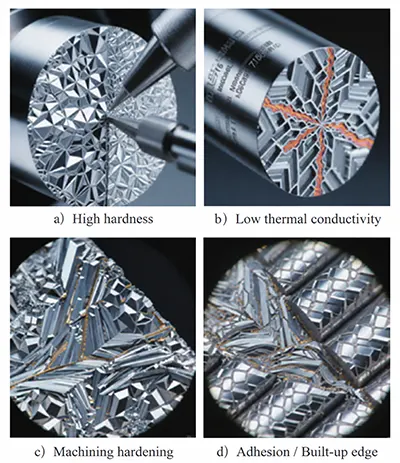
The combined effects reduce tool life to only 1/10 to 1/5 of that achieved when machining ordinary steel; tool performance must be enhanced through synergistic optimization of the substrate and coating (e.g., fine-grained tungsten carbide combined with a nanocoating). The microstructural evolution of work hardening in Inconel 718 is shown in Figure 1.
Problems and Challenges in the Machining Process
There are four main core challenges in machining Inconel 718 nickel-based high-temperature alloys.
1. Tool Life And Cost Issues
Cutting temperatures exceed 1,000°C, accelerating phase-transition wear in tools; although CBN grinding wheels are wear-resistant, they are prone to abnormal wear caused by microstructural changes during a transition period.
In deep-hole machining, the service life of gun drills is reduced by 30% to 50% due to thermomechanical fatigue, and the recommended cutting speed for carbide tools is only 20–30 m/min.
2. Difficulties In Surface Quality Control
Unstable chip morphology leads to fluctuations in surface roughness (Ra) values (which can exceed 3.2 μm), and during CBN grinding, instantaneous force changes cause localized burning.
Deviations in electron beam welding parameters can cause microstructural inhomogeneity at the joint, affecting assembly accuracy.
3. Narrow Cutting Parameter Window
Cutting speed (which can be increased to 150 m/min with laser-assisted machining) and feed rate (0.050–0.125 mm/r) must be strictly controlled to match material properties.
In electrical discharge machining (EDM), deviations in pulse parameters can result in variations in the thickness of the remelted layer exceeding 9.88%.
4. Machining Efficiency Bottlenecks
Shorter grinding wheel dressing intervals increase CBN grinding costs by at least 40%, while multi-axis programming for complex surfaces accounts for 30%–50% of the machining cycle.
Current mainstream industry technologies can effectively address these machining challenges:
① Laser-assisted machining technology reduces cutting forces by 46%, significantly improving cutting conditions.
② Intelligent parameter optimization systems precisely tailor machining processes, boosting overall machining efficiency by 30%.
③ New nano-coated cutting tools can extend tool life by 2 to 3 times.
These key machining technologies play a decisive supporting role in the domestic mass production of core components such as aircraft engine turbine discs in China.
A comparison of Inconel 718’s performance under different machining conditions is shown in Table 1.
| Machining Process | Cutting Speed (m/min) | Feed Rate (mm/r) | Cutting Force (N) | Temperature (°C) | Typical Characteristics |
|---|---|---|---|---|---|
| Conventional Turning | 20–30 | 0.050–0.150 | 800–1200 | 650–800 (measured by infrared thermal imager) | Cutting force first increases and then decreases as cutting speed increases. The peak value reaches 1200 N at a cutting speed of 30 m/min. |
| Laser-Assisted Turning | 60–150 | 0.050–0.125 | 1600–2500 | 980–1050 (laser power: 1200 W; wavelength: 1064 nm) | The peak cutting force reaches 2500 N (measured with a Kistler 9257B dynamometer), approximately 2.1 times that of conventional machining. |
| Milling | 30–50 | 0.050–0.100 | 1000–1800 | 500–750 (fluctuation of ±150°C) | Intermittent cutting causes the force fluctuation coefficient to reach 1.8–2.2. The optimized axial rake angle is 0.3–0.8 mm. |
| Drilling | 15–25 | 0.020–0.050 | 1200–2000 | Hole opening: 600 → hole bottom: 850 (embedded thermocouple: ±5°C) | Axial force accounts for 60% of the total cutting force. High-cobalt high-speed steel is recommended (cobalt content: 10%–12%). |
Table 1 Comparison of properties of Inconel 718 under different processing conditions
Current Status and Development Trends of CNC Machining Tool Technology
Overview of CNC Machining Technology
Computer Numerical Control (CNC) machining technology is a core process that enables the automated manufacturing of parts through a computer numerical control system;
Its technical advantages are particularly prominent in high-value-added fields such as aerospace.
1. Core Technical Features
① High-precision control: A closed-loop feedback system achieves micron-level machining accuracy;
For example, machining errors for Inconel 718 turbine discs can be controlled within ±0.01 mm.
Programs can be repeatedly called upon, ensuring batch product consistency of over 99.5%.
② Flexible production: Machining programs can be quickly switched by modifying G-code;
Five-axis simultaneous machining technology enables the one-time forming of complex surfaces (such as aircraft engine blades);
And the integrated CAD/CAM system reduces the design cycle for Inconel 718 components by 60%.
③ High-efficiency machining capabilities: Five-axis machining centers reduce the number of traditional machining steps from 8–10 to 2–3, boosting production efficiency by 40%–60%;
Optimized cutting parameters enable Inconel 718 machining speeds of up to 150 m/min (laser-assisted).
2. Three Major Trends In Technological Development
① Intelligence—integration of IoT technology enables real-time monitoring and adaptive adjustments during the machining process.
② Hybridization—combining additive manufacturing technology to repair Inconel 718 components and suppress Laves phase defects.
③ Sustainability—dry cutting technology reduces energy consumption by 30% while maintaining a surface roughness value (Ra) of <1.6 μm.
Through multi-axis coordinated control and adaptive strategies, this technology effectively addresses the challenges of tool wear (extending tool life by 2–3 times) and surface integrity control in difficult-to-machine materials, providing critical process support for high-end equipment such as aircraft engines.
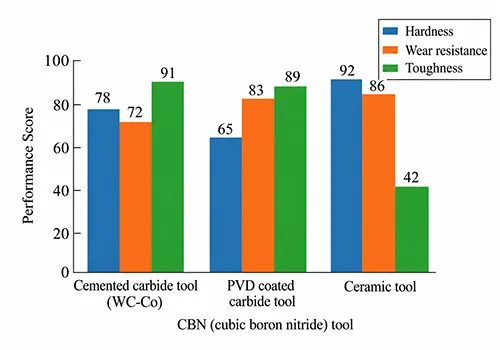
A comparison of tool material properties is shown in Figure 2.
Among them, ceramic tools have the highest hardness but low toughness and high brittleness, making them suitable for continuous cutting;
Cemented carbide tools offer optimal toughness and are suitable for rough machining;
PVD-coated and CBN tools feature outstanding wear resistance and good toughness, making them suitable for semi-finishing and precision cutting.
Each of these three types of tools has its own advantages and should be selected appropriately based on the machining conditions.
Current Status of Cutting Tool Technology
1. Cutting Tool Materials
Cemented carbide cutting tools account for more than 60% of the global market share, achieving a balance between hardness and toughness by optimizing the WC-Co ratio.
Although ceramic cutting tools can withstand temperatures exceeding 1,000°C, their brittleness limits their use in intermittent machining.
CBN cutting tools maintain good cutting performance even at 1,400°C and are suitable for machining hardened steel.
2. Coating Technology
TiAlN/AlCrN multilayer composite coatings enhance oxidation resistance through PVD/PCVD processes;
Nanoscale coatings increase bond strength by 30%, and cutting tools with AlCrN coatings achieve a 40% increase in tool life when machining Inconel 718.
1) TiAlN Coating. Formed by depositing Al into a TiN substrate; increasing the Al content significantly improves the high-temperature resistance and hardness of the tool coating.
2) AlCrN Coating. Consists of a Cr interface implantation layer (50–300 nm), a CrN bonding layer (0.1–1.0 μm), and an alternating multilayer structure of CrN and AlCrN.
3) Composite Deposition Technology. The AlCrN/WN multilayer structure, deposited using a combination of arc ion plating and DC magnetron sputtering, includes a transition layer in direct contact with the tool substrate.
4) Performance Advantages. The multilayer coating design effectively reduces diffusion and chemical reactions between the tool and the workpiece through chemical and thermal barrier effects, thereby optimizing cutting performance.
3. Structural Design
The wave-shaped cutting edge design reduces cutting temperature by 25°C, while optimized chip-breaking grooves reduce chip thickness fluctuation to 6%.
The front angle gradient design alleviates heat concentration issues and improves cutting stability when machining difficult-to-machine materials.
4. Smart Applications
The smart toolholder integrates 12 sensors to enable automatic wear detection, increasing the machining yield by 15 percent.
Digital twin technology keeps the margin of error in tool life predictions within ±8 percent.
Current cutting tool technology is evolving in the direction of material composites (such as diamond-coated tools), functional structures (such as adaptive friction compensation designs), and intelligent systems (such as AI-driven process optimization), providing critical support for high-efficiency, precision machining in fields such as aerospace.
Forecast of Future Development Trends
CNC cutting tool technology will achieve breakthroughs and innovations in four core areas.
① Material Innovation: CBN/PCD gradient composite materials improve impact resistance by 30%, enabling cutting speeds exceeding 200 m/min for Inconel 718.
Nanoceramic-reinforced metal matrix materials can extend tool life by 2 to 3 times, while self-healing coatings reduce wear rates by 40%.
② Smart Integration: Embedded sensors monitor cutting force and temperature in real time, and machine learning (ML) algorithms achieve wear prediction accuracy within ±5%.
G+ digital twin technology shortens the process validation cycle by 50% and supports cross-border collaborative manufacturing.
③ Green Upgrades: Thermal barrier coating technology reduces coolant consumption by 45%, while gradient structure design lowers cobalt consumption by 28%;
Data-driven tool-change strategy optimization increases tool utilization by 35%.
④ Specialized Design
Design: Inside-cooled inserts with a positive rake angle suppress built-up edge on Inconel 718, with surface roughness (Ra) controlled within 0.8 μm;
A modular system enables rapid switching between multiple processes, boosting machining efficiency by 40%.
› Future Development of Cutting Tool Technology
Technological development will establish a four-dimensional innovation system based on “materials, intelligence, environmental sustainability, and customization.”
These four dimensions will provide core support for manufacturing strategic equipment such as aircraft engines.
A comparison of future trends in cutting tool technology is shown in Table 2.
| Dimension | Current Technology | Future Development Trends | Technical Features | Application Areas |
|---|---|---|---|---|
| Materials | Cemented carbide, high-speed steel, ceramics, CBN, and PCD | Nanocomposites, functionally graded materials, and superhard coatings | Nanocrystalline structures improve toughness; gradient design optimizes stress distribution; superhard coatings improve wear resistance | Aerospace and machining of difficult-to-cut materials |
| Structure | Uniform coatings and single-layer structures | Multilayer nanostructures, biomimetic structures, and adaptive structures | Multilayer interface design suppresses crack propagation; biomimetic structures optimize chip evacuation; adaptive structures adjust performance according to machining conditions | High-efficiency machining and dry/minimum-quantity lubrication cutting |
| Intelligence | Fixed-parameter cutting and basic monitoring | Adaptive control, real-time monitoring, and predictive maintenance | Integrated sensors monitor tool conditions in real time; AI algorithms optimize cutting parameters; digital twins predict tool life | Smart manufacturing and unmanned machining |
| Manufacturing Processes | Conventional PVD/CVD coatings and machining | Atomic layer deposition, laser surface engineering, and additive manufacturing | Atomic-scale precision control; laser surface modification enables microstructure regulation; additive manufacturing creates complex geometries | Micro/nano machining and precision mold manufacturing |
| Performance Indicators | High hardness and high wear resistance | Multifunctional integration, environmental adaptability, and sustainability | Combines high hardness with high toughness; adapts to different machining environments; incorporates recyclable material design | Green manufacturing and multifunctional machining |
| Application Scenarios | General-purpose cutting | Extreme-condition machining and special-material machining | Improved high-temperature, corrosion, and impact resistance; suitable for difficult-to-machine materials such as titanium alloys and composites | Biomedical applications, new energy, and high-end equipment manufacturing |
Table 2. Comparison of Future Development Trends in Cutting Tool Technology
CNC Machining Tool Technology
Tool Material Selection
Machining Inconel 718 places stringent demands on tool materials, which must combine high hardness (≥93 HRA), high-temperature stability (>1000°C), and resistance to thermal shock.
› Cutting Tool Materials for Inconel 718
① Turning: Ultra-fine-grained cemented carbide (WC grain size < 0.5 μm) is the preferred choice for rough machining;
When combined with a TiAlN coating, it can reduce cutting edge temperature by 15%–20% and increase tool life by 30%;
Ta-C-Nb carbide additives can significantly improve resistance to plastic deformation.
② Milling: SiC-reinforced alumina-based ceramic materials retain their red hardness even at 1200°C; an AlCrN coating reduces surface roughness by 40%;
A gradient distribution of Cr suppresses the Ni–Ti diffusion reaction.
③ Drilling: High-cobalt cemented carbide (10%–12% Co content) absorbs impact loads, while TiCN-Al₂O₃-TiN multilayer coatings reduce crescent-shaped wear by 30%;
› Advances in Cutting Tool Technology
The composite coating structure reduces the incidence of thermal cracking to 1/37 that of traditional coatings.
Current cutting tool technology achieves performance breakthroughs through synergistic design between the substrate and the coating.
Ultrafine-grained cemented carbide optimizes heat resistance, ceramic composites enhance high-temperature stability, and high-cobalt alloys can improve impact resistance by 45%.
Laser-assisted machining can further increase cutting speeds to 150 m/min and extend tool life by 66%.
A comparison of the machining performance of different cutting tool materials is shown in Table 3.
| Comparison Dimension | CBN Tools | Cemented Carbide Tools (YG Grade) | Ceramic Tools |
|---|---|---|---|
| Hardness (HRA) | 94–96 (second only to diamond) | 89–93 (depends on cobalt content) | 92–95 (Al₂O₃-based) |
| Thermal Stability (°C) | >1200 (no oxidation) | 800–900 (cobalt binder softens) | 1000–1200 (silicon nitride-based) |
| Typical Tool Life | 8–10× that of cemented carbide tools when machining hardened steel | Baseline value (ordinary steel parts) | 3–5× that of cemented carbide tools during high-speed cutting |
| Surface Roughness Ra (μm) | 0.2–0.4 (finishing) | 0.8–1.6 (finishing) | 0.4–0.8 (finishing) |
| Impact Resistance | Strong toughness; well suited for interrupted cutting (BN-S20 grade) | Best (Co content ≥8%) | High brittleness (not suitable for interrupted cutting) |
| Cost Effectiveness | High unit price but low overall cost due to longer tool life | Economical and highly versatile | Moderate (requires dedicated machine-tool compatibility) |
| Suitable Applications | Hardened steel ≥55 HRC / chilled cast iron | Non-hardened steel / cast iron / non-ferrous metals | High-speed machining of high-temperature alloys / cast iron |
| Cutting Edge Treatment | Edge honing down to 0.02 mm | Conventional edge grinding (0.1 mm level) | Requires laser edge sharpening (<0.05 mm) |
Table 3. Comparison of Machining Performance of Different Cutting Tool Materials
Tool Geometry Optimization
Machining Inconel 718 places special demands on tool geometry, requiring performance improvements through multidimensional optimization.
① Geometric parameter optimization: A front angle of 6°–8° enhances chip-breaking resistance, while a back angle of 8°–10° reduces the coefficient of friction, lowering cutting forces by 15%–20%;
A principal rake angle of 55° combined with a cutting edge inclination of 10° achieves optimal cutting force distribution.
② Cutting Edge Treatment Technology: A combination of chamfering (R0.1–R0.2 mm) and rounding (R0.05–R0.10 mm) reduces impact energy by 25%;
Micro-sandblasting controls the surface roughness (Ra) of the cutting edge to 0.2–0.4 μm, increasing tool life by 20%.
③ Chip-Ejection Structure Design: A helix angle of 35°–45° and a deep-flute design reduce peak cutting temperatures by 12%;
Flute depths of 30%–40% of the tool’s nominal diameter prevent chip jamming.
The optimized design increases tool life by 30% and reduces crescent-shaped wear by 28%.
Laser-assisted machining can further increase cutting speeds to 150 m/min.
Optimization of Cutting Parameters
1. Optimization of Turning Parameters
Set the cutting speed to 40–60 m/min to balance the effects of frictional heat and reduce crescent-shaped wear.
A feed rate of 0.08–0.12 mm/r helps suppress chip buildup and stabilize the thickness of the shear slip zone.
Set the depth of cut to 0.5–1.5 mm to control cutting-force fluctuations to within 3%–5%.
2. Optimization of Milling Parameters
A cutting speed of 50–80 m/min reduces periodic impact loads; a feed per tooth of 0.05–0.08 mm/z optimizes chip-breaking efficiency.
An axial back-cut depth of 0.3–0.8 mm, combined with a radial back-cut depth of 0.5–1.2 mm, balances the cutting forces.
After optimization, machining efficiency increased by 22%–32%, the surface roughness value Ra stabilized at 1.2–1.5 μm, and subsurface lattice distortion was reduced by 40%.
Experimental Validation and Results Analysis
Experimental Design and Implementation
An L9(3,3) orthogonal experimental design was adopted to investigate the effects of tool material (K30 cemented carbide/Al₂O₃ ceramic/CBN), tool geometry (conventional/optimized Type 1/optimized Type 2), and cutting parameters (conservative/moderate/aggressive) on the machinability of Inconel 718.
The experiments were conducted on a DMG MORI five-axis machining center using standard AMS 5663 forgings (hardness 35–38 HRC) as workpieces.
After machining, data were collected using a Mitutoyo surface roughness tester, a Keyence microscope, and a ZEISS coordinate measuring machine.
The relative importance of each process parameter was evaluated through a combined analysis of range and variance;
The analysis was conducted with a significance level of α = 0.05, meaning the probability of “erroneously concluding that a factor has a significant effect” did not exceed 5%.
This threshold was used to determine whether the effects of each parameter on machining performance were statistically significant.
The test environment temperature was strictly controlled at (23 ± 2) °C, with humidity at (50 ± 5)%.
Test Data and Results
The test data show that tool life is as follows: CBN tools (90 min) > ceramic tools (65 min) > cemented carbide tools (45 min).
Surface quality: The optimal combination was CBN + optimized cutting edge, with a surface roughness value of Ra = 0.8 μm, a 75% reduction compared to the worst combination.
Cutting forces: The biomimetic groove structure reduced cutting forces by 18%–22%, with an even more significant reduction in tangential forces.
Interaction: The interaction coefficient between tool material and geometric parameters reached 0.73.
The results indicate that the synergistic optimization of CBN tools and biomimetic structures is the key path to achieving high-efficiency, precision machining.
Analysis and Discussion of Results
The experimental data indicate that although CBN tools exhibit the best overall performance in the machining of Inconel 718—with significantly superior high-temperature wear resistance and chemical stability compared to other materials—their high cost limits their application, necessitating process optimization to reduce costs.
In terms of geometric optimization, increasing the rake angle in combination with a finishing edge design reduced cutting forces by 18.7% and lowered the surface roughness value from 3.2 μm to 1.8 μm.
It can be observed that cutting speed has the greatest impact on surface quality; although surface quality improved by 26% at 60 m/min compared to 30 m/min, excessively high speeds exacerbate tool wear.
For every 0.02 mm/r increase in feed rate, the thickness of the hardened layer increased by 15%.
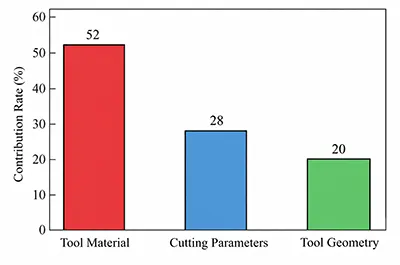
Analysis of variance (ANOVA) showed that tool material accounted for 52% of the variation in tool life, cutting parameters for 28%, and tool geometry for 20%.
Wear on the rake face is positively correlated with temperature, and wear increases exponentially when temperatures exceed 900°C;
Crescent-shaped wear is closely related to cutting speed.
The results indicate that although CBN tools offer clear advantages under extreme conditions, costs must be reduced through parameter optimization;
Structurally improved cemented carbide is suitable for conventional machining and offers better cost-effectiveness.
In the future, the integrated application of gradient materials and intelligent monitoring systems can be explored.
A comparison of the experimental results is shown in Figure 3.
Conclusion
The main conclusions regarding CNC machining tool technology for Inconel 718 components are as follows:
① CBN tools offer the best overall machining performance, while ultra-fine-grain cemented carbide tools provide outstanding value for money.
② Optimizing tool geometry and cutting edge structure can reduce cutting forces by 18% to 22% and increase tool life by 30%.
③ After increasing the cutting speed to 150 m/min through laser-assisted machining, tool life improved by 66%.
In summary, tool material accounts for 52% of the impact on tool life; parameter optimization can achieve a synergistic improvement in both efficiency and tool life.
This technology can reduce the unit machining cost of aerospace components by 27%.